

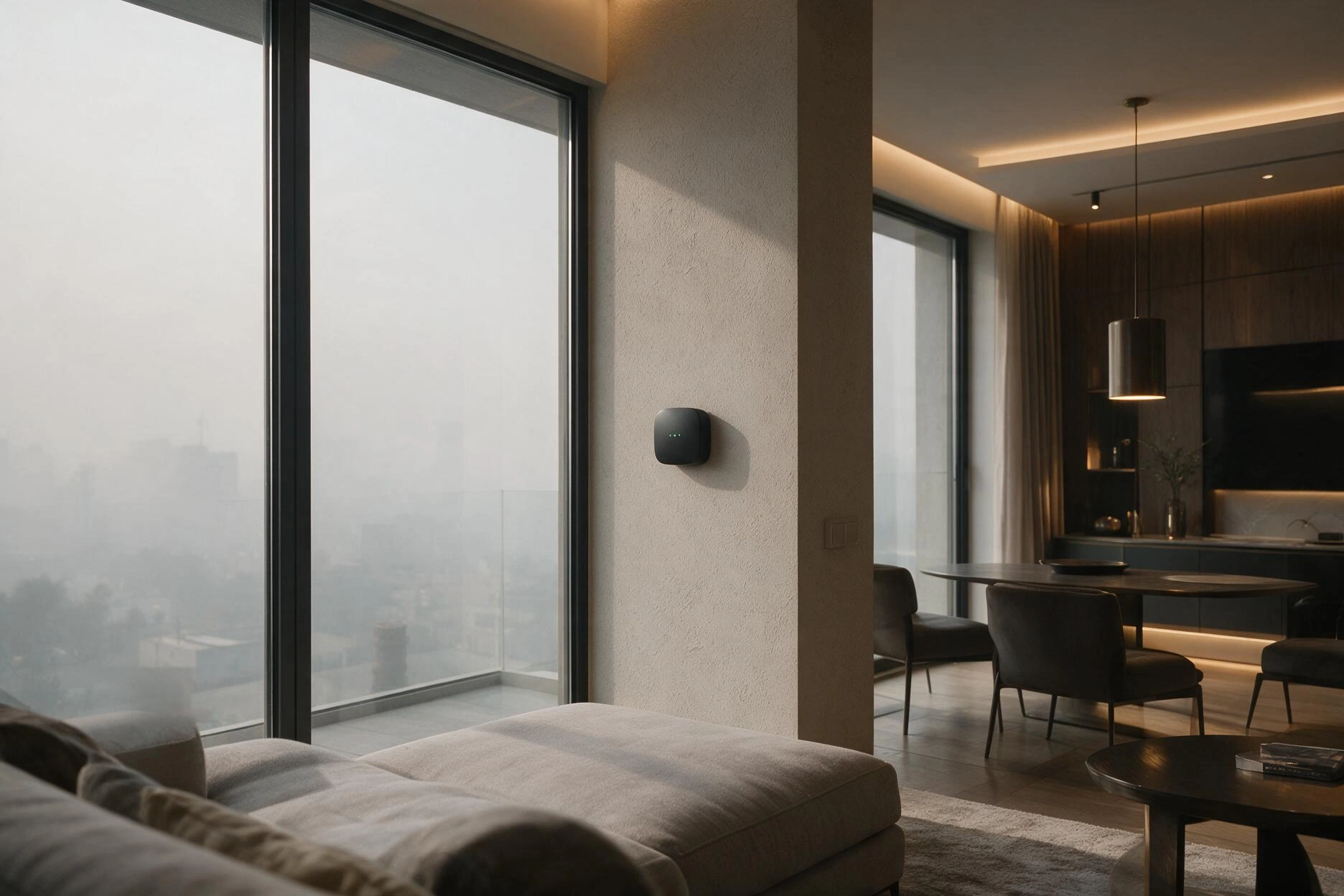
Delhi NCR's outdoor air pollution doesn't stay outdoors — closed windows and running AC don't stop CO2 and particulate matter from building up indoors too, especially in well-sealed modern apartments. An air quality sensor monitors CO2, temperature, and humidity in real time and can automatically trigger ventilation, an air purifier, or HVAC when levels cross a threshold — turning a health risk you can't see into something you can actually act on.
Planning a home in Delhi NCR? Talk to TechVault about wiring air quality monitoring into your automation.
Why Does Indoor Air Quality Matter, Even With the AC On?
Most homeowners assume a sealed, air-conditioned room is "clean air." It isn't automatically.
CO2 builds up indoors simply from people breathing in a closed room — no outdoor pollution needed. Once a room is also sealed against Delhi NCR's outdoor air (which is the right instinct during pollution season), that CO2 has nowhere to go unless the system is actively managing it.
Indoor CO2 concentration has measurable effects on cognitive performance well before it becomes "dangerous" in a traditional sense. Concentrations between 1,000–1,400 ppm are associated with eye and throat irritation and reduced concentration; 1,400–2,000 ppm with headaches, dizziness, and fatigue; and above 2,000 ppm with more significant drops in decision-making performance, based on research published in Environmental Health Perspectives. Outdoor air, for comparison, typically runs around 400–450 ppm.
What Does an Air Quality Sensor Actually Measure?
A dedicated indoor air quality sensor — like the Ajax LifeQuality, which we use in our security and surveillance installations at TechVault — typically tracks three things together:
- CO2 concentration — via a non-dispersive infrared (NDIR) sensor, which measures carbon dioxide directly rather than estimating it
- Temperature — for comfort and to catch HVAC issues early
- Humidity — which affects both comfort and mould/condensation risk, especially relevant during Delhi NCR's monsoon months
This is different from a basic smoke or motion sensor. Air quality detectors use a dedicated NDIR CO2 sensor rather than the simpler resistive sensors found in cheaper consumer devices — that accuracy is what lets the sensor feed reliable data into a wider automation system, rather than just displaying a rough estimate.
How Does It Actually Trigger Automation?
This is where an air quality sensor stops being a gadget and becomes part of the smart home system.
When CO2 or humidity crosses a threshold you've set, the sensor can automatically trigger connected devices — turning on ventilation, switching on an air purifier, or nudging the AC into a different mode — through the same KNX-based automation platform as the rest of the home. You get notified either way, but the room starts correcting itself before you've even noticed the air feels stale.
Planning a home in Noida, Gurgaon, or anywhere in Delhi NCR? At TechVault, this is exactly the kind of sensor we recommend wiring into the automation plan from day one, rather than adding as an afterthought once the false ceiling is closed.
Air Quality Sensor vs Basic Home Automation — What Changes
| Without Air Quality Sensing | With Air Quality Sensing |
|---|---|
| AC runs on a fixed schedule or manual control | AC/ventilation respond to actual CO2 and humidity levels |
| No visibility into indoor air until someone feels unwell | Real-time readings and historical charts in an app |
| Purifiers run constantly or on guesswork | Purifiers trigger only when air quality actually drops |
| No record of conditions over time | Data logged for months, useful for tracking patterns across pollution season |
Is It Expensive? Is It Worth It? What Can Go Wrong?
Is it expensive?
A dedicated air quality sensor is a modest addition to an existing automation system — the real cost is in ensuring it's properly integrated with ventilation, HVAC, or purifiers, rather than just displaying a number on an app. As a planning note, sensor hardware is typically a small line item; the value is in the integration work around it.
Is it worth it?
For Delhi NCR specifically, where outdoor air quality routinely worsens through winter, having automated, real-time visibility into indoor conditions — and a system that responds without manual intervention — is one of the more practical smart home additions available, particularly for homes with children or elderly residents.
What can go wrong?
The most common issue is treating the sensor as a standalone gadget rather than wiring it into an automation scenario — a sensor that only shows a number, without triggering anything, gives you information without giving you a fix. The second is placement: a sensor too close to a door or window can give misleading readings that don't reflect the room's actual air quality.
Who Is This For?
- Homes with children or elderly residents, where indoor air quality has a more pronounced health impact
- New construction or renovation projects in Delhi NCR, where sensors and automation triggers can be planned in from the start
- Anyone already running an automated home who wants indoor air treated with the same visibility as lighting or security
Not sure which sensor fits your home? Talk to our expert for a free consultation.
Planning a smart home in Noida or Delhi NCR? Contact TechVault for a consultation — we'll wire air quality monitoring into your automation before pollution season hits.
FAQ's
Does an air quality sensor replace an air purifier?
No — it works alongside one. The sensor detects when air quality drops and can automatically trigger a connected purifier or ventilation system, rather than running it constantly on guesswork.Can this be added to an existing smart home system?
Yes, in most cases. Wireless air quality sensors typically connect to the same hub or platform already managing security and other automation, without needing new wiring.What CO2 level should I be concerned about indoors?
Indoor CO2 up to around 1,000 ppm is generally considered acceptable. Levels between 1,000–1,400 ppm are associated with mild symptoms like irritation and reduced concentration, and levels above 2,000 ppm are linked to more noticeable effects on decision-making, based on published indoor air quality research.Does this help with Delhi's outdoor pollution specifically, or just indoor air?
Both, indirectly. The sensor measures indoor conditions, but by triggering purifiers and ventilation intelligently, it helps manage how much outdoor pollution actually affects the air inside your home.