

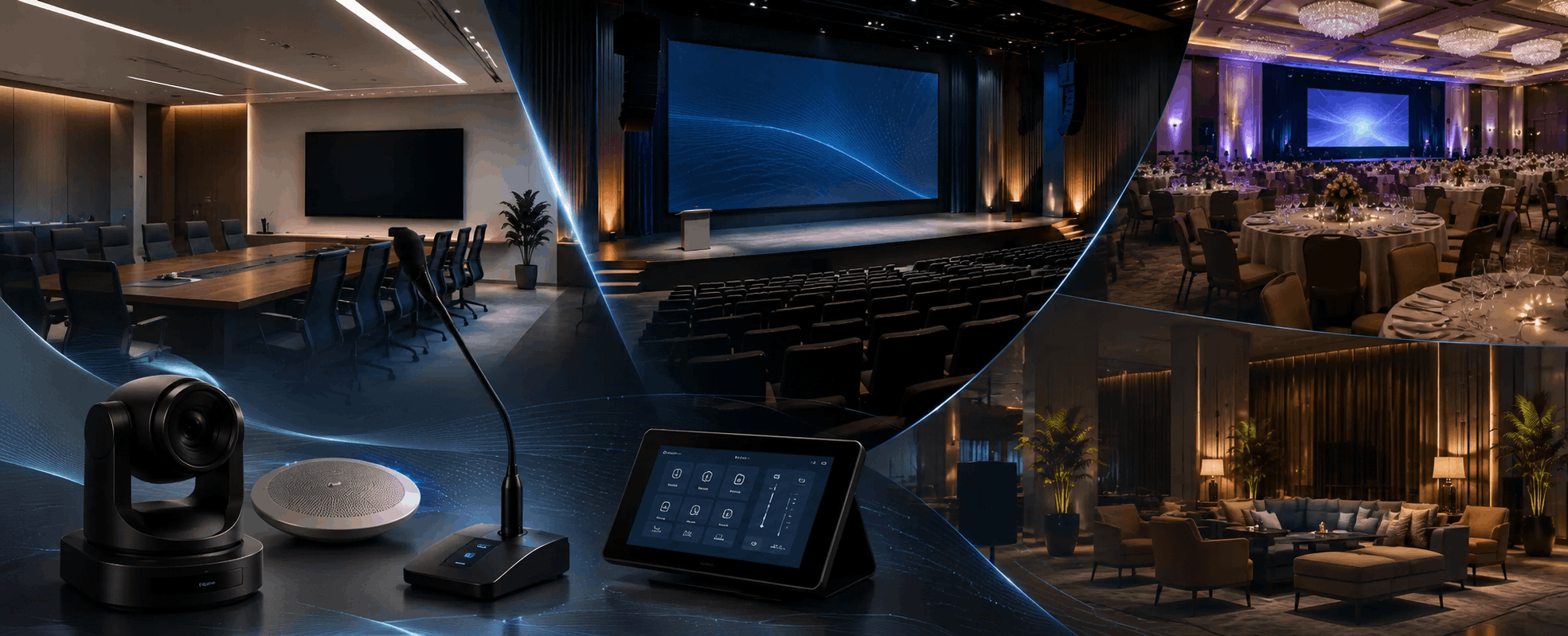
A commercial AV system is the audio and video setup that runs a business space — the screens, speakers, microphones, and the single control that ties them together. It's what lets a meeting start with one tap, an event fill a hall with clear sound, or a hotel lobby play music evenly across every corner.
The difference from a home setup is simple: a commercial
system has to work reliably for lots of different people, in bigger spaces,
operated by staff who didn't install it. At Techvault, we design and install
these systems for offices, hotels, and auditoriums across Delhi NCR, Noida,
Gurgaon, and Jaipur. Here's how they work and what to expect.
What Goes Into a Commercial AV System?
Every commercial system is built from a few basic parts:
- Screens
or projectors — what people see, whether it's a boardroom display or a
big screen on an auditorium stage
- Speakers
and microphones — so everyone can hear clearly, and be heard, no
matter where they sit
- A
control panel — one simple interface to start, stop, and adjust
everything
- The
wiring behind it all — connecting every device so it works as one
system, not separate gadgets
The most important part isn't any single device. It's that a
staff member can walk in and start a meeting or an event without calling for
technical help.
How Are the Needs Different for Offices, Hotels, and Auditoriums?
Each type of space needs something different from its AV
system. Here's a quick comparison:
Space |
What Matters Most |
What It Usually Needs |
|
Meeting rooms |
Easy, reliable video calls |
A screen, ceiling mics, a camera, one control panel |
|
Auditoriums |
Clear sound and visuals for everyone |
Big speakers, a large screen, a mixing setup |
|
Hotel banquet halls |
Flexibility for different events |
Adjustable speaker zones, motorised screens |
|
Hotel lobbies & restaurants |
Pleasant background music |
Ceiling speakers, subtle signage screens |
Offices
In an office, the AV system is used every single day for
meetings and video calls. So the priority is simple: it has to just work. If
someone needs to call IT every time they start a call, the system has failed.
A good office setup means one tap to start a video call,
microphones that pick up the whole room clearly, and a camera that
automatically focuses on whoever is speaking. This connects naturally to
broader office
automation like room booking and lighting.
Hotels
Hotels are trickier because the same space gets used for
completely different things — a wedding today, a corporate seminar tomorrow. So
the system needs to adapt quickly.
That means audio that can be split into zones for different
layouts, screens that drop down when needed, and background music for lobbies
and restaurants — all managed by staff from one place. This is part of full hotel automation.
Auditoriums
Auditoriums are the most demanding. Sound has to reach every
seat evenly — not too loud in front, not too soft at the back — and everyone
needs to see the stage clearly.
This takes properly designed speaker systems, a large stage
screen or projector, and audio equipment that keeps voices and music clear for
a full room. If you're planning a school or college hall specifically, our
guide on school
auditorium AV systems covers that in detail.
Which Brands Are Used in Commercial AV?
Commercial spaces need equipment built to run all day, every
day. We build these systems using BOSE, Crown by Harman, and electro-voice
for audio, BenQ, Epson, Panasonic, and LG for
screens and projection, and Crestron or KNX for the control that ties it
together. The right mix depends entirely on the space — a small meeting room
and a 500-seat auditorium need very different equipment.
Why Does "One System Controls Everything" Matter?
Here's what separates a good commercial setup from a
frustrating one: whether it all works together.
Imagine an auditorium event. Instead of one person running
to adjust the lights, another lowering the screen, and someone else fiddling
with the sound — a single "Event Mode" button does it all at once.
The lights set themselves, the screen comes down, the microphone switches on,
and the room cools to the right temperature.
That's the real value of connecting AV to the building's automation system —
one tap handles what used to take three people and ten minutes.
What Does a Commercial AV System Cost in India?
Project Type |
Approx. Cost |
|
Meeting / conference room |
₹2,50,000 – ₹10,00,000 |
|
Premium boardroom |
₹10,00,000 – ₹30,00,000+ |
|
Hotel banquet hall |
₹8,00,000 – ₹35,00,000+ |
|
Mid-size auditorium |
₹15,00,000 – ₹50,00,000+ |
|
Large or multi-hall auditorium |
₹50,00,000 – ₹2,00,00,000+ |
These are rough estimates — the actual cost depends on the
size of the space, how many seats it holds, the brands chosen, and how deeply
it connects to the rest of the building. A site visit is needed for an accurate
quote.
FAQs
What is a commercial audio video system?
It's the screens, speakers, microphones, and control setup
that runs a business space like an office, hotel, or auditorium. Unlike a home
system, it's built to serve many people, cover large rooms evenly, and be
operated easily by staff.
How is it different from a home AV system?
A commercial system is built for reliability and scale —
many users, bigger spaces, and equipment that runs continuously. A home system
is designed for a few people in a controlled space. The equipment and the way
it's controlled are quite different.
What's the most important thing in a commercial AV system?
That it's easy to use and reliable. A system a staff member
can't start without technical help isn't doing its job, no matter how good the
equipment is.
Can it connect to the building's other systems?
Yes — and that's where it becomes most useful. When AV
connects to lighting, climate, and screens through one control system, a single
button can run an entire event, instead of controlling each thing separately.
What does it cost in India?
It ranges widely. A meeting room starts around ₹2,50,000, a
hotel banquet hall runs ₹8,00,000 to ₹35,00,000+, and a mid-size auditorium is
usually ₹15,00,000 to ₹50,00,000+. A site visit is needed for an accurate
figure.
Planning a Commercial AV System?
Whether it's a meeting room, a hotel hall, or an auditorium, a commercial AV system works best when it's designed as part of the whole building — not added on as separate equipment. Talk to our team for a free consultation, or explore our office automation, hotel automation, and auditorium services.