

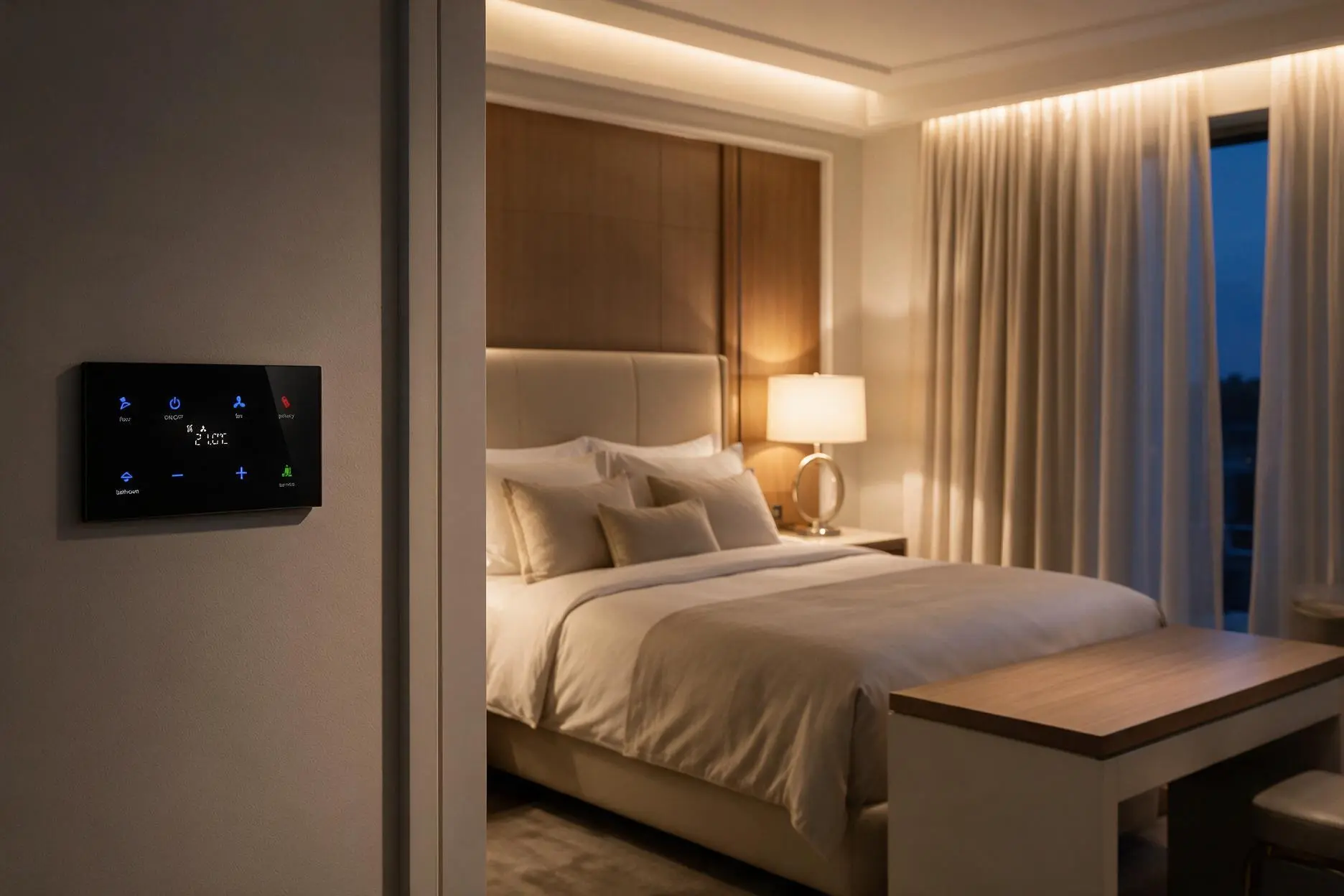
A guest room management system (GRMS) is a hotel-specific automation platform that controls lighting, HVAC, curtains, and door locks in each room based on occupancy — automatically adjusting temperature and lighting when a guest checks in, and setting the room back when it's empty. Unlike general building automation, a GRMS is built around hospitality workflows: it syncs with the property management system (PMS) so a room's status updates automatically at check-in, check-out, and Do Not Disturb.
What Does a GRMS Actually Do?
A GRMS is a room-level automation system, not a building-wide one. It sits between the room's devices — HVAC, lighting, curtains, locks, TV — and the hotel's PMS, using occupancy sensors, door contacts, and the guest's own key card or digital key to decide what mode a room should be in at any moment.
At its core, a GRMS runs on three inputs:
- Occupancy sensors — motion and door/window contacts that detect whether a room is occupied, vacant, or unrented
- Room Control Units (RCUs) — the hardware that actually switches lighting, HVAC, and curtains based on that occupancy state
- PMS integration — so room status (occupied, vacant, dirty, clean, DND) updates automatically instead of needing a manual check
This is different from a standard building management system (BMS), which typically manages shared infrastructure — corridors, lobbies, central plant — rather than the guest-facing experience inside each individual room.
How Does a GRMS Save Energy?
This is the number hotels actually care about, and it's grounded in real data, not a marketing claim.
HVAC alone accounts for roughly 45% of a hotel's total energy use, which makes it the single biggest lever a GRMS can pull. Honeywell's INNCOM system, one of the established hospitality energy management platforms, cites ASHRAE studies showing that roughly 3% of HVAC energy is saved for every one degree of temperature setback — and that a properly PMS-integrated system can deliver 25–40% in guestroom HVAC energy savings compared to a traditional, non-integrated thermostat, in hotels with average occupancy.
In practice, this looks simple: when a room goes vacant, the GRMS lets the AC drift a few degrees warmer (or cooler, depending on season) and dims or switches off the lighting. When the guest returns — or checks in for the first time — the room resets to a comfortable, pre-set condition before they walk in.
GRMS vs Basic Hotel Automation — What's the Difference?
| Feature | Basic Room Automation | Full GRMS |
|---|---|---|
| Occupancy detection | Often none, or a single motion sensor | Multi-sensor — motion, door contact, sometimes key-card insert |
| PMS integration | Rare or manual | Automatic — room status syncs with check-in/check-out |
| HVAC control | Manual thermostat | Occupancy-based setback, scheduled by room state |
| Staff visibility | Manual room checks | Real-time room status dashboard for housekeeping/engineering |
| Guest control | Individual switches | Scene-based — one control for lighting, curtains, DND, and comfort together |
| Typical use case | Budget or limited-scope properties | Mid-scale to luxury hotels prioritising energy and guest experience |
The gap isn't just features — it's what each system is actually trying to solve. Basic automation gives a guest convenience. A full GRMS gives the hotel operational visibility as well, which is where most of the ROI comes from.
What Does a GRMS Cost in India?
The figures below are estimated planning ranges based on industry sources, not fixed pricing — actual cost depends on property size, brand, and integration scope.
As a general planning range for a per-room GRMS installation:
| Component | Typical Range |
|---|---|
| RCU hardware, per room | Varies significantly by brand and feature set |
| Occupancy/door sensors, per room | Add-on cost per sensor type |
| PMS integration (property-wide) | One-time setup cost, scales with property size |
| Staff dashboard / monitoring software | Often licensed per room or per property |
Because GRMS pricing depends heavily on property size, existing PMS platform, and how many rooms are being fitted at once, the most reliable way to get an actual number is a property walkthrough rather than a generic per-room estimate — brand, wiring condition, and integration complexity all move the final quote meaningfully.
Is It Expensive? Is It Worth It? What Can Go Wrong?
Is it expensive?
There's a real upfront cost, particularly for PMS integration across a full property. Most hotels recover this through HVAC energy savings alone over time, given how large a share of total energy cost climate control represents.
Is it worth it?
For any property where energy cost or guest experience consistency matters — which is most mid-scale and above properties — yes. The energy savings are measurable, and staff efficiency gains (fewer manual room checks, automatic housekeeping updates) compound on top of that.
What can go wrong?
The most commonly reported issue across hospitality automation reviews is inconsistent PMS sync, which can create "ghost occupied" rooms — a room shows as occupied in the system when it's actually vacant, which defeats the energy-saving logic entirely. The second common issue is treating GRMS as a plug-and-play product rather than a system that needs to be properly integrated with the property's specific PMS and wiring from day one.
Who Is a GRMS For?
- Mid-scale to luxury hotels looking to cut HVAC energy cost at scale
- New hotel builds where GRMS can be planned into the electrical design from the start
- Existing properties doing a renovation, where a GRMS retrofit can be planned alongside other room upgrades
- General managers and hotel engineering teams evaluating where operational efficiency gains are actually available
Planning a GRMS installation for a hotel in Noida or Delhi NCR? Talk to TechVault about how it fits into your property's existing PMS and wiring.
FAQ's
What's the difference between a GRMS and a BMS?
A BMS typically manages shared building infrastructure — corridors, lobbies, central plant equipment. A GRMS is specifically focused on individual guest rooms and is built around hospitality workflows like check-in, check-out, and housekeeping status.How much energy does a GRMS actually save?
Industry data from established hospitality energy platforms points to roughly 25–40% in guestroom HVAC energy savings when a system is properly integrated with the property's PMS, largely because HVAC represents around 45% of total hotel energy use.Can a GRMS be retrofitted into an existing hotel?
Yes, though it depends on the property's existing wiring and PMS platform. A retrofit is more involved than specifying GRMS during new construction, but it's a common and well-established upgrade path.Does a GRMS work with any PMS?
Most established GRMS platforms integrate with major PMS systems, but the specific integrations vary by vendor — this is worth confirming directly for a specific property's PMS before choosing a system.