

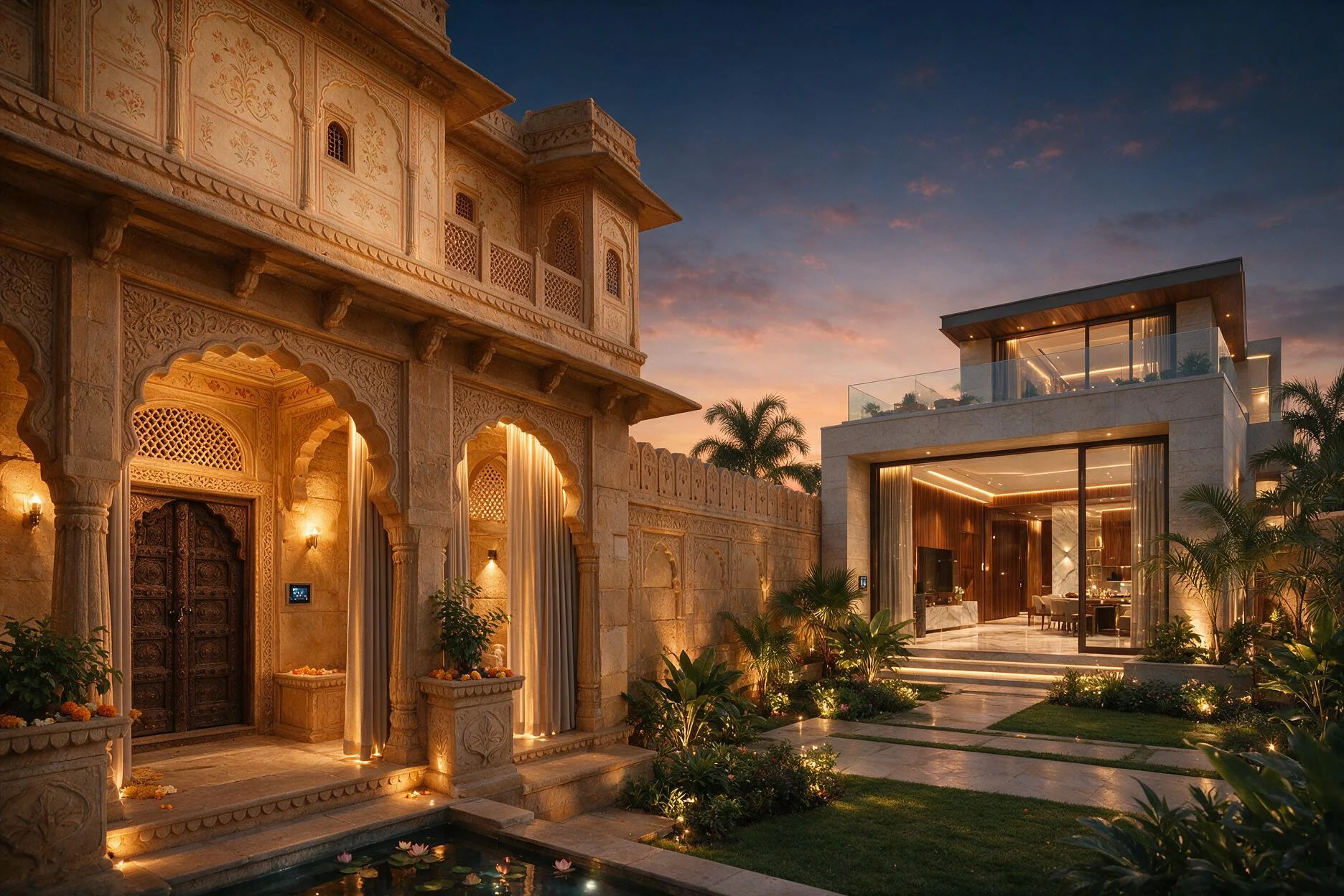
Rajasthan's heritage havelis, palace hotels, and palatial villas can be fully automated — smart lighting, climate, curtains, and security — without breaking a single wall, chasing conduits, or disturbing original stonework, frescoes, or jali screens. The answer is wireless KNX RF retrofit control, which lets a property built centuries before electricity was standardised run on a modern automation system while keeping its architecture completely intact. For boutique hotels and heritage resorts across Jaipur, Udaipur, and Jodhpur, this is the difference between "automation isn't possible here" and a discreet, fully controlled property.
Own a heritage property or luxury villa in Rajasthan? Talk to TechVault about non-invasive automation.
Why Is Automating a Heritage Property So Different?
A new villa under construction can have automation wiring planned into it from day one. A 150-year-old haveli cannot — and this is where most standard automation approaches fall apart.
Heritage and palatial properties come with constraints a modern flat never has: original stone and lime-plaster walls that can't be chased for conduit, hand-painted frescoes and inlay work that can't be disturbed, carved jali screens and jharokhas that define the space, and often conservation restrictions that legally limit what can be modified.
For these properties, the usual "wire everything into the walls" approach isn't just expensive — it's often prohibited, and always destructive to the exact heritage value that makes the property worth what it is. The goal flips entirely: instead of building automation into the structure, you add it onto the structure, invisibly.
How Does Non-Invasive Automation Actually Work?
The technology that makes this possible is KNX RF — the wireless version of the KNX automation standard. Instead of running the usual green KNX bus cable between every device, KNX RF lets switches, sensors, dimmers, and actuators communicate over radio frequency.
According to the KNX Association's own guidance, KNX RF is specifically suited to renovations and heritage properties precisely because it eliminates the need for new cabling — preserving the integrity of existing structures and décor while still delivering full automation. It's the same reasoning the industry applies to apartments, rentals, and any property "with historical value that can't be modified, or requires a lot of permits to even start renovations."
In practice, this means:
- Battery-powered wireless switches and keypads that mount onto a wall surface — no chasing, no conduit
- Retrofit dimmer and actuator modules that fit behind existing switch plates or inside existing fittings
- Wireless sensors for occupancy, temperature, and light, placed without any wiring
- A hybrid option — where any areas that can take wiring (a renovated wing, a new annexe) run on wired KNX, while heritage zones run on RF, all as one unified system
Crucially, unlike proprietary wireless systems, KNX RF is configured through the same professional ETS software as wired KNX and maintains full interoperability — so a heritage property isn't locked into a second-class "lite" system. It's the same KNX standard, delivered wirelessly.
What Can Actually Be Automated in a Heritage Property?
| System | What It Delivers | Non-Invasive Method |
|---|---|---|
| Lighting | Scene-based control, dimming, zone lighting to highlight architecture | Retrofit dimmer modules, wireless keypads |
| Curtains & drapes | Motorised control of heavy heritage drapery | Battery or surface-wired motors on existing tracks |
| Climate | Room-by-room temperature control, occupancy-based setback | Wireless thermostats and RF actuators |
| Security & access | Discreet surveillance, smart locks, guest access | Wireless sensors, retrofit digital locks |
| Guest room control (for hotels) | Per-room control without wiring every room | RF-based room control units |
For a heritage hotel specifically, this unlocks something valuable: proper guest room management — occupancy-based climate, welcome scenes, energy setback on checkout — in a property where running new cabling to every room was never an option.
Non-Invasive vs Traditional Wired Automation
| Traditional Wired Automation | Non-Invasive KNX RF Retrofit |
|---|---|
| Requires chasing walls, running conduit | No wall damage — devices mount on the surface |
| Disruptive, often needs the property vacated | Installed with the property in use |
| Impossible or restricted in conservation zones | Respects conservation restrictions |
| Best planned during construction | Ideal for finished, historic, or occupied buildings |
| Lower long-term cost if done during build | Slightly higher per-device, but avoids civil work entirely |
Is It Expensive? Is It Worth It? What Can Go Wrong?
Is it expensive?
Wireless retrofit devices carry a slightly higher per-unit cost than wired equivalents, but for a heritage property this almost always works out cheaper overall — because it eliminates civil work, restoration of disturbed surfaces, and the risk of damaging irreplaceable heritage features. The comparison isn't "wired vs wireless hardware," it's "wireless retrofit vs the cost and risk of opening up a heritage wall."
Is it worth it?
For a boutique hotel or heritage resort, automation directly affects guest experience and energy cost on an ongoing basis, while the non-invasive method protects the exact architectural character guests are paying to experience. For a private palatial home, it's modern comfort without compromising the property's soul or value.
What can go wrong?
The most common mistake is a provider treating a heritage property like a new build and proposing a wired system — leading to either a refused quote or, worse, damage to protected features. The second is using a cheap proprietary wireless system that locks the property into a closed ecosystem; KNX RF avoids this by staying on the open KNX standard. Wireless range and battery management also need proper planning for a large property, which is a design consideration, not a limitation.
Who Is This For?
- Boutique hotels and heritage resorts across Jaipur, Udaipur, and Jodhpur wanting automation without touching protected architecture
- Owners of palatial homes and havelis who want modern control while preserving the property's character
- Heritage property developers and conservation architects planning sensitive restorations
- Palace-hotel operators needing guest room management in buildings that can't be rewired
TechVault works across Rajasthan on exactly these projects — smart home automation in Jaipur, Udaipur, and Jodhpur, as well as Agra — where heritage and luxury properties need automation that respects the building first.
Own a heritage or luxury property in Rajasthan? Talk to our expert for a site assessment that respects the building first.
Planning automation for a heritage property or villa in Jaipur, Udaipur, or Jodhpur? Contact TechVault — we design non-invasive systems that preserve the architecture while delivering full control.
FAQ's
Can a heritage building really be automated without any wiring?
Largely, yes. KNX RF uses wireless, often battery-powered devices that mount onto existing surfaces, so lighting, climate, curtains, and security can be automated without chasing walls. Some areas that can take minimal wiring may use a hybrid approach, but the heritage-sensitive zones stay untouched.Is wireless KNX RF as reliable as wired KNX?
For retrofit and heritage use, it's the recommended solution by the KNX Association itself. Wired KNX is marginally more robust for very large new builds, but properly designed RF — with repeaters and correct placement for a large property — delivers reliable, professional-grade automation while preserving the structure.Will automation damage frescoes, stonework, or carved features?
That's the entire point of the non-invasive approach — it's specifically designed to avoid it. Surface-mounted wireless devices and retrofit modules mean protected features stay exactly as they are.Can this work for a heritage hotel with many rooms?
Yes. Wireless room control units allow per-room guest room management — occupancy-based climate, welcome scenes, checkout energy setback — without running new bus cable to every room, which is usually impossible in a historic hotel.