

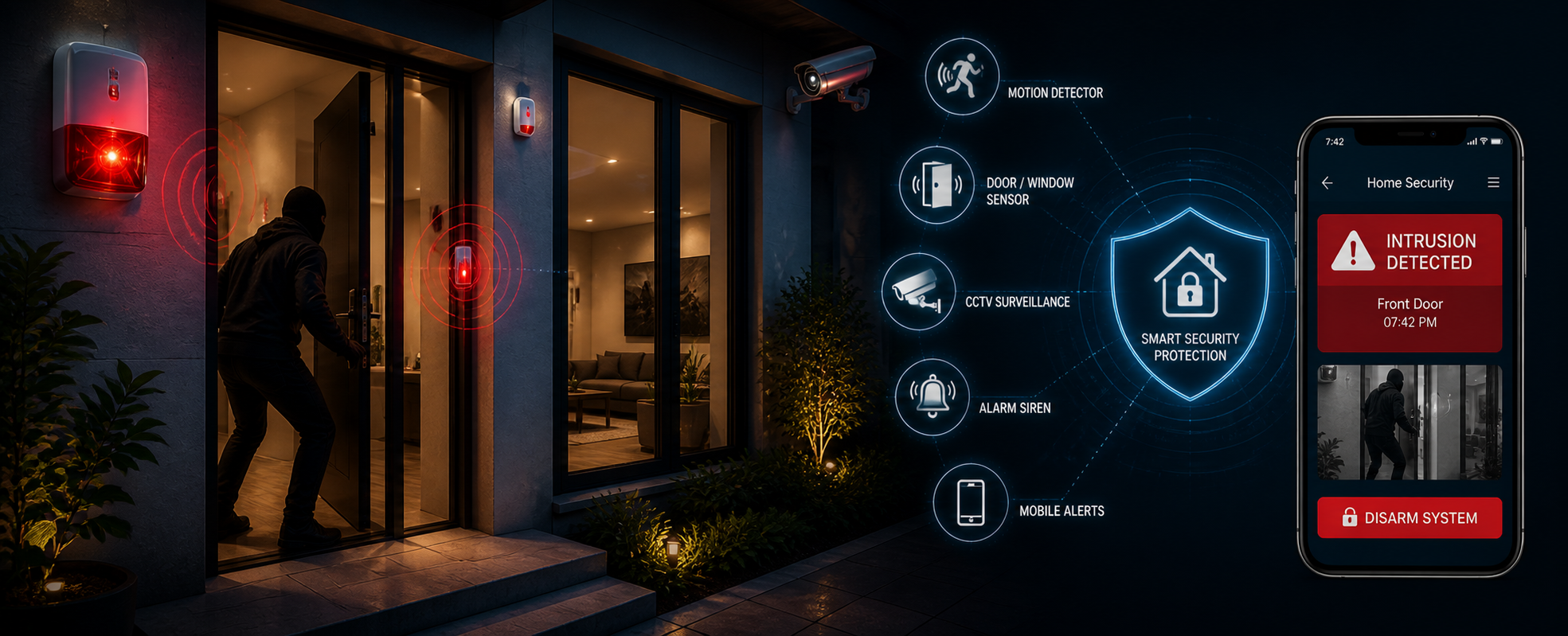
India recorded over 3.5 lakh property crimes in 2025, with daytime burglaries increasing sharply as more families travel and work away from home. Yet, the majority of Indian households — even those in luxury apartments and independent villas — remain protected only by a single door lock and a CCTV camera that records a burglary but does nothing to prevent it. A burglar alarm system changes that equation entirely: it detects an intrusion in real time and responds immediately, before a crime is completed.
At Techvault, we have installed complete home security systems across Noida, Delhi NCR, Jaipur, Gurgaon, and 50+ cities across India. This guide provides everything you need to understand, compare, and select the right burglar alarm system for your home in 2026.
What is a Home Burglar Alarm System?
A home burglar alarm system — also called an intruder alarm system or home security alarm — is an integrated network of sensors, detectors, a control panel, and alert mechanisms designed to detect unauthorised entry into a property and trigger an immediate response.
Unlike a CCTV camera that passively records activity, a burglar alarm system actively responds the moment a sensor is triggered. A PIR (Passive Infrared) motion detector detects movement. A magnetic door or window sensor detects an opening. A glass break detector picks up the specific acoustic frequency of breaking glass. The moment any sensor is activated while the system is armed, the control panel triggers a 100-110dB siren, sends a push notification to the homeowner's phone, and — in monitored systems — alerts a 24/7 response centre.
The core purpose of a burglar alarm is deterrence first, detection second. Studies consistently show that a visible alarm system reduces the probability of a break-in by 60-70%. Most burglars are opportunists who avoid properties that present any meaningful resistance. A prominent siren box on the exterior wall, a keypad at the entrance, and a flashing LED sensor in the living room are frequently enough to make an intruder choose a different target.
How Does a Burglar Alarm System Work?
Every burglar alarm system — from a Rs. 5,000 DIY kit to a Rs. 1,50,000 professional installation - follows the same fundamental operating principle. Sensors placed at entry points and across the interior of the property monitor for intrusion. They are connected - either by wire or wirelessly - to a central control panel. When the system is armed and a sensor triggers, the control panel processes the input and executes its programmed response.
The arming and disarming process is managed through a keypad, key fob, mobile app, or proximity card. Most modern systems support multiple arming modes. Full arm activates all sensors when the home is unoccupied. Home arm (perimeter arm) activates door and window sensors only - allowing occupants to move freely inside without triggering motion detectors. Sleep mode activates perimeter sensors and any bedroom door sensors while leaving common areas unarmed.
When a sensor triggers while the system is armed, the control panel enters an alarm state. In standard systems, this triggers the external siren immediately and sends a GSM or Wi-Fi alert to the homeowner's registered mobile numbers. In professionally monitored systems, the alarm signal is transmitted to a monitoring centre where trained operators verify the alarm — using two-way audio or video - and dispatch a response if confirmed. Modern systems with AI-powered cameras, such as those from Ajax Systems, can distinguish between a genuine intrusion and a false trigger caused by a pet or a passing vehicle before escalating the alarm.
Types of Burglar Alarm Systems in India
Wired Burglar Alarm Systems
Wired systems connect all sensors and detectors to the control panel through physical cables. They are the most reliable type — immune to radio frequency interference, not dependent on battery life for sensors, and extremely difficult to jam or circumvent. Wired systems are the preferred choice for new construction projects where cable infrastructure can be planned during the civil works phase. They are significantly harder to retrofit into a finished building.
In Techvault security projects, we integrate wired burglar alarm zones with KNX home automation — allowing security events to trigger automated responses across the entire home. An intrusion trigger can simultaneously sound the alarm, activate all lighting, lock all motorised doors, and begin CCTV recording — all through one unified KNX bus command.
Wireless Burglar Alarm Systems
Wireless systems use radio frequency (RF), Wi-Fi, or cellular (GSM/4G) communication between sensors and the control panel, eliminating the need for cable installation. This makes them significantly faster and less expensive to install, and ideal for retrofitting into completed homes, apartments, and rented properties. The trade-off is battery dependency for sensors — most quality wireless sensors require battery replacement every 1-3 years.
In 2026, wireless systems will have largely closed the reliability gap with wired alternatives. Ajax Systems, which Techvault installs, uses encrypted 868 MHz radio frequency communication with frequency hopping — making it virtually impossible to jam — and provides battery life of 2-7 years per sensor. Wireless systems are now the dominant choice for residential burglar alarm installations in India.
GSM / 4G Burglar Alarm Systems
GSM or 4G alarm systems use a SIM card to communicate alerts and notifications directly to mobile phones via calls and SMS, without requiring an internet connection. They are popular in areas with unreliable broadband connectivity and in vacation homes or properties that are unoccupied for extended periods. Basic GSM systems can call up to 6 stored numbers in sequence when an alarm triggers. Advanced GSM systems combine cellular communication with Wi-Fi and an app interface for real-time notifications.
Smart Monitored Alarm Systems
The fastest-growing category in India's home security market in 2026. Smart monitored systems combine wireless sensor hardware with a 24/7 professional monitoring service and a comprehensive mobile application. When an alarm triggers, the monitoring centre attempts to verify the alarm through two-way audio or video before dispatching a response. This dramatically reduces false alarm responses while ensuring a confirmed intrusion receives an immediate human response.
Key Components of a Burglar Alarm System
Control Panel
The control panel is the brain of the alarm system. It receives signals from all connected sensors, processes arming and disarming commands, manages communication with monitoring centres, and triggers alert outputs. In advanced systems like Ajax Hub 2 Plus, the control panel connects simultaneously over Ethernet, Wi-Fi, and dual SIM 4G — ensuring communication even if one channel is disrupted. The panel must be installed in a tamper-proof location, ideally inside a locked cabinet in the distribution board area.
PIR Motion Detectors
Passive Infrared (PIR) motion detectors are the primary interior detection component. They detect changes in infrared radiation caused by a moving warm body — a person moving across the room. Modern PIR detectors feature pet immunity (distinguishing a 25kg dog from a person), temperature compensation for Indian climate conditions, and anti-masking technology that detects if a sensor has been physically covered or spray-painted. Ajax Motion Protect Plus additionally uses microwave detection as a second layer of verification, reducing false alarms to near zero.
Door and Window Sensors (Magnetic Contacts)
Magnetic contact sensors are the most essential detection component for any Indian home. They consist of two parts — a magnet and a reed switch — installed on opposite sides of a door or window frame. When the door or window opens, the magnetic circuit breaks and triggers the alarm. These sensors protect every potential entry point and are the first line of detection for any burglary attempt. A complete home security installation should cover every external door, every ground-floor window, and any easily accessible upper-floor windows.
Glass Break Detectors
Glass break detectors use an acoustic sensor to detect the specific frequency pattern of breaking glass — distinguishing it from other loud sounds. They are particularly valuable in homes with large glass facades, sliding glass doors, or floor-to-ceiling windows where a burglar might choose to break glass rather than open a door. A single glass break detector can cover all glass surfaces within a 9-metre radius.
Siren and Strobe
The external siren box — typically mounted prominently on the front or side elevation of the building — serves a dual purpose. Its 100-110dB alarm output immediately alerts neighbours and passersby to an active intrusion. Its visible presence acts as a deterrent before any intrusion is attempted. Most quality external sirens include a tamper switch (triggering an alarm if removed), a backup battery (sounding the alarm even if the main power is cut), and a flashing LED strobe for continuous visible indication.
Video Verification
An increasingly important component in 2026 is video verification — integrating cameras with the alarm system so that a motion trigger or sensor alarm can be visually confirmed before escalating. Ajax Systems' MotionCam detector includes a built-in camera that captures a photo sequence when triggered, allowing the homeowner and monitoring centre to visually verify whether an alarm is genuine before responding. This dramatically reduces false alarm dispatches and significantly accelerates response to genuine intrusions.
Home Alarm System Price Guide — India 2026
Basic DIY Wireless Kit (Rs. 3,000 – Rs. 8,000): Entry-level systems available on e-commerce platforms. Typically includes a GSM control panel, 2-4 door sensors, one PIR detector, and a keypad or remote. Limited app functionality, no professional monitoring, manufacturer-dependent cloud. Suitable for rental apartments and basic deterrence.
Mid-Range Wireless System (Rs. 8,000 – Rs. 25,000): Purpose-built residential security systems from established brands. Includes 4-8 zones, PIR and door sensors, siren, app control, GSM and Wi-Fi communication. Suitable for 2-3 BHK apartments and small independent houses requiring reliable, self-monitored security.
Professional Wireless System (Rs. 25,000 – Rs. 75,000): Systems like the Ajax system from authorised integrators. Professional-grade hardware with encrypted communication, tamper protection, video verification, and optional 24/7 monitoring. Suitable for luxury apartments, independent houses, and villas requiring premium security.
Integrated Smart Security System (Rs. 75,000 – Rs. 2,00,000+): Complete integration of burglar alarm with CCTV, access control, digital door locks, video doorbells, and KNX home automation. Everything controlled through one app, one interface. Suitable for luxury villas, farmhouses, and high-value commercial properties. Techvault specialises in this category.
How to Choose the Right System for Your Home
Assess your entry points first: Count every external door, every ground-floor window, and any easily accessible upper-floor window or terrace access point. Your burglar alarm system must cover every one of these — an incomplete perimeter has no value.
Choose wireless for retrofit, wired for new construction: If your home is already built and finished, wireless is the only practical option. If you are constructing or undertaking a major renovation, wired sensors provide superior long-term reliability and eliminate battery concerns.
Prioritise communication redundancy: An alarm system that communicates only over Wi-Fi is disabled by a power cut or router failure. Choose a system with at least two independent communication paths — Wi-Fi plus GSM/4G is the recommended minimum for Indian conditions.
Consider monitoring options carefully: Self-monitored systems notify you but rely on your response. Professionally monitored systems have a dedicated response centre that acts when you cannot. For vacation homes, elderly residents, or homeowners who travel frequently, professional monitoring is strongly recommended.
Choose a brand with local service: A burglar alarm system requires periodic maintenance — battery replacements, sensor testing, and firmware updates. Choose a brand with an authorised service presence in your city. Techvault provides ongoing maintenance contracts for all installed systems across our service network.
Smart Home Integration — The Techvault Approach
A standalone burglar alarm that only sounds a siren is one layer of security. In a Techvault-integrated smart home, the burglar alarm is one component of a unified security and automation ecosystem that responds intelligently to every security event.
When the Away scene is activated — either manually as the homeowner leaves or automatically through geofencing when the last person exits the property boundary — the KNX system simultaneously arms the Ajax alarm, locks all digital door locks, activates perimeter camera recording, closes all motorised shutters, and sends a confirmation notification to the homeowner's phone. If a sensor triggers while the system is armed, every light in the home activates at full brightness, the Ajax siren sounds, CCTV recording starts on all cameras, and an instant alert with a photo sequence from the MotionCam detector is pushed to the homeowner's device — all within two seconds of the sensor trigger.
This level of integration — where every security system interacts with every other system through one unified automation platform — is what distinguishes a Techvault smart security installation from a collection of independent devices. Our clients across Noida, Delhi, Gurgaon, and Jaipur consistently describe it as the feature that gives them the greatest peace of mind when travelling away from home.
Frequently Asked Questions
Q1. What is a home burglar alarm system?
A home burglar alarm system is an electronic security network of sensors, detectors, a control panel, and alert mechanisms that detect unauthorised entry into a property and immediately trigger an alert through a siren, mobile notification, or monitoring centre call. It deters burglars and protects your home even when you are away.
Q2. Which is the best burglar alarm system in India in 2026?
For premium residential security, Ajax Systems is the leading choice in India in 2026 — offering encrypted wireless communication, AI-powered motion detection, video verification, and simultaneous Ethernet, Wi-Fi, and 4G communication from the hub. For mid-range installations, Honeywell and DSC offer reliable options with strong service networks. Godrej provides the widest after-sales service network across India.
Q3. What is the price of a home burglar alarm system in India?
Home burglar alarm system prices in India in 2026 range from approximately Rs. 3,000 for basic DIY kits to Rs. 2,00,000+ for fully integrated professional systems. Mid-range professionally installed wireless systems from established brands typically cost Rs. 25,000 to Rs. 75,000 for a standard 3 BHK home, including hardware, installation, and configuration.
Q4. What is the difference between a wired and wireless burglar alarm?
Wired burglar alarm systems connect sensors to the control panel through physical cables — delivering the highest reliability and immunity to interference, but requiring cable installation during construction. Wireless burglar alarm systems use radio frequency, Wi-Fi, or cellular communication — easier to install and ideal for retrofit projects, but sensor batteries require periodic replacement.
Q5. Can a burglar alarm system be integrated with CCTV and a smart home?
Yes. Techvault integrates burglar alarm systems with CCTV cameras, digital door locks, video doorbells, motorised shutters, and KNX home automation — creating a unified security ecosystem controlled through one app and one interface. When an alarm triggers, CCTV recording activates, lights come on, and doors lock automatically — all simultaneously.
Q6. What sensors does a complete home burglar alarm need?
A complete home burglar alarm system should include PIR motion detectors for each room, magnetic door and window sensors on all entry points, a glass break detector for glass doors and large windows, an external siren with strobe, a tamper-proof control panel, and a keypad or app for arming and disarming. For premium installations, MotionCam detectors add visual verification of every alarm event.
Q7. Does Techvault install burglar alarm systems in Noida and Delhi?
Yes. Techvault designs, supplies, installs, and commissions complete home and commercial burglar alarm systems across Noida, Delhi, Gurgaon, Jaipur, Chandigarh, and 50+ cities across India. We are an authorised Ajax Systems provider and provide complete smart security solutions — from standalone alarm installations to fully integrated smart home security systems. Call +91-94148-16207 for a free site assessment.