

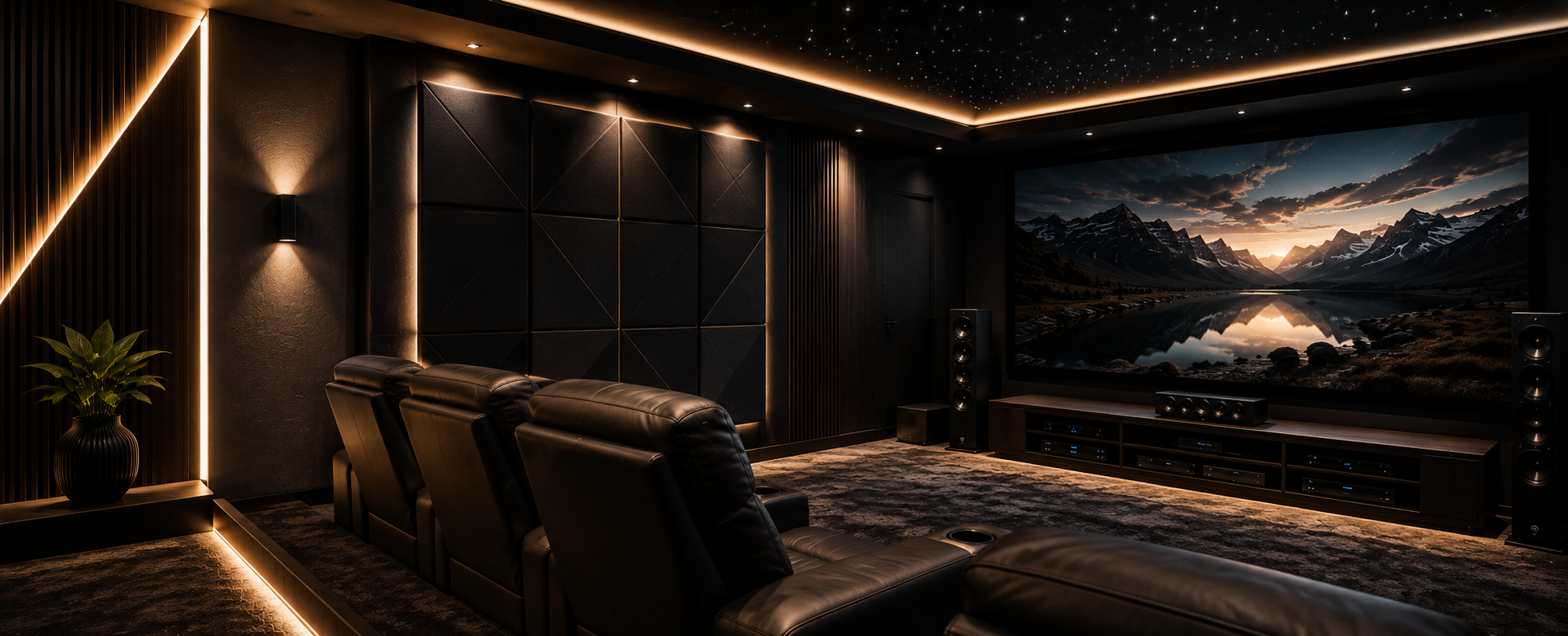
A home theatre in India costs roughly ₹3,00,000 for a good entry-level setup in an existing room, ₹8,00,000 to ₹20,00,000 for a proper dedicated theatre with Dolby Atmos and acoustic treatment, and ₹25,00,000 upwards for a luxury cinema room. But most quotes you receive only cover the equipment. The part that decides how the room actually feels to use every day — the automation — is usually left out.
At TechVault, we design and install home theatres as part of
complete KNX-integrated homes across Delhi NCR, Noida, Gurgaon, and Jaipur.
This guide breaks down what a home theatre really costs in India, and explains
exactly where automation fits in, what it does, and what it adds to the budget.
What's Actually Included in a Home Theatre Cost?
Most people think of a home theatre as speakers and a
screen. In practice, the cost splits across five layers — and skipping any one
of them is what makes a finished room disappointing:
Layer |
What It Covers |
Share of Budget |
|
Audio |
Speakers, subwoofers, AV receiver or processor,
amplification |
35–45% |
|
Video |
Projector or display, screen, mounting |
20–30% |
|
Room |
Acoustic treatment, soundproofing, false ceiling, seating |
15–25% |
|
Automation |
Scene control, lighting, curtains, keypad, programming |
10–20% |
|
Cabling & labour |
Speaker cable, HDMI, conduit, installation, calibration |
5–10% |
The layer that gets cut first is almost always the room and
the automation — and those are the two that decide whether the theatre gets
used weekly or gathers dust.
What Does a Home Theatre Cost in India — By Tier?
Tier |
Setup |
Room Type |
Approx. Cost |
|
Entry |
5.1 in-wall/in-ceiling, TV or basic projector |
Existing living room |
₹3,00,000 – ₹6,00,000 |
|
Mid |
5.1.2 or 7.1 Atmos, 4K projector, motorised screen |
Semi-dedicated room |
₹6,00,000 – ₹15,00,000 |
|
Premium |
7.1.4 Atmos, acoustic treatment, recliners, scene control |
Dedicated theatre room |
₹15,00,000 – ₹35,00,000 |
|
Luxury |
9.1.6+, full acoustic build, star ceiling, KNX integration |
Purpose-built cinema |
₹35,00,000 – ₹1,00,00,000+ |
These are indicative estimates. Actual cost depends on room
size, brand selection, how much civil and acoustic work is needed, and whether
the project is new construction or a retrofit — confirmed only after a site
assessment.
Where Does Automation Fit into a Home Theatre?
This is the part most quotes skip, so it's worth being clear
about what it actually means.
A home theatre has a lot of moving parts: the projector, the
screen, the AV receiver, the room lighting, the curtains or blinds, and the air
conditioning. Without automation, watching a film means operating each of these
separately — dimming lights on one switch, lowering the screen on another
remote, switching the AV input on a third, adjusting the AC on a fourth.
Automation collapses all of that into one button.
You press "Movie" on a keypad, and the room does
the rest: lights fade to 5% over ten seconds, the screen comes down, the
projector powers on and switches to the right input, curtains close, and the AC
drops to viewing temperature. When you pause, the lights come up gently to 30%
so you can walk out. When the film ends, everything reverses.
That's the difference between owning expensive equipment and
owning a home theatre.
What Can Automation Actually Control in a Theatre Room?
System |
What Automation Does |
|
Lighting |
Fades to viewing level, step/aisle lights stay on for
safety, bias light behind the screen |
|
Screen |
Motorised screen drops and retracts with the scene |
|
Projector |
Powers on, switches input, powers off with the room |
|
AV system |
Selects source, sets volume, mutes on pause |
|
Curtains & blinds |
Close for blackout, open when the room is done |
|
Climate |
Adjusts before you sit down, since a full room heats up |
|
Pause logic |
Lights rise partway when content pauses, drop again on
play |
The pause behaviour is the one people notice most. It sounds
like a small thing until you've used it — and then a theatre without it feels
unfinished.
What Does the Automation Layer Cost?
Automation in a theatre room isn't one product — it's a set
of components plus the programming that ties them together:
Component |
Approx. Cost |
|
KNX actuators for the room (lighting, screen, curtain
circuits) |
₹35,000 – ₹90,000 |
|
Keypad (Orican or CORE, depending on finish) |
₹18,000 – ₹90,000 |
|
DALI-2 drivers for dimmable theatre lighting |
₹1,200 – ₹4,500 per fixture |
|
Motorised screen control integration |
₹15,000 – ₹35,000 |
|
Curtain/blind motor and control |
₹25,000 – ₹80,000 per window |
|
ETS6 programming and scene setup for the room |
₹25,000 – ₹60,000 |
Typical automation layer for one theatre room: ₹1,50,000
– ₹5,00,000, depending on how many circuits and how premium the keypad is.
On a ₹15,00,000 theatre, that's roughly 10–20% of the budget — and it's the
part that changes the daily experience most.
If the rest of the home is already on KNX, the theatre room
simply becomes another set of zones on the existing system, which brings this
cost down significantly.
What Does the Room Itself Cost?
The other commonly underestimated layer. A dedicated theatre
room needs work that has nothing to do with electronics:
Item |
Approx. Cost |
|
Acoustic wall panels and bass traps |
₹1,50,000 – ₹6,00,000 |
|
Soundproofing (doors, walls, ceiling) |
₹2,00,000 – ₹8,00,000 |
|
False ceiling with speaker cutouts and cove lighting |
₹80,000 – ₹3,00,000 |
|
Tiered platform/riser |
₹60,000 – ₹2,50,000 |
|
Recliner seating (per seat) |
₹45,000 – ₹2,00,000 |
|
Carpet and heavy curtains |
₹50,000 – ₹2,00,000 |
Skipping acoustic treatment is the single most common way a
well-funded theatre ends up sounding average. Hard parallel walls create echo
that no amount of speaker upgrading will fix.
Which Brands Do We Specify — and What Do They Cost?
Brand selection is what moves a home theatre budget the
most. In our projects, we work with Sonance and TruAudio for
in-wall and in-ceiling architectural speakers, B&W (Bowers &
Wilkins) and Revel Speakers for premium front channels, DENON
and Marantz for AV receivers and processors, Devialet where the
client wants reference-level audio, and BenQ, Epson or Panasonic
for projection depending on room size and ambient light. Seating typically uses
Radio Motor recliners.
Control is handled through KNX with a keypad in the room.
Two theatres with identical layouts can differ by ₹10,00,000
purely on brand tier — the design and the automation logic stay the same.
A Real Project: 7.1.4 Dolby Atmos Theatre, Ozone City, Aligarh
In a dedicated theatre room within a 75,000 sq ft luxury
farmhouse at Ozone City, Aligarh, we installed a full 7.1.4 Dolby Atmos layout
— TruAudio in-ceiling speakers for the four height channels built into the
false ceiling, in-wall front left, right and centre flanking a 4K motorised
projection screen, side and rear surrounds mounted at the recommended angles,
and dual subwoofers in the front corners for even bass across the seating.
The automation side is what the client actually interacts
with. A single keypad at the door runs four scenes: Movie (lights to 5%,
screen down, projector on, curtains closed), Pause (lights to 30%), Interval
(lights to 60%, screen stays down), and Room Off (everything reverses
and shuts down).
Indicative split for a project of that scope:
- Speakers
and subwoofers: ₹9,00,000 – ₹14,00,000
- Projector,
screen and mounting: ₹6,00,000 – ₹10,00,000
- AV
processing and amplification: ₹3,00,000 – ₹6,00,000
- Acoustic
treatment and room build: ₹6,00,000 – ₹12,00,000
- Seating:
₹4,00,000 – ₹8,00,000
- Automation
layer (KNX, keypad, screen/curtain control, programming): ₹2,50,000 –
₹4,50,000
- Cabling,
installation and calibration: ₹2,00,000 – ₹3,50,000
Figures are indicative for a project of this scale and
finish level, not a fixed quotation.
What Pushes a Home Theatre Budget Up?
- Retrofitting
instead of pre-wiring — running cable through finished walls and
ceilings adds 30–50% to the installation cost
- Room
shape — very long, narrow or irregular rooms need more acoustic
correction
- Ambient
light — a room with large windows needs a brighter projector and
blackout curtains, or an ALR screen
- Seat
count — more rows means more surround channels and a larger screen
- Brand
tier — the single biggest variable, and the easiest to control
What Can You Save On — and What Shouldn't You?
Being honest about this matters more than upselling.
Reasonable to economise on: brand tier for surround
and height channels (front three matter far more), seating for the first phase,
decorative finishes.
Not worth cutting: pre-wiring and conduit during
construction, acoustic treatment, and the automation layer. All three are
extremely expensive to add later — and the automation is what determines
whether the room actually gets used.
FAQs
What is the minimum budget for a home theatre in India?
A genuinely good entry-level setup — 5.1 in-wall or
in-ceiling speakers, a decent projector or large TV, and basic control — starts
around ₹3,00,000 for an existing room. Below that you're buying a sound system,
not a home theatre.
Is automation necessary in a home theatre, or optional?
Technically optional, practically transformative. Without it, you operate lights, screen, projector, AV and climate separately every single
time. With it, one button runs the room. It's typically 10–20% of the budget, and it's the layer clients say they notice most.
Can automation be added to an existing home theatre?
Partly. Scene control for lighting, screen and AV can often
be added if there's access above a false ceiling. Full KNX integration with
dimmable lighting usually needs new cabling, which is why it's far cheaper to
plan during construction.
How much does the automation layer cost on its own?
For a single theatre room, roughly ₹1,50,000 to ₹5,00,000
covering actuators, keypad, screen and curtain control, and ETS6 programming.
If the home already runs on KNX, the theatre becomes additional zones on the
existing system and costs considerably less.
Does a more expensive speaker system guarantee better sound?
No. Placement and room acoustics affect the result more than
brand tier does. A well-placed, well-treated ₹6,00,000 system routinely
outperforms a poorly-placed ₹20,00,000 one in an untreated room.
How long does a home theatre installation take?
Pre-wiring runs alongside electrical work during
construction. After the room is ready, speaker and screen installation
typically takes 3–5 days, with calibration and automation programming adding
another 2–4 days depending on complexity.
Planning a Home Theatre?
The most useful thing you can do is decide the automation
and acoustic scope before the room is finished — those are the two layers that
are painful and expensive to retrofit. If you're planning a home theatre in
Noida, Delhi-NCR, Gurgaon, or Jaipur, talk to our team for a room
assessment and an itemised estimate. You can also explore our home theatre, audio-video and home automation services, or
read our guide on home
theatre speaker placement.