

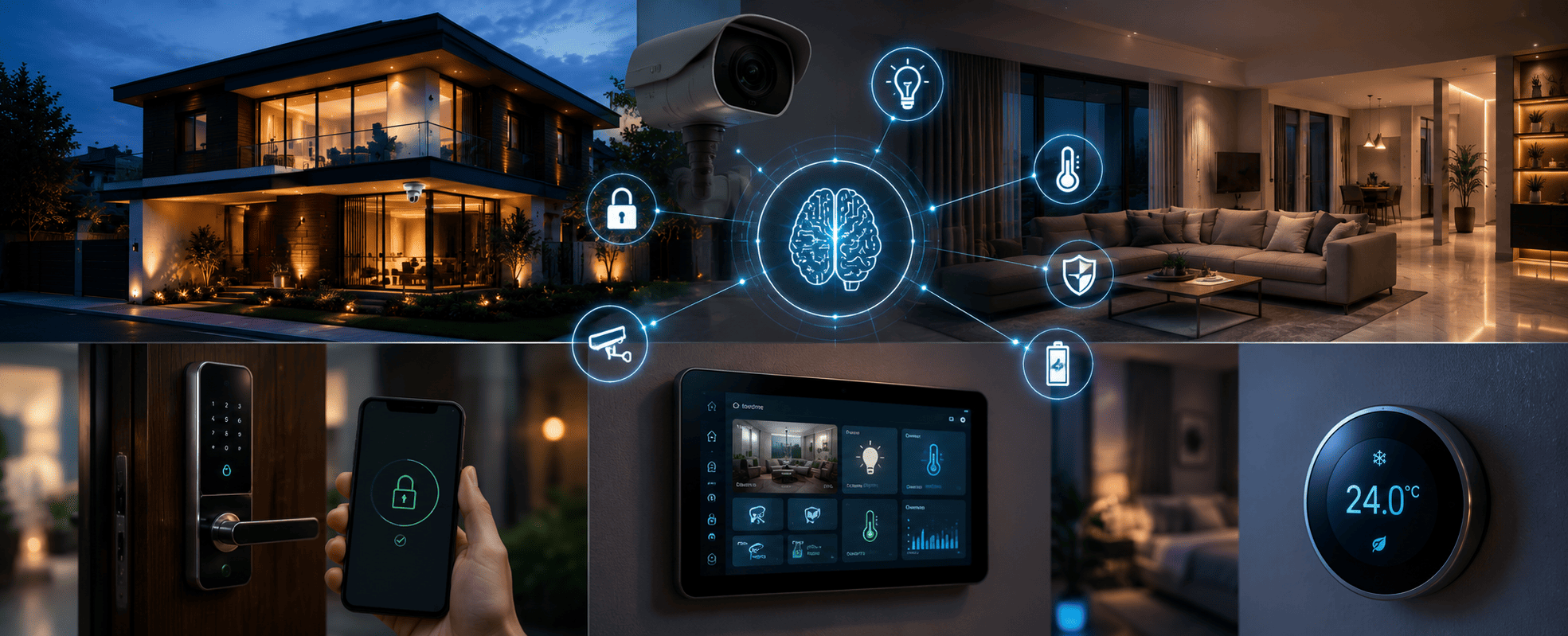
In home automation, "AI" mostly means systems that
learn from usage patterns and adjust automatically, rather than the
science-fiction idea of a home that thinks for itself. The most practical
applications today are pattern-based energy optimisation, smarter security
camera alerts that distinguish between people, vehicles, and animals, and voice
assistants that interpret natural-language commands more accurately over time.
Automation and AI get used somewhat interchangeably in
marketing, but they're not the same thing, and understanding the difference
helps set realistic expectations for what a smart home can actually do today
versus what's still mostly hype. This guide looks at where AI is genuinely
useful in a KNX home automation system right now.
What Does "AI" Actually Mean in a KNX Home Automation System?
Traditional KNX automation is rule-based: "if
motion is detected and it's after sunset, turn on the lights." This works
well and is the foundation of most scene logic, but it requires someone to
define the rules upfront, and the rules don't change unless someone updates
them.
AI-enhanced features add a pattern-learning layer on
top of this foundation, for example, a thermostat that notices a household
consistently lowers the temperature at 10 PM and gradually adjusts its schedule
to match, without anyone manually reprogramming it. The KNX system still
executes the underlying commands (adjusting the thermostat, switching lights), and AI primarily affects when and how those commands get triggered.
How Does AI Improve Energy Efficiency in Smart Homes?
This is currently one of the most practical applications of
AI in home automation:
- Occupancy
pattern learning: rather than fixed schedules, the system gradually
learns when rooms are typically occupied and adjusts climate/lighting
accordingly
- Adaptive
thermostat scheduling: similar to how some standalone smart
thermostats learn preferences, this can be applied within a KNX system's
climate zones
- Anomaly
detection: flagging unusual energy consumption (e.g., an AC running
continuously in an empty room) that might indicate a fault or a scene that
wasn't triggered correctly
The key difference from purely rule-based automation is that
these adjustments happen gradually based on actual usage, rather than requiring
someone to notice a pattern and manually update a schedule.
How Does AI Enhance Smart Home Security?
AI-based video analytics is one of the more mature
applications available today, and it directly addresses a common complaint with
traditional motion-based security: too many false alerts.
- Person,
vehicle, and animal differentiation — instead of any motion triggering
an alert, AI-enabled cameras can distinguish between a person walking up
to the door, a car in the driveway, or a pet moving through the garden
- Familiar
face recognition (where enabled) — reducing alerts for household
members while still flagging unrecognised individuals
- Activity-based
alerts — for example, flagging if someone lingers near an entrance for
an extended period, rather than just detecting any movement
This connects directly to the security and
surveillance systems we install — AI analytics typically run on the camera
or NVR itself, with the results feeding into the same alert and automation
logic as other sensors on the KNX bus.
How Do Voice Assistants Use AI in a KNX System?
Voice assistants (Alexa, Google Assistant) rely on AI for
natural-language processing — interpreting spoken commands and matching them to
the correct device or scene. As we covered in our guide on voice control and KNX integration,
the AI component here is mostly in how the assistant interprets what you
said, while the KNX-IP gateway handles translating that into bus commands.
Over time, these assistants also improve at handling
variations in phrasing — "turn off the lights," "lights
off," and "make it dark in here" can all map to the same
command, which is a direct result of the underlying AI model's language
understanding improving.
How Does AI-Enhanced Automation Compare to Traditional Rule-Based Automation?
Aspect |
Rule-Based Automation |
AI-Enhanced Automation |
|
How it works |
Pre-defined "if-then" logic set during
programming |
Pattern learning adjusts behaviour based on usage over
time |
|
Setup |
Requires explicit configuration for each scenario |
Initial setup similar, but adapts gradually afterwards |
|
Predictability |
Highly predictable — same trigger always produces the same
result |
May adjust over time, which some users find less
predictable initially |
|
Best for |
Core scene logic (lighting, climate, security scenes) |
Refinements layered on top of core logic — energy
schedules, alert filtering |
|
Maturity in KNX systems |
Well-established foundation of most installations |
Emerging — most useful in security analytics and energy
optimisation currently |
In practice, most KNX systems use rule-based logic as the
foundation, with AI-enhanced features added selectively where they provide
clear value — particularly security camera analytics and energy pattern
optimisation.
What Are the Realistic Limitations of AI in Home Automation Today?
It's worth being direct about where AI in home automation is
still limited, since marketing often overstates current capabilities:
- Most
"AI" features still require a stable rule-based foundation: AI doesn't replace scene programming, it refines it
- Pattern
learning takes time: adaptive features typically need weeks of usage
data before adjustments become noticeable
- Privacy
considerations: AI video analytics and voice processing often involve
cloud processing; understanding what data is processed locally versus sent
to a cloud service is worth discussing during system design
- Not
every "AI-powered" claim reflects a meaningful difference: some products use the term primarily for marketing, even when the
underlying functionality is closer to standard automation
A Real Example: AI Camera Analytics Reducing False Alerts in Gurgaon
On a villa project in Gurgaon, the homeowner's original camera setup generated frequent nighttime alerts from a security camera covering the driveway — most of which turned out to be triggered by a neighbour's cat. After upgrading to cameras with AI-based object classification, the system was reconfigured to only send alerts for person or vehicle detection in that zone, reducing irrelevant notifications significantly while keeping the underlying KNX-integrated alert and lighting response unchanged for genuine triggers.
Conclusion
AI in home automation today is most useful as a refinement layer on top of solid rule-based KNX automation — particularly for reducing false security alerts and gradually optimising energy use based on actual household patterns. It's not a replacement for well-designed scene logic, but rather an enhancement that becomes more useful as the underlying home automation system is already working well. For homeowners evaluating "AI-powered" claims, the most useful question is simply: what specifically does this do differently, and how would I notice the difference in daily use?
FAQs
Do I need to buy "AI-enabled" devices specifically, or does my existing KNX system already use AI?
Most existing KNX automation is rule-based, which works well
on its own. AI-specific features (like camera analytics or adaptive
thermostats) typically require devices designed for those capabilities — this
can often be added selectively rather than requiring a full system replacement.
Will AI-based automation make decisions I don't want, like changing my schedule without asking?
Well-designed AI features in home automation typically
suggest or gradually adjust within boundaries you set, rather than making
unrestricted changes. It's worth discussing during planning how much adaptive
behaviour you want versus fixed, predictable rules.
Is AI camera analytics reliable enough to replace monitoring by a security service?
AI analytics improve alert relevance significantly, but
they're best understood as reducing false alerts and improving the usefulness
of notifications — not as a replacement for a monitored security service if
that's part of your setup.
How do I know if a product's "AI" claim is meaningful?
Ask what specifically the AI feature does differently from a
standard rule-based equivalent — for example, "does this thermostat just
follow a schedule I set, or does it adjust that schedule based on usage over
time?" A specific, demonstrable difference is a good sign; vague claims
are worth questioning.