

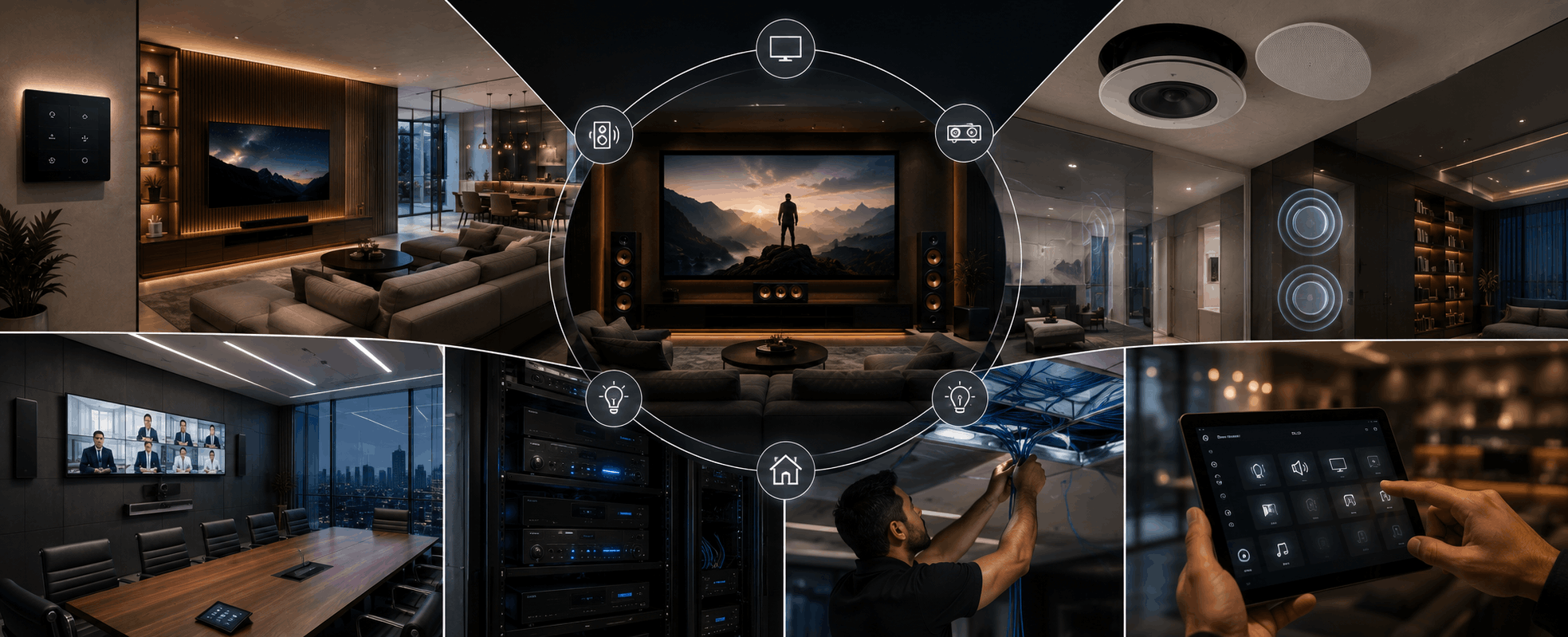
Audio-video integration is now a standard part of how Indian
homes and offices are designed, from cinematic home theatres and whole-home
audio to video conferencing systems for corporate boardrooms. With so many
providers offering AV and automation services, picking the right partner
directly affects whether the finished system performs reliably for years or
becomes a recurring source of frustration.
At techvault, we design, install, and program AV systems as
part of complete KNX-integrated smart homes across Delhi NCR, Noida, Gurgaon,
and Jaipur. This guide covers what actually separates a reliable AV integration
company from one that simply sells equipment, based on what we look for in our
own projects, and what we'd recommend any homeowner check before signing a
contract.
Why Does Choosing the Right AV Integrator Matter So Much?
An AV installation isn't just speakers and a screen, it's
planning, wiring, calibration, and integration with the rest of the home's
automation. Getting it wrong doesn't just mean mediocre sound; it means rework,
exposed cabling, and a system that doesn't talk to the rest of the home.
Three things are at stake with the wrong choice:
- Performance:
Poor speaker placement and uncalibrated acoustics make even premium
hardware sound average
- Integration:
A standalone AV system that doesn't connect to home automation means
separate remotes and apps for everything
- Long-term
reliability: Without proper documentation and after-sales support,
even small issues become expensive to diagnose later
What Should You Check Before Choosing an AV Integration Company?
1. Industry Experience and Project Portfolio
Look at how long the company has actually been delivering AV
projects, and ask to see completed work in your city. A portfolio of real
installations — home theatres, multi-room audio, architectural speaker
integration — tells you more than a sales brochure ever will.
2. Range of Services, Complete Solution vs Single Focus
Some providers only handle home theatres; others only do
corporate conferencing. A genuine audio-video solutions provider should
be able to cover:
- AV
system design and acoustic planning
- Multi-room
audio systems
- Architectural
and invisible speaker integration
- Intelligent
lighting and shading integrated with the AV scene
- Structured
cabling and networking
- After-sales
support and maintenance
3. Customization, Not Off-the-Shelf Packages
Every space is different — a compact apartment living room
and a dedicated home theatre room need fundamentally different AV approaches. A
good integrator assesses the room, the use case, and the budget before
recommending a specific setup, rather than proposing the same package to every
client.
4. Brand Certifications and Partnerships
This is one of the clearest signals of a serious integrator.
Look for companies that are certified partners or authorized dealers for
established AV brands — this typically means access to genuine products with
manufacturer warranty, trained installation staff, and reliable long-term
support.
At techvault, our AV projects are built around brands
including Sonance and TruAudio for architectural and invisible
speaker systems, B&W (Bowers & Wilkins), Revel Speakers, DENON,
Marantz, and Devialet for premium audio performance, and SONOS
for multi-room streaming — all integrated into a KNX scene control system
using Crestron or KNX-native control where the project calls for it, so
the entire AV setup responds to a single keypad press alongside lighting and
climate.
5. Project Management Process
A proper AV installation involves planning, wiring,
integration, testing, and training — not just mounting hardware. Before
committing, ask:
- Is
there a clear project timeline?
- How
does the company coordinate with architects and interior designers?
- Do
they provide a system walkthrough or demonstration before final handover?
6. After-Sales Support and Maintenance
AV and automation systems need occasional troubleshooting,
software updates, and adjustments as your needs change. A reliable provider
offers maintenance contracts, remote diagnostics, and defined response times
for on-site support — not just a one-time installation and a goodbye.
7. Reviews and Reputation
Check Google reviews, LinkedIn, and direct references from
past clients in your city. A company confident in its work will readily share
contacts from completed projects.
8. Transparent, Itemized Pricing
Cost shouldn't be the only factor, but vague, bundled
estimates are a red flag. A trustworthy integrator provides an itemized quote —
equipment, installation labour, programming, and support — so you can compare
providers on a like-for-like basis.
What Are the Real Benefits of Choosing the Right AV Partner?
- Seamless
user experience — from one-touch scene control to voice commands, the
right integration makes daily use effortless
- Genuine
equipment with manufacturer warranty — authorized dealers provide
products backed by real support, not grey-market imports
- Solutions
tailored to your space — a home theatre, multi-room audio setup, or
corporate conferencing system designed around your actual layout and
budget
- Future-proof
systems — built on open standards like KNX, capable of expanding as
your needs evolve, rather than locking you into one closed ecosystem
- Clean,
integrated aesthetics — speakers and cabling planned to disappear into
the architecture, not dominate the room
- Time
and cost efficiency — one accountable team managing design through
installation, instead of coordinating multiple vendors
- Long-term
reliability — proper documentation (including the system's programming
file) and ongoing support keep the system performing for years
Real Example
On a villa project in Greater Noida, we integrated
multi-room audio using a mix of in-ceiling and invisible speaker systems across
the living room, master bedroom, and spa bathroom, alongside a dedicated home
theatre with architectural front speakers and a motorized screen. All zones
were brought into the same KNX scene logic as lighting and climate — a single
"Evening" scene starts ambient music in the living room at a preset
volume, while "Movie Time" in the theatre room handles the screen,
projector, lighting, and audio together.
The interior designer's brief was strict: no visible speaker
grilles in the formal living areas. This required coordinating speaker
placement with the false ceiling and wall plastering schedule months before the
audio system was even commissioned — a reminder that good AV integration starts
at the design phase, not after the room is finished.
What Does AV Integration Cost in India?
Scope |
Approx. Cost |
|
Basic living room AV (display + soundbar + smart control) |
₹80,000 – ₹2,00,000 |
|
Multi-room audio (3-5 zones) |
₹1,50,000 – ₹6,00,000 |
|
Dedicated home theatre with Dolby Atmos |
₹3,00,000 – ₹15,00,000+ |
|
Full villa AV + KNX scene integration |
₹8,00,000 – ₹30,00,000+ |
These figures are indicative and depend heavily on brand
selection, room acoustics, and the depth of KNX integration with the rest of
the home. For a complete cost breakdown, see our home theatre cost guide.
FAQs
What's the difference between an AV company and a home automation company?
An AV-only company typically focuses on displays, speakers,
and conferencing systems in isolation. A home automation company integrates AV
into the same control system as lighting, climate, and security — so a single
scene command handles all of them together. We'd recommend choosing a provider
that offers genuine integration, not just AV in isolation, particularly for
whole-home projects.
Should I choose an integrator based on brand partnerships alone?
Brand certifications are a strong signal of legitimacy and
access to genuine products, but they shouldn't be the only factor. Combine it
with checking the company's project portfolio, their approach to customization,
and their after-sales support structure.
Can a small apartment justify a professional AV integrator, or is that only for large villas?
Professional integration is valuable at any scale — a
well-planned multi-room audio system or living room AV setup in an apartment
benefits just as much from proper acoustic planning and clean installation as a
large villa does. The scope and budget simply scale down accordingly.
How long does a typical AV integration project take?
A basic living room AV setup can be completed in a few days.
A dedicated home theatre with acoustic treatment and full KNX integration
typically takes 2-4 weeks depending on room readiness and the complexity of
programming required.
Is it worth paying more for a certified integrator versus a local electrician?
For basic on/off audio control, a local electrician may
suffice. For genuine AV performance — calibrated acoustics, multi-room scene
integration, and long-term reliability — a certified integrator's design and
programming expertise typically delivers a meaningfully better result, and the
documentation they provide protects the system's serviceability for years.
Still Deciding on the Right AV Partner?
Choosing the right audio-video integration company comes
down to verified experience, the right brand partnerships, genuine
customization, and reliable after-sales support — not just the lowest quote. Talk to our team for a free
consultation on your home theatre, multi-room audio, or full AV integration
project, or explore our audio-video
services to see what's possible.