

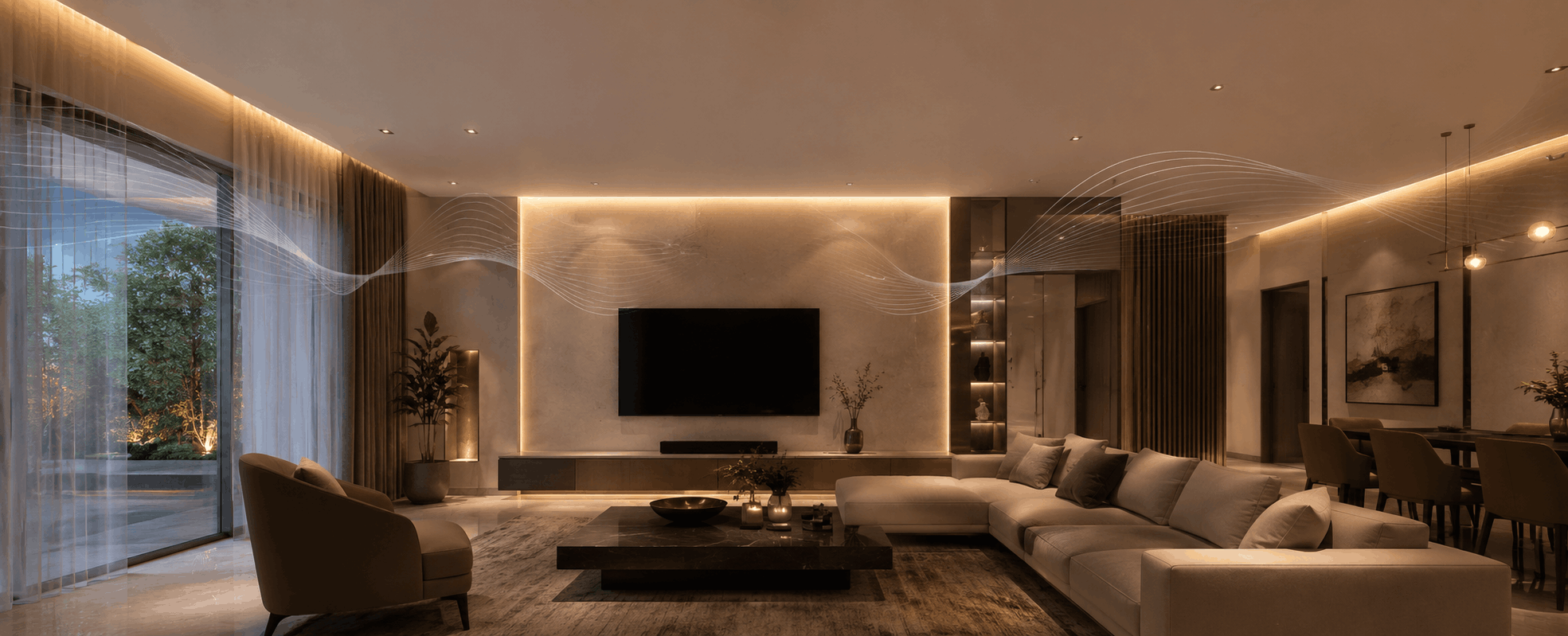
Invisible speakers are audio drivers installed behind walls,
ceilings, or plaster surfaces so they produce no visible hardware — no grilles,
no boxes, no wires. The surface itself (drywall, plaster, even wood panels)
becomes the speaker, vibrating to generate sound that fills a room without any
indication of where it is coming from. In a KNX-integrated luxury home,
invisible speakers connect to the same multi-room audio system as every other
zone — controllable from a single Basalte keypad, voice command, or app.
At Techvault, we specify and install invisible and architectural speaker systems as part of complete KNX smart home projects across Delhi NCR, Noida, Gurgaon, and Jaipur. This guide covers how invisible speaker technology works, the leading brands, where they perform best in a luxury Indian home, and how we integrate them into a unified audio system.
What Makes Invisible Speakers Different from In-Wall or In-Ceiling Speakers?
Most homeowners group all hidden audio under "invisible
speakers" — but there is a meaningful technical difference between the
categories:
Type |
Visibility |
Technology |
Finish |
|
In-ceiling speakers |
Grille visible |
Traditional cone driver, flush-mounted |
Paintable grille, usually round |
|
In-wall speakers |
Grille visible |
Traditional cone driver, recessed into the wall |
Paintable grille, rectangular |
|
Architectural invisible |
Grille visible but minimal |
Slim cone driver, very low profile |
Paint-matched grille |
|
True invisible (DML/plaster-in) |
Completely invisible |
Distributed Mode Loudspeaker (DML) or exciter panel |
Skim-coated plaster, painted over entirely |
True invisible speakers use DML (Distributed Mode
Loudspeaker) technology — a rigid panel with an exciter attached to its
back. The exciter causes the panel to vibrate across its entire surface,
generating sound from the wall or ceiling itself rather than from a cone driver
pointing in one direction. The result: no visible hardware at all, even after
the room is finished and painted.
Why Are Invisible Speakers Growing in Luxury Indian Homes?
Three factors are driving adoption in high-end Indian
residential projects:
Minimalism in luxury interiors — Architects and
interior designers working on premium Indian villas increasingly want clean,
uninterrupted wall and ceiling surfaces. A grille — even a paint-matched one —
introduces a visual element that breaks the surface. DML invisible speakers
allow the design intent to remain completely intact.
Early-stage integration — As more Indian luxury
homeowners plan KNX automation systems during construction (rather than
retrofitting later), audio is now being designed into the project from the
beginning. This makes invisible speaker installation practical — the panels go
in before plaster, and the room is finished over them.
Whole-home audio expectations — Luxury homeowners
increasingly expect music to follow them through the home without visible
hardware in every room. Invisible speakers make this possible in spaces where
even a slim in-ceiling grille would be intrusive — a formal living room with a
decorated ceiling, a prayer room, a spa bathroom.
Which Brands Lead in Invisible Speaker Technology?
Brand |
Technology |
Best Known For |
Typical Use |
|
Amina Technologies |
DML — panel vibration across the entire surface |
True invisibility, even sound distribution, and moisture-resistant variants |
Luxury residential, hospitality |
|
TruAudio (Wraith Series) |
Exciter-based panel technology |
Clean integration, a wide range of architectural and
invisible options |
Residential, bespoke installations |
|
Sonance (Invisible Series) |
In-plaster cone drivers |
Room-filling background sound, strong brand recognition |
Residential, commercial background audio |
Amina Technologies holds the strongest position for
true invisibility — their Distributed Mode Loudspeaker panels are placed behind
drywall or plaster and completely concealed, with sound distributed across the
entire surface rather than projected from a single point. This creates a
natural, enveloping quality where sound appears to come from the room itself
rather than from speakers.
TruAudio's Wraith Series uses exciter technology that
turns the surface into a sound panel, favoured by integrators for its clean
installation process and the flexibility of TruAudio's broader architectural
range.
Sonance bridges the gap between true invisible and
architectural — their invisible series is plastered over and painted, though
with a slightly more traditional driver approach than Amina's DML technology.
Where Do Invisible Speakers Work Best in a Luxury Indian Home?
Not every room is an equal candidate for invisible speakers
— the choice depends on use, acoustic priorities, and design intent:
Room |
Invisible Speaker Suitability |
Why |
|
Formal living/drawing room |
★★★★★ |
Design intent matters most here — no grilles on decorated
ceilings or feature walls |
|
Spa bathroom/wellness room |
★★★★★ |
Moisture-resistant DML options available; clean surfaces
essential |
|
Prayer room/pooja room |
★★★★★ |
Ambient sound without visual intrusion is perfectly suited |
|
Master bedroom |
★★★★ |
Background audio and wake-up scenes; DML suits
lower-output ambient use well |
|
Home office |
★★★★ |
Professional look, conference call audio, focus music |
|
Kitchen |
★★★ |
Background audio; in-ceiling is often more practical given a steam/grease environment |
|
Home theatre |
★★ |
DML speakers excel at ambience but typically lack the
directional precision needed for surround channels — in-wall/in-ceiling
preferred for theatre front channels |
|
Outdoor / terrace |
★ |
DML panels are not designed for outdoor exposure —
architectural outdoor speakers are better suited |
How Does TechVault Integrate Invisible Speakers into a KNX Smart Home?
Invisible speakers — whether DML or exciter-based — are
passive drivers that need amplification and a source signal, exactly like any
other architectural speaker. Our integration process:
1. Zone planning — During the home automation design phase,
we map audio zones alongside lighting, climate, and curtain zones. Invisible
speaker zones are planned the same way — each room or area that needs audio is
a zone, with its own amplifier channel and KNX address.
2. Pre-construction installation — DML panels must go
in before plaster and paint. This is coordinated with the false ceiling
contractor and civil team — panels are mounted in position, speaker cable is
run concealed, and the room is finished over them. For the audio-video system to work
seamlessly, this stage must happen at the right point in the construction
sequence.
3. Amplification — Invisible speakers connect to a
multi-zone amplifier in the central AV rack, typically via the same structured
cabling infrastructure as the rest of the home's networking and AV systems.
4. KNX scene integration — Via the KNX-IP gateway,
audio zones are brought into the same scene logic as lighting and climate. A
"Good Morning" scene can gradually raise bedroom lighting while
starting background music in the bedroom zone — from a single keypad press or
scheduled trigger. A "Leave Home" scene mutes all audio zones
simultaneously, alongside turning off lights and setting the HVAC to away mode.
5. Control — Audio zone selection, source, and volume
appear as controls within the same premium
switches and lighting keypad interface used for everything else — no
separate audio remote needed.
A Real Example
On a villa project in Greater Noida, we integrated invisible
speakers across the formal living room, master bedroom, and spa bathroom —
three zones where design integrity made visible grilles unacceptable to the
interior designer. DML panels were installed before plaster was applied in all
three rooms, and cabled back to the central AV rack.
All three zones were programmed into the KNX scene logic
alongside lighting and curtain automation — the "Evening" scene in
the living room includes a background music source starting at a preset volume,
while "Sleep" in the master bedroom fades audio out over five minutes
alongside the lighting dim-down. The spa bathroom zone activates with a
dedicated "Wellness" scene tied to the bathroom lighting circuit.
The interior designer signed off on all three rooms without
a single visible speaker or grille — the finished rooms are indistinguishable
from rooms with no audio system at all.
What Does an Invisible Speaker System Cost in India?
|
Scope |
Approx. Cost (Supply + Installation, excl. KNX
integration) |
|
Single room (DML invisible, 2 panels) |
₹80,000 – ₹2,00,000 |
|
3-zone invisible system (living, bedroom, bathroom) |
₹2,50,000 – ₹6,00,000 |
|
Whole-home invisible audio (5-8 zones) |
₹5,00,000 – ₹15,00,000+ |
These figures cover speaker panels and installation only —
amplification, source equipment, and KNX integration costs are additional and
depend on the overall automation scope. All costs are indicative estimates;
actual pricing requires a site assessment and project scope confirmation.
FAQs
Can invisible speakers be installed in an existing home, or only during construction?
DML and plaster-in invisible speakers must be installed
before plaster is applied — they cannot be retrofitted without opening walls
and ceilings. However, some architectural speakers with minimal-profile grilles
can be retrofitted where false ceiling access exists. If an existing home needs
audio without visible hardware, we assess the specific layout and recommend the
most practical approach during a site visit.
Do invisible speakers sound as good as traditional speakers?
For ambient background listening, music throughout the home,
and voice assistant audio, DML invisible speakers perform excellently. For a
dedicated home theatre with surround sound, traditional in-wall and in-ceiling
architectural speakers generally provide better directional accuracy — this is
why we typically specify invisible speakers for living and bedroom zones and
in-wall/in-ceiling for theatre front channels in the same project.
Which invisible speaker brand does TechVault specify?
We specify based on the project's specific requirements —
Amina for maximum true invisibility and moisture-resistant applications,
TruAudio for projects where we're also using their broader architectural range,
and Sonance, where background listening performance is the primary priority. No
single brand is right for every project.
How is an invisible speaker zone controlled in a KNX home?
The same way as lighting and curtains — through a KNX
keypad, the home automation app, or a voice command. The KNX-IP gateway bridges
the audio system's control protocol into the KNX bus, so scene commands that
include audio (source, volume, on/off) trigger simultaneously with lighting and
climate — no separate audio interface is needed.
Will the plaster crack or affect sound quality over time?
DML panels are designed to vibrate at very low amplitude —
the movement is imperceptible to the touch and does not crack properly applied
plaster over time. Quality of plaster application matters — this is part of the
installation briefing we provide to the plastering contractor during
construction coordination.
Ready to Include Invisible Speakers in Your Home?
Invisible speaker integration works best when planned from
the beginning of a construction or renovation project — once walls and ceilings
are finished, the options narrow significantly. If you're planning a new luxury
home or major renovation in Noida, Delhi NCR, or Gurgaon, talk to our team to include
audio zone planning in your KNX automation brief from the start.