

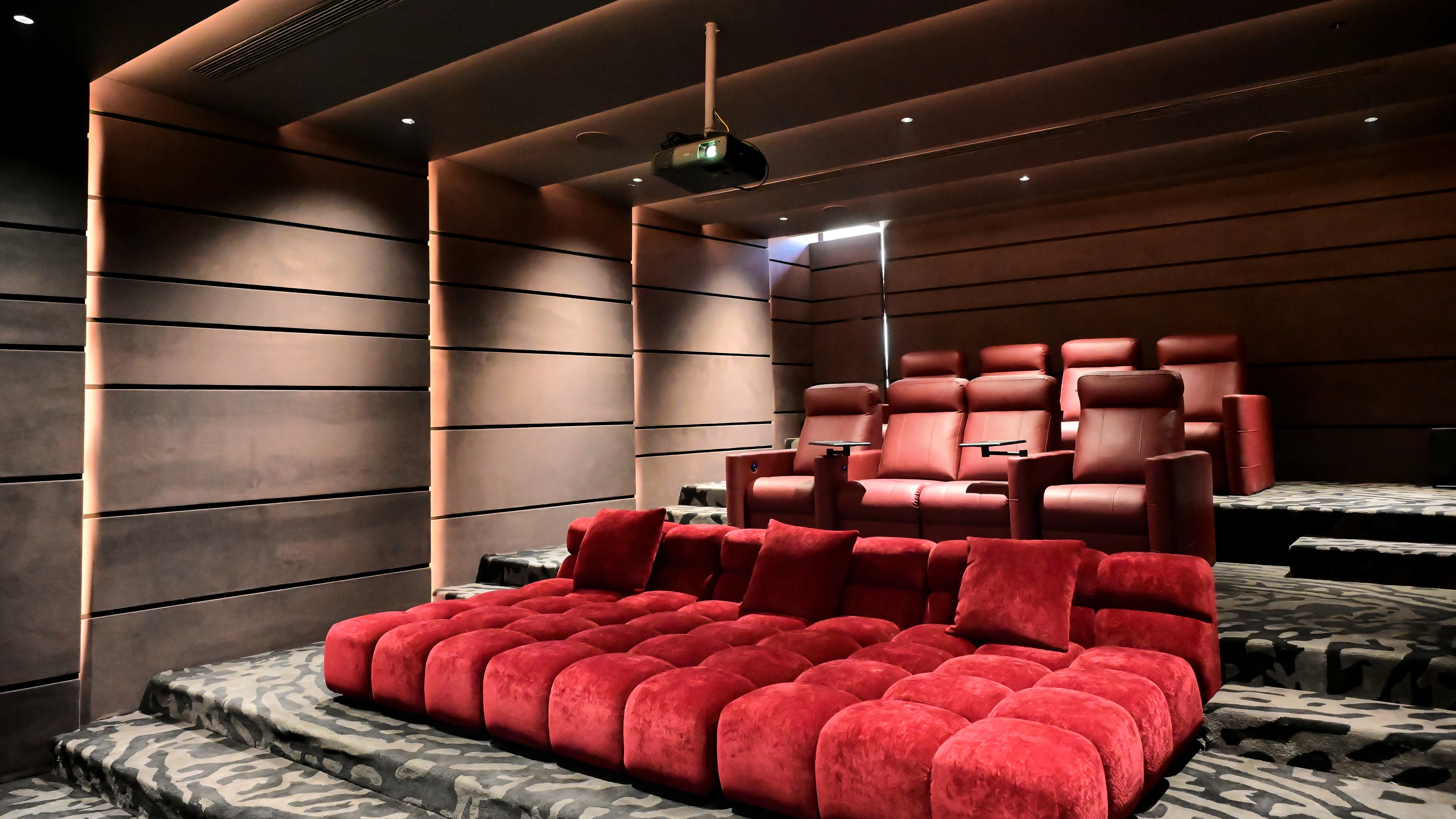
Home theatre or home cinema - what are you actually building?
The two terms are used interchangeably, but they describe different projects. A home theatre usually shares a living space and does a lot of jobs - TV, gaming, movies. A private home cinema is a single-purpose room built only for watching content, where acoustics, seating, and light are all controlled. If you own a villa or penthouse with a room to spare, the second is what delivers a true cinema feel.
As integrators, our first question is never "which speakers?" - it's "which room, and what can we do to it?" That decision shapes everything else.
What makes a home cinema "luxury" rather than just expensive?
Luxury here means engineered, not just costly. A reference-grade cinema controls three things a normal room can't: sound leaking in and out (isolation), how sound behaves inside the room (acoustic treatment), and how the picture is seen from every seat (calibrated projection and sightlines). Expensive gear in an untreated room still sounds ordinary — the room is the real equipment.
How do you design the room itself?
Room design comes before any product. We plan proportions, seating tiers so back rows see over front rows, a screen sized to the seating distance, and speaker positions built into the architecture. CEDIA - the AV industry body - publishes design recommendations (not fixed rules) for viewing angles, screen size, and speaker placement, and we work to those. In Indian villas, a basement or a windowless internal room is often ideal because it is naturally darker and easier to isolate.
Which projector and screen suit a private cinema?
A dedicated cinema uses a projector and a large screen, not a TV - that scale is the point. Because the room is controlled for light, you can run a projector to its full potential. We specify projection from confirmed partners such as BenQ, matched to the throw distance, screen size, and brightness the room needs. For immersive sound, the screen is usually acoustically transparent so speakers can sit behind it.
What sound system does a home cinema need?
The modern benchmark is Dolby Atmos - object-based audio that adds height/overhead channels so sound moves around and above you, rather than only left-to-right. Typical layouts range from 5.1.2 up to 7.2.4 depending on room size. We build these with speakers from partners like Revel, B&W, or TruAudio, driven by an Atmos-capable processor and amplification from Marantz or DENON. Speaker count matters less than correct placement and calibration.
How much do acoustics and soundproofing matter?
More than almost anything else. Isolation stops the cinema from disturbing the rest of the home (and neighbours, in apartments), while internal treatment - absorption and diffusion -stops echo and muddiness. In Indian construction, hard concrete-and-tile rooms are acoustically "live," so treatment is essential, not optional. Getting this right is what separates a real cinema from a loud living room.
What about lighting, seating and comfort?
Comfort is part of the experience. We use dimmable bias and cove lighting - controlled through DALI or KNX scenes - so light fades smoothly without ever hitting the screen. Tiered platforms carry recliner seating with clear sightlines, and finishes like acoustic fabric walls and a fibre-optic "star" ceiling add the signature cinema mood. Every luxury detail still serves the picture and sound first.
How does automation tie the whole room together?
This is where a KNX integrator adds the most value. One press of a "Movie" scene dims the lights, closes the drapes, lowers the screen or masking, powers up the projector and processor, and sets the volume — then raises the lights gently when the film ends. As your AV and automation partner, we programme these scenes so a reference-grade system feels as simple as a single tap.
How much does a private home cinema cost in India?
Cost depends on room size, level of acoustic work, and the gear tier. The figures below are indicative estimates only - every room is different, so treat them as planning ranges, not quotes.
Tier | What it includes | Indicative cost (India) |
|---|---|---|
| Premium | Dedicated room, quality projector, 5.1.2 Atmos, basic acoustic treatment, automation scene | ₹15–30 lakh |
| High-end | Reference speakers, 7.2.4 Atmos, acoustically transparent screen, tiered recliner seating, full lighting + automation | ₹30–75 lakh |
| Bespoke / reference | Acoustically isolated room, acoustician-designed treatment, top processing and amplification, star ceiling, full KNX integration | ₹75 lakh–₹2 crore+ |
Home theatre vs private home cinema - at a glance
Home theatre | Private home cinema | |
|---|---|---|
| Room | Shared living space | Dedicated, single-purpose |
| Display | Large TV or projector | Projector + large screen |
| Sound | Surround / soundbar to Atmos | Calibrated Dolby Atmos |
| Acoustics | Minimal | Isolated + treated |
| Light control | Partial | Fully controlled |
| Best for | Everyday viewing | Reference movie nights |
FAQs
Do I need a dedicated room for a home cinema?
For a true cinema experience, yes—a dedicated room lets you fully control light, sound, and seating. A shared living-room theatre is a good alternative when a spare room isn't available, but it can't match the isolation and immersion of a purpose-built cinema.
What size room is ideal for a home cinema?
There's no single number — the room's proportions and seating distance matter more than raw area. We size the screen and speaker layout to the room, following CEDIA design recommendations, so even a modest dedicated room can perform well when treated correctly.
Is Dolby Atmos worth it at home?
For a dedicated cinema, it usually is. Atmos adds height channels for object-based, three-dimensional sound, which is a large part of the modern cinema feel. In a treated room with correct speaker placement, the difference over standard surround is clearly audible.
Can a home cinema be soundproofed in an apartment?
It can be significantly improved, though full isolation is harder in shared-wall apartments than in standalone villas. We assess the structure first and design isolation and treatment to suit — the goal is that neighbours aren't disturbed and the room sounds clean inside.
Should the cinema be integrated with my home automation?
Ideally, yes. Integrating the cinema into KNX automation lets a single scene control lights, screen, drapes and AV together, which makes a complex system genuinely easy to use — and lets it work in sync with the rest of your smart home.
How long does a private home cinema take to build?
It varies with civil and acoustic work, but a dedicated cinema is a project measured in weeks, not days, because the room is built and treated before equipment goes in. We share a realistic timeline once the room and scope are confirmed.
Ready to plan your private cinema?
Every great cinema starts with the room. Book a design consultation with our team to assess your space, or visit us to experience a reference setup before you decide on anything.