

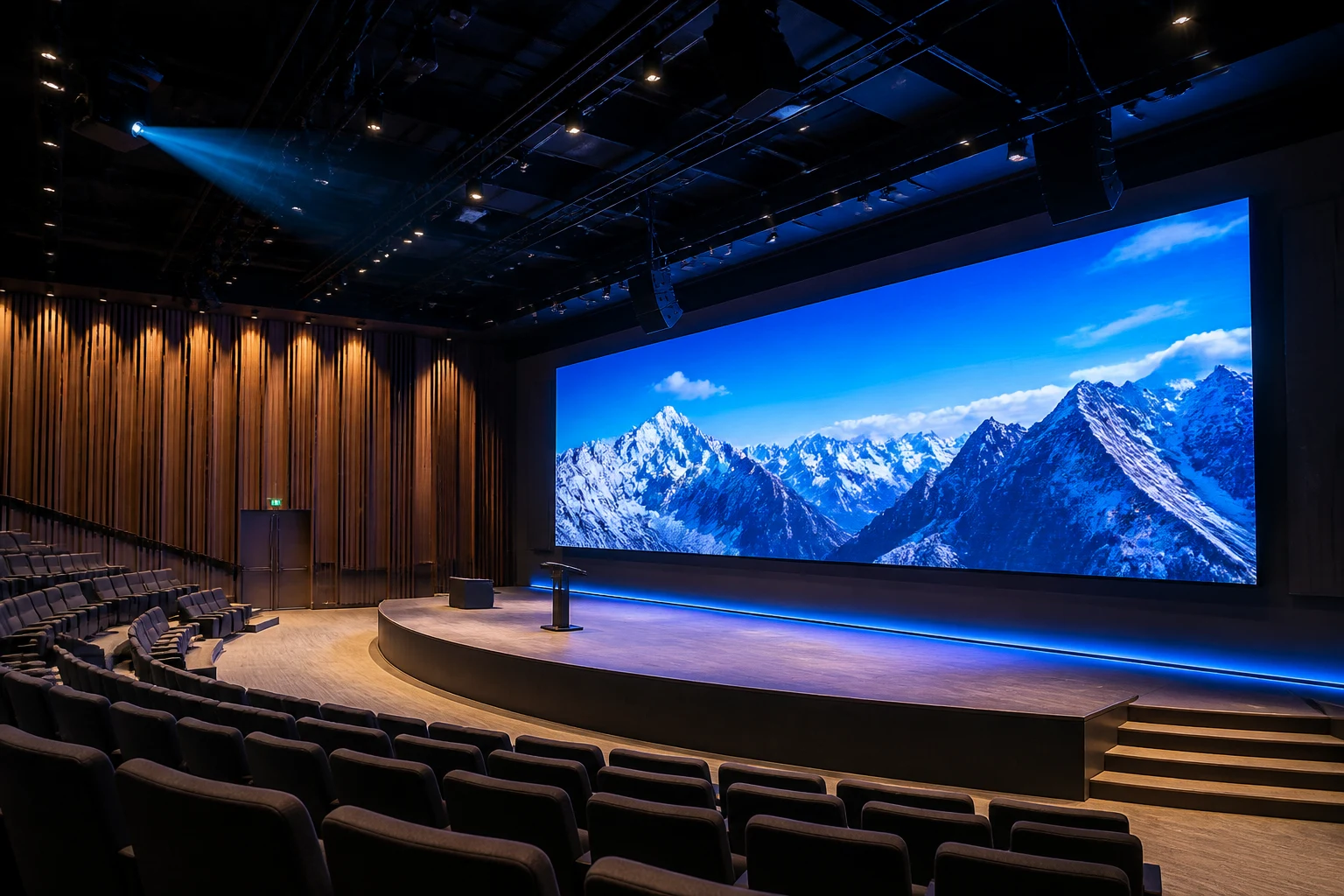
For an auditorium display, the choice comes down to one dominant factor: how much ambient light your hall has. A projector is the cost-effective choice for a controlled, darkened auditorium where lighting can be dimmed; an LED video wall wins in any hall with windows, stage lighting, or events that can't run in the dark — because it's self-emissive and stays vivid where a projected image would wash out. This guide breaks down brightness, cost, lifespan, and maintenance so you can match the display to your actual hall, not a spec sheet.
Planning an auditorium AV project? Talk to TechVault for an on-site display assessment.
What's the Core Difference Between a Projector and an LED Wall?
A projector emits light through a lens onto a reflective screen — the audience sees reflected light. An LED video wall emits light directly from each pixel, where every diode is its own light source.
That single distinction — reflected light vs emitted light — decides almost everything else: how each performs under ambient light, how bright it can go, how long it lasts, and what it costs to run over a decade.
- Projector — throws an image onto a screen; brightness measured in lumens; needs a controlled-light environment to look its best
- LED wall — a large display built from seamlessly tiled LED panels; brightness measured in nits; stays vivid even under bright ambient light
Which One Handles Ambient Light Better?
This is the question that decides most auditorium projects, and the answer isn't close.
A projected image competes with every other light source in the room. Once ambient light in a hall passes a few hundred lux — which happens the moment you have windows open, stage lighting on, or house lights up for a live event — a projected image starts to wash out and lose contrast.
An LED wall doesn't have this problem. Because each pixel emits its own light, an LED video wall is roughly 3 to 5 times brighter than a typical projector setup, and stays clearly legible under conditions that would leave a projected image grey and faded. For any auditorium that hosts events without dimming the lights — school assemblies with daylight, corporate town halls, cultural functions — this is the deciding factor.
Planning a school, college, or corporate auditorium in Noida or Delhi NCR? The first question we ask is simple: can your hall actually be darkened during events? If not, the display decision is usually made for you.
Projector vs LED Wall — Side by Side
| Factor | Projector | LED Video Wall |
|---|---|---|
| Ambient light | Needs controlled/dim lighting | Stays vivid in bright halls |
| Brightness | Measured in lumens; washes out over ~a few hundred lux | 3–5x brighter; readable under stage/daylight |
| Upfront cost | Lower — cost-effective for large images | Higher initial investment |
| Lifespan | Lamp: 2,000–5,000 hrs; laser: 10,000–30,000 hrs | Panels: 50,000–100,000+ hrs |
| Maintenance | Periodic lamp/filter replacement | Occasional panel servicing; one failed panel doesn't kill the whole display |
| Best for | Darkened auditoriums, budget projects, controlled light | Bright halls, live events, camera/broadcast, permanent installs |
| Image size | One projector can throw a very large image | Scales infinitely — add more panels |
What About Cost Over Time — Not Just Upfront?
This is where the comparison gets more honest. A projector almost always wins the purchase invoice. But an LED wall vs projector comparison can't stop there.
Over a 10-year deployment, a projector needs lamp or filter replacements (laser models less often), and its brightness degrades over time. An LED panel is rated for 50,000 to 100,000+ hours — over a decade of daily use before brightness halves — with no lamps to replace.
The practical rule: for a hall that's used occasionally and can be darkened, a projector's lower upfront cost usually makes it the sensible choice. For a hall in constant use, or one where dimming isn't practical, the LED wall's higher upfront cost is often offset by lower running cost and zero lamp replacement over its life.
There's also a factor most institutions undervalue: if your auditorium events are filmed or livestreamed, an LED wall serves as a production-quality background that a camera captures cleanly, whereas a projected screen can show flicker or banding on camera. For any hall doing hybrid or recorded events, this alone often decides it.
Is It Expensive? Is It Worth It? What Can Go Wrong?
Is it expensive?
A projector setup has a genuinely accessible entry cost. An LED wall is a larger upfront investment — but for the right hall, the lower running cost and superior performance justify it over the installation's life.
Is it worth it?
It depends entirely on the hall. Matching the display to your actual ambient-light conditions and usage is what makes it worth it — a correctly chosen projector in a dark hall is excellent value; an LED wall in a bright, high-use hall is worth every rupee. The wrong choice either way is the expensive mistake.
What can go wrong?
The most common mistake is choosing a projector for a hall that can't actually be darkened — leading to a washed-out, low-contrast image that no amount of extra lumens fully fixes. The second is choosing an LED wall for a small, controlled auditorium where a projector would have delivered the same experience at a fraction of the cost. Both come from speccing the display before assessing the room.
Who Is This For?
- Schools and colleges planning an auditorium display for assemblies, events, and performances
- Corporate facilities with town-hall spaces, especially those running hybrid or filmed events
- Community and cultural venues hosting a mix of lit and darkened functions
- Architects and facility planners scoping AV budgets during a building or renovation phase
Display choice is one part of a larger auditorium AV system — sound, lighting, and control all need to be designed together. We cover the audio side in detail in our guide to school and college auditorium AV systems, and this display decision usually sits within a broader commercial AV project.
Not sure which display your hall actually needs? Talk to our expert for an on-site assessment before you spec anything.
Planning an auditorium project in Noida or Delhi NCR? Contact TechVault — we assess your hall's light, size, and usage before recommending a display, not after.
FAQ's
Is a projector or LED wall better for a school auditorium?
It depends on whether the hall can be darkened during events. If assemblies happen in daylight or with house lights on, an LED wall stays legible where a projector would wash out. For a hall that can be fully darkened, a projector is a cost-effective choice.Why is an LED wall brighter than a projector?
Because it's self-emissive — each pixel produces its own light, rather than reflecting projected light off a screen. This makes an LED wall roughly 3–5 times brighter and readable under ambient light that would fade a projected image.Does an LED wall cost more than a projector?
Upfront, almost always yes. But over a 10-year life, the projector's lamp replacements and brightness degradation narrow the gap, and for high-use halls the LED wall's lower running cost can make it more economical overall.Which is better for livestreamed or filmed events?
An LED wall. It provides a clean, flicker-free background that cameras capture well, whereas a projected screen can show banding or flicker on camera at certain shutter speeds.