

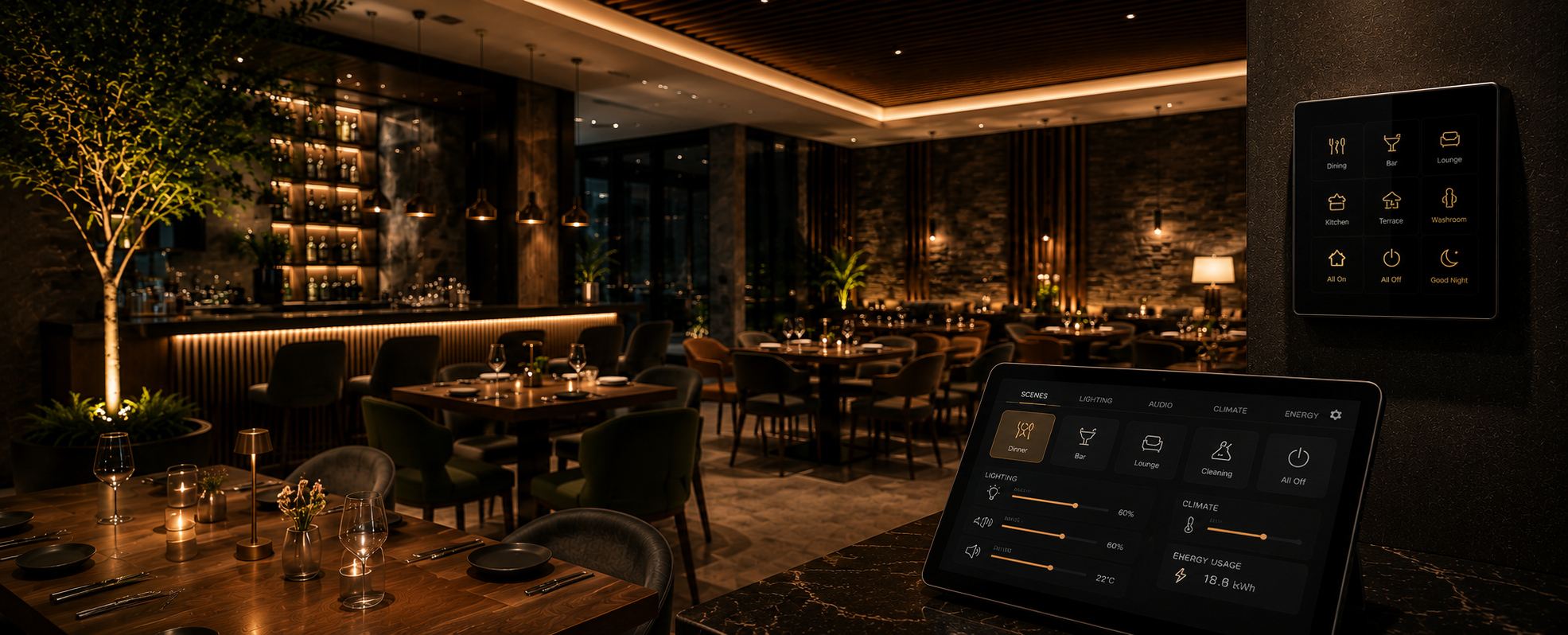
Running a successful restaurant in India requires more than
great food. The ambiance, the sound, the temperature, the energy costs — every
operational detail affects the guest experience and the bottom line
simultaneously.
Restaurant automation India is the integration of
smart lighting, AV, climate, and energy management systems into one intelligent
platform. In our projects across Delhi NCR, Jaipur, and Goa, we have
consistently seen restaurant automation deliver measurable improvements in both
guest satisfaction and monthly operating costs — with energy savings between
25–40% in the first year alone.
This guide covers everything a restaurant owner, hospitality
group, or interior designer needs to know about automating a restaurant or
F&B space in India.
What is Restaurant Automation and Why Does It Matter for F&B Spaces?
Restaurant automation means replacing manual control of
lighting, AV, HVAC, and energy systems with pre-programmed scenes, schedules,
and sensors that respond to occupancy, time of day, and operational mode —
without staff intervention.
Why it matters in the Indian F&B context:
Indian restaurants operate across dramatically different
dayparts — morning breakfast service, afternoon lunch rush, evening dining, and
late-night bar operations. Each day part requires a completely different
ambiance. Without automation, staff manually adjust dozens of switches,
dimmers, and AV controls multiple times per shift — creating inconsistency,
wasting energy, and consuming management attention.
Technical entities used in restaurant automation:
|
Entity |
Function in Restaurant |
|
KNX TP Bus |
Wired backbone for lighting + AV control |
|
DALI Protocol |
Individual dimming of each luminaire |
|
DMX512 |
Colour-changing RGB and decorative lighting |
|
DSP Amplifier |
Multi-zone audio with EQ per zone |
|
Dante Audio Network |
IP-based audio routing between zones |
|
PIR Occupancy Sensor |
Automatic lighting adjustment per zone |
|
KNX Energy Meter |
Real-time electricity monitoring per circuit |
|
HVAC FCU Controller |
Zone-based climate management |
|
KNX IP Gateway |
Remote access and app control |
|
Scene Controller |
One-button activation of all systems |
How Does Smart Lighting Work in a Restaurant?
Restaurant smart lighting in India uses DALI-controlled
dimmers, DMX colour controllers, and KNX actuators to create scene-based
ambiance presets — activated by schedule, occupancy sensor, or a single
keypad button.
A professionally designed restaurant lighting system has at
least four distinct scenes programmed and ready:
|
Scene |
Lighting Level |
Colour Temp |
Best For |
|
Breakfast / Lunch |
80–100% |
4,000K cool white |
High energy, fast turnover |
|
Evening Dining |
40–60% |
2,700K warm white |
Relaxed, lingering guests |
|
Bar / Lounge |
20–30% + RGB accents |
2,200K + colour |
Premium atmosphere |
|
Cleaning / Setup |
100% |
5,000K daylight |
Pre-service prep, post-close |
|
Emergency |
100% all zones |
Neutral white |
Safety mode |
In our recent project for a fine-dining restaurant in Delhi, we programmed 7 distinct lighting scenes on KNX - including a "Romantic Friday" preset with candlelight-warm 2,200K downlights and subtle amber wall washers. The restaurant manager activates the entire evening setup in under 3 seconds from a Basalte keypad at the host station.
Why DALI Over Standard Dimmers for Restaurants?
DALI (Digital Addressable Lighting Interface) gives
each luminaire its own address — meaning every spotlight over a dining table,
every cove light strip, every accent fixture can be individually adjusted. This
level of control is impossible with standard dimmer switches.
Standard dimmer: controls one circuit at one brightness
level. DALI system: controls 64 individual devices per line, each independently
programmable.
For restaurants with complex lighting designs — layered cove
lighting, directional accent spots, pendant clusters, bar back-lighting — DALI
is the professional standard, not an upgrade.
What AV Systems Does a Restaurant Need?
A restaurant Audio-Video system in India uses DSP amplifiers,
multi-zone audio distribution, and KNX integration to deliver different music,
volume levels, and content to dining areas, bar zones, private dining rooms,
and outdoor terraces — all controlled centrally.
Multi-Zone Audio Architecture for Indian Restaurants
Most restaurants in India operate across 3–6 distinct audio
zones:
|
Zone |
Volume Level |
Music Style |
System Required |
|
Main dining hall |
65–70 dB |
Background music |
Ceiling speakers + zone amp |
|
Bar counter |
72–78 dB |
Upbeat / curated |
In-ceiling + subwoofer |
|
Private dining room |
Independent control |
Client's choice |
Separate zone amp channel |
|
Outdoor terrace |
68–74 dB |
Ambient / jazz |
IP65-rated landscape speakers |
|
Kitchen pass |
Low / talkback only |
Staff communication |
Commercial PA |
|
Restrooms |
60–65 dB |
Ambient |
Small in-ceiling speakers |
A Dante audio network allows audio sources —
streaming services, DJ input, microphone feed, TV broadcast — to be routed to
any zone digitally over the restaurant's IP network. No separate audio cabling
required per source.
DSP (Digital Signal Processor) amplifiers apply
independent equalization, volume limits, and routing logic to each zone. The
head chef's kitchen announcement does not bleed into the dining room. The bar
zone's music does not disturb the private dining conversation.
In our project for a 180-cover rooftop restaurant in Jaipur, we installed a 12-zone Dante-networked audio system — integrated with KNX so the "Evening Service" lighting scene simultaneously adjusted audio levels and source selection across all zones. Zero manual intervention required from the service team.
How Does Restaurant Energy Management Work?
Restaurant energy management using KNX energy meters and
HVAC automation reduces electricity consumption by 25–40% — by automatically
scheduling HVAC, controlling lighting based on occupancy, and monitoring
real-time energy draw per circuit.
Restaurants are among the highest per-square-metre energy
consumers in commercial real estate. In India, a typical 150-cover restaurant
consumes ₹80,000–1,50,000 in electricity monthly. Smart energy management
directly impacts this cost.
Three-Layer Restaurant Energy Strategy
Layer 1 — Occupancy-Based Lighting: PIR occupancy
sensors in non-public zones — storage, staff areas, restrooms, prep kitchen —
automatically switch lights off when unoccupied. Average saving: 18–22% on
lighting circuits.
Layer 2 — HVAC Scheduling: HVAC systems pre-cool the
restaurant 45 minutes before opening. During off-peak hours (split shifts,
between service periods), FCU controllers raise the setpoint automatically.
Average saving: 15–25% on HVAC.
Layer 3 — Real-Time Energy Metering: KNX energy meters
monitor individual circuits — kitchen equipment, HVAC, lighting, AV — in real
time. Data is visible on the management dashboard. Abnormal consumption (a
freezer compressor running continuously, lighting left on overnight) triggers
an instant mobile alert.
|
Energy Source |
Without Automation |
With Automation |
Saving |
|
Lighting |
₹35,000/month |
₹24,500/month |
~30% |
|
HVAC |
₹60,000/month |
₹45,000/month |
~25% |
|
Kitchen equipment |
₹40,000/month |
₹36,000/month |
~10% |
|
Total |
₹1,35,000/month |
₹1,05,500/month |
~22% |
What is the Cost of Restaurant Automation in India?
Restaurant automation investment varies based on the size of
the F&B space, the number of lighting circuits, audio zones, and the level of
integration required.
|
Restaurant Type |
Scope |
Investment Range |
|
QSR / Café (800–1,200 sq ft) |
Smart lighting + 2-zone audio |
₹3.5–6 lakh |
|
Casual Dining (1,500–3,000 sq ft) |
Lighting + 4-zone AV + HVAC scheduling |
₹8–14 lakh |
|
Fine Dining (2,500–5,000 sq ft) |
Full KNX + DALI + Dante + energy metering |
₹15–28 lakh |
|
Large Format / Rooftop (5,000+ sq ft) |
Complete integration + outdoor AV |
₹25–50 lakh |
|
Hotel F&B (multiple outlets) |
Enterprise deployment across all outlets |
₹40 lakh–1 crore+ |
Benefits of Restaurant Automation in India?
1. Consistent Ambiance — Every Service, Every Day
Manual control creates inconsistency — a trainee bartender
sets the wrong lighting, music is too loud during lunch, and the evening scene is
not activated on time. Restaurant automation removes human error from
ambiance management. Every service period begins with exactly the right
environment, every time.
2. Reduced Staff Workload
Service staff spend significant time managing
non-guest-facing tasks — adjusting lights, changing music volume, and following up
with maintenance on HVAC complaints. Automation handles all of this
automatically, freeing staff to focus entirely on guests.
3. Energy Cost Reduction
As demonstrated in the energy management section, smart HVAC
scheduling and occupancy-based lighting deliver 22–35% savings on monthly
electricity bills — a direct improvement to the restaurant's operating margin.
4. Remote Management
Restaurant owners and operations managers can monitor and
control all systems from a mobile app — check whether the restaurant is
properly secured after closing, verify HVAC is off, and confirm energy consumption
is within budget. From anywhere in India or internationally.
5. Scalability Across Multiple Outlets
For restaurant groups and hospitality chains operating across Delhi, Jaipur, Mumbai, and other cities, KNX-based restaurant automation allows standardised programming across all outlets — one scene definition deployed across the entire chain with consistent results.
FAQs
What is restaurant automation in India?
Restaurant automation in India integrates KNX-controlled
smart lighting, multi-zone AV systems, HVAC scheduling, and energy metering
into one platform — allowing restaurant owners to preset ambiance scenes,
reduce energy costs, and manage all systems remotely.
How much does smart lighting for a restaurant cost in India?
Smart lighting for a restaurant in India starts at ₹1.5–3
lakh for a basic QSR or café (800–1,200 sq ft) and scales to ₹8–15 lakh for a
full DALI-controlled fine-dining setup with multiple ambiance scenes.
Can restaurant automation integrate with existing POS systems?
Yes. KNX automation platforms can integrate with POS systems
via API — automatically triggering a "Table Turn" lighting scene when
a table is cleared, or activating "Bar Open" mode at a time linked to
the POS system clock.
Which protocol is best for restaurant lighting automation - KNX or DALI?
KNX and DALI are complementary, not competing. DALI controls
individual luminaires (dimming, colour temperature), while KNX manages the
broader system (scenes, scheduling, AV, HVAC). Professional restaurant
automation uses both DALI for lighting device control and KNX for system-level
intelligence.
How does multi-zone audio work in a restaurant?
Multi-zone audio uses a DSP amplifier and Dante network to
route different audio sources to different areas simultaneously — the bar plays upbeat music at 75dB. In comparison, the dining room plays ambient jazz at 65dB, both controlled independently from a single central system.