

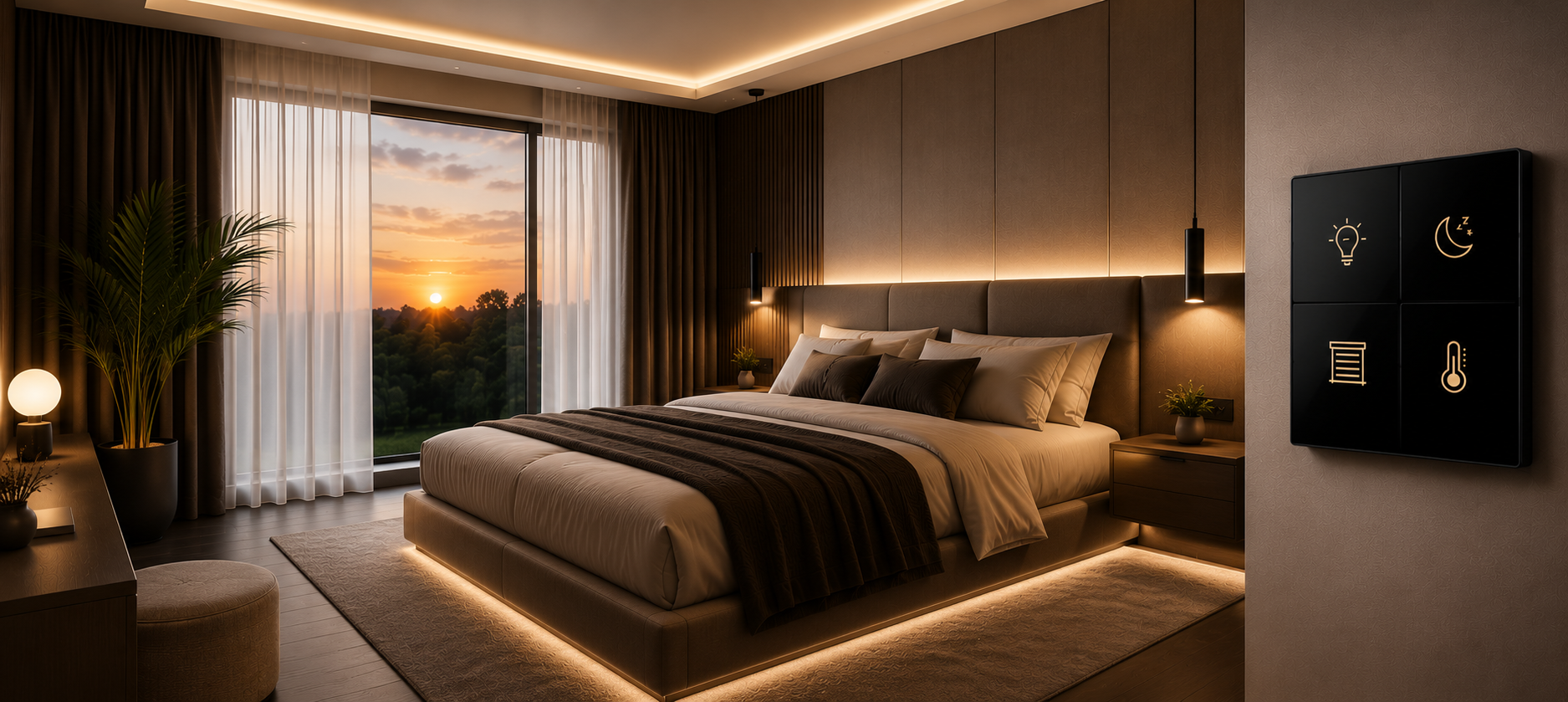
Smart bedroom automation integrates lighting control, air conditioning, motorised curtains, and scene programming into one coordinated system. So your bedroom wakes you gently, helps you sleep better, and adjusts automatically to your daily routine without requiring you to touch a single switch.
The bedroom is where you spend roughly one-third of your life. Yet in most Indian homes, it remains the least thoughtfully designed space from a technology perspective - a ceiling fan, a basic switch panel, manually drawn curtains, and an AC remote that lives somewhere under the pillow. Every morning starts with multiple physical actions. Every night ends the same way.
Smart bedroom automation changes this completely. In projects our team has completed across Delhi and Gurgaon, the bedroom automation is consistently the feature homeowners praise most - not because it is the most technically complex, but because it affects daily life most directly.
This guide covers everything: the technology, the scenes, the brands, the costs, and a real installation example from a Noida project.
What Can Be Automated in a Bedroom?
The 5 Systems That Work Together in a Smart Bedroom
A complete smart bedroom automation system covers five interconnected elements:
1. Lighting - DALI Dimming and Scene Control: Every light circuit in the bedroom - ceiling downlights, bedside wall sconces, wardrobe internal lights, cove lighting- is controlled through DALI-compatible LED drivers and lighting actuators. This allows each circuit to be individually dimmed from 0–100% and recalled as part of a scene.
2. Air Conditioning - KNX Thermostat Integration: The bedroom AC - whether a split unit, cassette, or fan coil unit - is controlled through a KNX room thermostat or HVAC controller module. Temperature setpoints, fan speed, and operating mode are all programmed into scenes and can be adjusted automatically based on time, occupancy, or external weather conditions.
3. Motorized Curtains and Blackout Blinds: Somfy or Nice tubular motors drive both the decorative curtains and the blackout roller blind on each window. The blackout blind is independent of the sheer curtain - both can be positioned anywhere from fully open to fully closed in any combination. Position recall is stored in scene programming.
4. Scene Keypads and Control Interface: A Basalte or ABB keypad beside the bed replaces the cluster of switches on the wall. Four buttons handle every scenario: Good Morning, Sleep, Movie/Read, and Away. The homeowner never needs to open an app or touch a phone to control the room.
5. Occupancy and Environmental Sensing: A KNX presence detector confirms when the room is occupied or unoccupied. A KNX sensor monitors ambient light levels. Together, these sensors enable fully automatic operation - the lighting switches off automatically when the room is empty, and curtains adjust based on sunlight intensity.
The Good Morning Scene - Waking Up the Right Way
How Bedroom Automation Changes Your Morning
In a conventional bedroom, waking up means: alarm goes off, reach for phone, turn off alarm, sit up in darkness, find the light switch, turn on AC or fan, walk to the window, pull the curtains. Fourteen minutes after the alarm, you are finally fully awake and in the right environment.
In a smart bedroom, the Good Morning scene begins two minutes before your target wake time - programmed once during our commissioning session, running every morning automatically.
Here is the exact sequence from a project we completed in a 4BHK villa in Noida Sector 44:
06:28 AM — Two minutes before wake time: The blackout blind begins rising slowly - 1% per second - allowing natural light to gradually enter the room. This gentle light increase begins the natural wake process before any sound occurs.
06:30 AM — Wake time: The bedside sconces rise to 30% warm white (2,700K) - enough light to open your eyes without the shock of full brightness. The ceiling downlights stay off. The AC shifts from sleep mode (26°C, low fan speed) to morning mode (24°C, medium fan speed). The decorative curtains draw fully open.
06:35 AM — Five minutes later: If the KNX presence detector confirms the homeowner is still in the room, the downlights rise to 60% cool white (4,000K) - bright enough for getting dressed. The bedside sconces step down as the main light rises.
06:45 AM — Ready to leave the bedroom: The homeowner presses "Away" on the Basalte keypad. All lights switch off, AC steps to standby, curtains return to the daytime position (sheers closed, blackout open), and the door lock registers the bedroom as unoccupied.
Total morning switches touched manually: zero.
The Sleep Scene - Falling Asleep in the Right Environment
Why Lighting and Temperature Matter for Sleep Quality
Sleep science is clear on two points: light colour temperature and room temperature directly affect the speed and quality of sleep onset. Most Indian bedrooms fail on both counts - bright white overhead lights stay on until the moment you close your eyes, and the AC remote gets adjusted five times before anyone settles.
The Sleep scene in a KNX-programmed bedroom addresses both automatically.
At bedtime - pressing Sleep on the Basalte keypad:
The downlights fade to off over 90 seconds - not a sudden switch, but a gradual dimming that signals the brain to begin melatonin production. The bedside sconces drop to 8% warm amber (2,200K) - the lowest, warmest light level available, similar to a bedside lamp with a very warm bulb. This circadian-friendly low-level light does not suppress melatonin the way blue-white light does.
The AC shifts to sleep mode: temperature rises 1°C above the active setpoint (typically 25°C), fan speed drops to its quietest setting, and a night setback schedule is activated - the AC steps temperature up by 0.5°C every 90 minutes until morning, following the natural rise in body temperature during REM sleep cycles. This reduces energy consumption by 18–25% compared to running the AC at a fixed setpoint all night.
The blackout blind - if not already closed - drops fully. Complete darkness, confirmed.
After 20 minutes, the bedside sconces fade completely to off. The room is dark, quiet, and at the correct temperature. The homeowner touched one button.
Motorized Blackout Blinds - Why They Matter in Indian Bedrooms
The Problem with Manual Curtains in India
In Indian cities, early morning light is a genuine problem. Delhi's summer sunrise is before 5:30 AM. Streetlights in residential areas like Gurgaon DLF sectors run all night. If your curtains do not block light completely - and most decorative curtains do not - sleep quality suffers every morning.
Motorized blackout blinds solve this permanently.
A blackout roller blind with side channels (fabric guide tracks on each side of the window) delivers near-complete light blockage - typically 99.5%+ light reduction. Paired with a Somfy RTS or io-homecontrol tubular motor, the blind drops fully at bedtime as part of the Sleep scene and rises gradually as part of the Good Morning scene.
The combination of a blackout blind (for darkness and temperature insulation) and a decorative sheer curtain (for daytime privacy) gives complete control over the bedroom environment at any hour.
| Curtain Configuration | Light Blockage | Privacy | Automation |
|---|---|---|---|
| Decorative fabric only | 40–60% | Partial | Optional |
| Blackout fabric without side channels | 75–85% | Good | Optional |
| Blackout roller with side channels | 99%+ | Complete | Yes - motorized |
| Sheer + blackout combination (motorized) | 99%+ (full), 0% (sheer only) | Full range | Yes - independent motors |
In every bedroom project we complete in Noida and Delhi NCR, we install both layers - sheer for daytime privacy and ambiance, blackout for sleep. The two motors are programmed independently, allowing any combination.
DALI Dimming - Why Not All Dimmers Are the Same
What DALI Delivers That Standard Dimmers Cannot
Standard phase-cut dimmers - the rotary or push dimmers found in most Indian homes - work by cutting a portion of the AC waveform to reduce power to a bulb. This causes visible flicker at low levels, a buzzing sound in some LED drivers, and an inability to dim below about 10% without the light simply switching off.
DALI (Digital Addressable Lighting Interface) is a completely different system. It communicates digitally with the LED driver, instructing it to output a precise lumen level - from 100% down to 0.1% with no flicker, no buzz, and smooth fade transitions at any speed.
In a bedroom, this matters enormously. The difference between a light that fades smoothly from 30% to 0% over 90 seconds (creating the Sleep scene described above) and one that steps down in visible increments and flickers at 5% is the difference between a genuine sleep experience and a frustrating gadget.
| Feature | Phase-Cut Dimmer | DALI Digital Dimmer |
|---|---|---|
| Dimming range | 10–100% | 0.1–100% |
| Flicker at low levels | Common | None |
| Fade transition | Stepped | Smooth - any duration |
| Minimum dim level | ~10% | 0.1% |
| Integration with KNX | Via basic module | Native DALI/KNX gateway |
| Scene recall | Limited | Unlimited scenes |
| Energy metering | No | Yes - per channel |
| Cost (India) | ₹800–2,500 | ₹3,500–8,000 per channel |
For a master bedroom with 4–6 lighting circuits, the additional cost of DALI over standard dimming is typically ₹15,000–30,000. For a system that affects your sleep quality every night of your life, the investment calculus is straightforward.
KNX Thermostat - Bedroom Climate Control That Thinks for You
How a KNX Thermostat Is Different from a Smart AC Remote
A KNX room thermostat - such as the ABB i-bus thermostat or Core room controller - is not a smart remote for your existing AC. It is a wall-mounted sensor and controller that communicates directly on the KNX bus and integrates with your AC through an HVAC gateway module.
What this enables:
Setpoint integration with scenes - the Sleep scene sets the AC to 25°C automatically. The Good Morning scene steps to 24°C. The Away scene switches the AC to standby. No manual adjustment at any point.
Occupancy-based operation - if the KNX presence detector detects that the room is empty, the AC steps to setback mode (28°C) automatically. When presence is detected again, it returns to the active setpoint. In Indian summers, this alone saves significant electricity in a house where rooms are empty for large parts of the day.
Night setback scheduling - as described in the Sleep scene section, the thermostat incrementally raises the temperature through the night following sleep science recommendations. Most homeowners report their AC running 2–3 hours less per night after this programming.
Remote override - if you arrive home at an unusual time, the app allows setpoint adjustment from anywhere. But the default behaviour handles every normal day without any input.
What Does Smart Bedroom Automation Cost in India?
Budget Guide by Level
| Level | What Is Included | Investment |
|---|---|---|
| Entry | WiFi smart switches + motorized blackout blind | ₹45,000–80,000 |
| Mid-range | KNX dimming + motorized curtain + AC integration | ₹1.2–2 lakhs |
| Premium | Full DALI + Somfy motors + KNX thermostat + Basalte keypad | ₹2.5–4 lakhs |
| Master Suite | Premium + cove + wardrobe + presence sensing + Gira keypad | ₹4–7 lakhs |
The entry level delivers meaningful improvement — a single motorized blackout blind and two WiFi smart switches for the bedside lamps transform the morning and sleep experience at a fraction of the full system cost.
For new construction or full renovation, specifying the full KNX bedroom system during the electrical phase adds approximately 30–40% to the automation cost versus retrofitting, making it significantly more cost-effective to plan from day one.
People Also Asked
What is smart bedroom automation in India?
Smart bedroom automation integrates lighting, air conditioning, motorized curtains, and scene control into one system. A single keypad button activates the Sleep scene - lights dim to warm amber, AC steps to sleep mode, and blackout blinds close - or the Good Morning scene that wakes you gradually with rising light and temperature adjustment.
Do motorised blackout blinds really help with sleep in India?
Yes. Complete darkness - 99%+ light blockage with side-channel blackout roller blinds - significantly improves sleep quality by preventing early morning light from disrupting sleep cycles. In Indian cities with early summer sunrises and bright streetlights, motorized blackout blinds are one of the most impactful bedroom upgrades available.
Can I add bedroom automation to my existing home in Noida or Delhi?
Yes. WiFi-based smart switches retrofit into existing switch boxes without new wiring. Motorized blinds can be installed on any existing window with a power outlet nearby. For full KNX integration, our team assesses the ceiling accessibility and recommends the right approach for your specific bedroom configuration.
What is the minimum budget for smart bedroom automation in India?
A basic but meaningful bedroom automation setup - one motorized blackout blind, two smart dimmable bedside lamps, and a smart AC controller - can be completed for ₹45,000–70,000. A full KNX master bedroom with DALI dimming, Somfy motors, and a Basalte keypad typically starts at ₹2.5 lakhs.
Does bedroom automation work without internet in India?
KNX-based bedroom automation operates on a dedicated bus cable, completely independent of your internet connection. The Good Morning and Sleep scenes run on programmed schedules stored in the KNX devices themselves - not in any cloud server. If your router is offline, your bedroom continues to function exactly as programmed.