

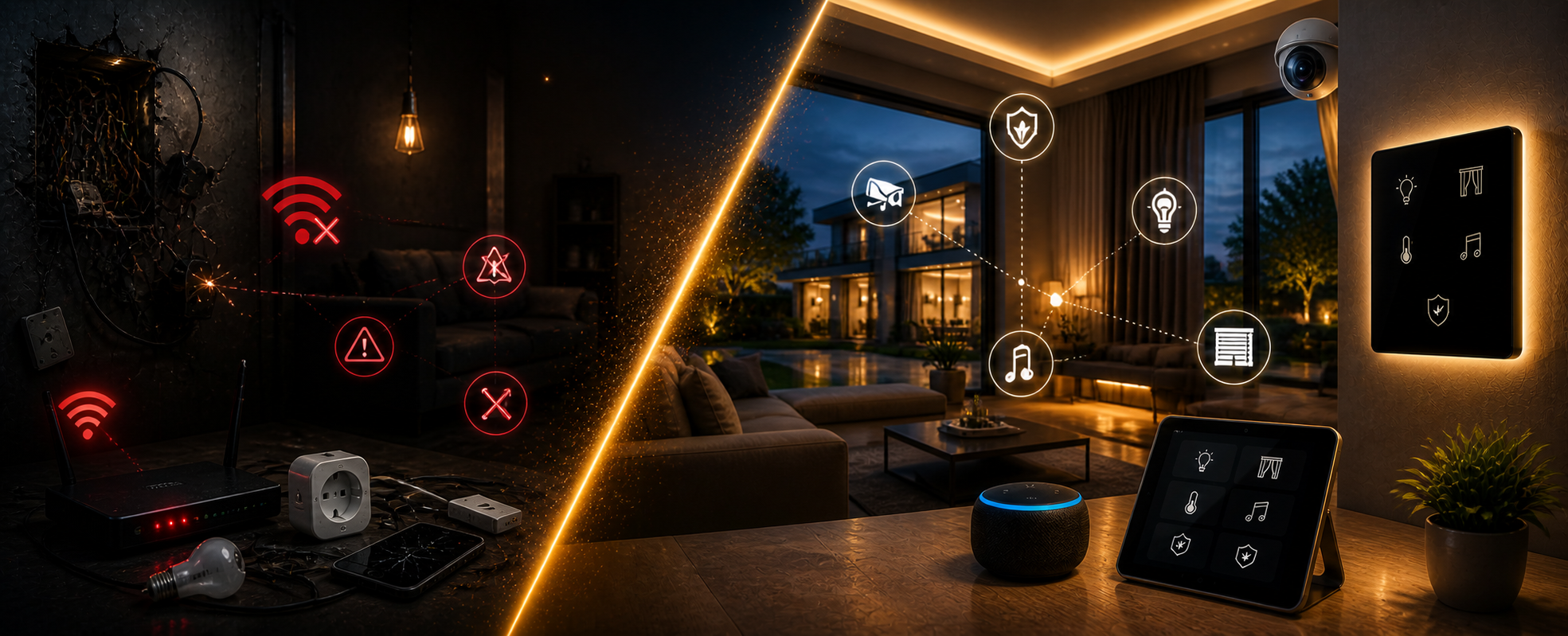
What Are the Biggest Home Automation Myths in India?
Home automation myths are outdated beliefs, like "it only works for billionaires" or "one WiFi outage kills everything", that stop Indian homeowners from adopting technology that saves energy, improves security, and adds long-term property value. The smart home market in India is projected to cross ₹12,000 crore by 2027, yet most buyers hesitate because of misinformation that circulated a decade ago. This guide settles the record.
We have installed KNX, ABB, Core, Basalte, Ajax, and integrated AV systems across hundreds of homes in Noida, Gurgaon, Delhi, and Jaipur. The objections we hear most often are not based on current technology; they are based on fear, outdated demos, or a neighbour's bad experience with a cheap WiFi gadget. Let us address every one of them.
Myth 1: "Home Automation Is Only for the Ultra-Rich"
This is the most persistent myth — and the most damaging one, because it stops practical buyers from even exploring their options.
The truth: Home automation in 2026 exists across three distinct budget tiers. A basic smart lighting and security setup for a 3BHK apartment in Noida starts at ₹1–5 lakhs. A mid-range system with KNX-based lighting control, motorised curtains, and a video door phone typically falls between ₹5–10 lakhs. A full luxury installation with Basalte keypads, multi-room audio, HVAC integration, and a centralised KNX bus system in a 5,000 sq ft villa ranges from ₹10–50+ lakhs.
Myth 2: "If the Internet Goes Down, the Whole House Stops Working"
This is the number one technical objection we hear during consultations — and it reveals a genuine misunderstanding between consumer-grade WiFi gadgets and professional automation systems.
The truth: Professional home automation systems built on the KNX protocol operate over a dedicated two-wire TP (Twisted Pair) bus cable that is completely independent of your home's WiFi or broadband connection. KNX is an ISO/IEC 14543-3 certified international standard. If your internet drops at 2 AM, your lights, climate control, and alarm system continue to function without interruption.
Even for WiFi-based systems, most modern smart switches store scene configurations locally on the device firmware. A router restart does not reset your scheduled lighting or security scenes.
The confusion arises from cheap, cloud-dependent smart plugs that genuinely do fail without internet. These are not home automation systems — they are standalone gadgets. There is a significant difference between a ₹800 smart plug from an e-commerce site and a certified KNX installation.
Myth 3: "Home Automation Is Too Complicated to Use"
The assumption here is that you need a degree in electrical engineering to operate your own home. This was arguably true in 2010, when touchscreen controllers required 20-minute tutorials.
The truth: Modern home automation interfaces are deliberately simpler than a TV remote. A well-programmed Basalte keypad has four buttons. One press sets the living room to "Dinner Mode" — lights at 60%, curtains at 40%, music on. Another press activates "Leave Home" — everything off, alarm armed, AC set to standby.
Our team programs every installation to match the homeowner's daily routine. Scene-based control means the homeowner interacts with outcomes, not systems. The underlying complexity of group addressing, datapoint types, and ETS6 programming is entirely invisible to the end user. Voice control via Amazon Alexa or Google Assistant adds another layer of simplicity — "Alexa, good night", triggering a full home shutdown is not complicated. It is the opposite.
Myth 4: "It Will Look Ugly and Ruin My Interior Design"
This myth likely comes from early installations that used bulky touchscreen panels, visible cable conduits, and generic plastic controllers mounted on feature walls.
The truth: The best home automation hardware today is designed by industrial designers, not engineers. We install extensively in luxury homes across Delhi NCR, producing keypads thinner than a standard modular switch plate, available in glass, aluminium, and leather finishes. Their Sentido and Fibonacci series are referenced in architecture publications.
In several of our South Delhi farmhouse projects, the automation keypads were specified directly by the interior designer, not retrofitted after the fact. When done correctly, automation hardware enhances an interior.
Myth 5: "It Needs Constant Maintenance and Will Break Down Often"
This fear is understandable for anyone who has experienced a cheap smart home gadget failing within a year, app shutdowns, bricked firmware updates, and cloud servers going offline.
The truth: Professional systems built on open standards like KNX are not dependent on any manufacturer's cloud server or app. KNX has been an international standard since 1990, for over 35 years. An ABB or Schneider KNX actuator installed in 2005 can be reprogrammed and expanded today using the same ETS (Engineering Tool Software) used for new installations.
Myth 6: "Home Automation Only Works in New Constructions - Not Ready Homes"
This myth stops apartment owners from even having the conversation. The assumption is that installation requires tearing down walls and rewiring everything from scratch.
The truth: Retrofit is entirely possible; the approach simply depends on the system type.
Wireless automation is a direct retrofit. Smart switches replace existing modular switches with no new wiring, provided a neutral wire is present, which most post-2010 Indian apartments have. A complete WiFi smart switch retrofit across a 3BHK takes two days with zero civil work.
Wired automation requires running a KNX TP bus cable — typically a 0.8mm LIYY data cable. In apartments with accessible false ceilings, this is a half-day activity. For fully-finished homes, wireless KNX RF modules communicate over the 868 MHz frequency band and eliminate the need for bus cable.
We have completed full KNX installations in occupied, furnished apartments in Noida Sector 50 and Gurgaon DLF Phase 4 — with residents continuing to live in the property throughout the installation process.
Myth 7: "Smart Home Systems Become Obsolete in a Few Years"
The fear: investing ₹10 lakhs in a system that will need full replacement in five years — like an old smartphone.
The truth: This concern is valid for proprietary, closed-ecosystem products — not for open-standard systems. KNX's backward and forward compatibility is one of its defining features. A KNX project file created in ETS3 in 2004 can be opened and modified in ETS6 today. New KNX devices from any of the 500+ certified KNX manufacturers worldwide communicate with devices installed a decade ago on the same bus.
The Matter protocol — now supported by Apple, Google, Amazon, and Samsung — is designed for long-term interoperability. KNX has released KNX IoT compliance specifications that bridge existing KNX installations with Matter-compatible ecosystems, future-proofing investments already made.
Buying a KNX system in 2026 is not buying a product that will be obsolete in five years. It is adopting a standard that has been the backbone of smart buildings globally for three decades.
Why Do These Myths Persist in India?
Three reasons. First, the Indian market was flooded with cheap, unreliable WiFi gadgets between 2018 and 2022. Many homeowners had bad experiences and generalised them to "all smart home technology."
Second, most builders and electricians are not trained in automation systems. Their default advice — "it's complicated, don't bother" — reflects their own knowledge gap, not the technology's actual limitations.
Third, marketing in this space historically targeted ultra-premium buyers, leaving mid-market homeowners with the impression that it is not relevant to them.
Techvault has been correcting this narrative, one project at a time — from compact 2BHK smart lighting setups in Noida to full KNX whole-home automation in South Delhi farmhouses or villas. The technology has never been more accessible, more reliable, or better designed than it is right now.
Frequently Asked Questions
Is home automation worth it for a regular apartment in India?
Yes. Even a basic smart lighting and security setup in a 2–3BHK delivers measurable results — 20–30% reduction in lighting energy consumption through occupancy-based control, improved security via remote monitoring, and convenience through scene-based control. Entry-level setups start at ₹1.5 lakhs.
Can I add home automation to my existing home without breaking walls?
Yes, in most cases. WiFi smart switches retrofit directly into existing modular switch boxes. For KNX systems, wireless KNX RF modules eliminate the need for new bus cable in fully finished homes. Our team assesses each property individually before recommending an approach.
What happens to my smart home system if the company shuts down?
For KNX-based systems, nothing changes. KNX is an open international standard — no single manufacturer controls it. If any specific brand discontinues a product, compatible replacements from 500+ other KNX manufacturers will work on the same installation.
How long does a home automation installation take?
A WiFi smart switch retrofit across a 3BHK takes 1–2 days. A full KNX installation in an under-construction home — planned alongside the electrical phase — typically takes 2–3 weeks for a 4,000 sq ft property. Retrofit KNX installations in ready homes take 3–5 days, depending on the scope.
Does TechVault provide support after installation?
Yes. We provide commissioning documentation, ETS project file backup, and ongoing support for all KNX installations. Our service team covers Delhi, Noida, Gurgaon, and Jaipur. Contact us