

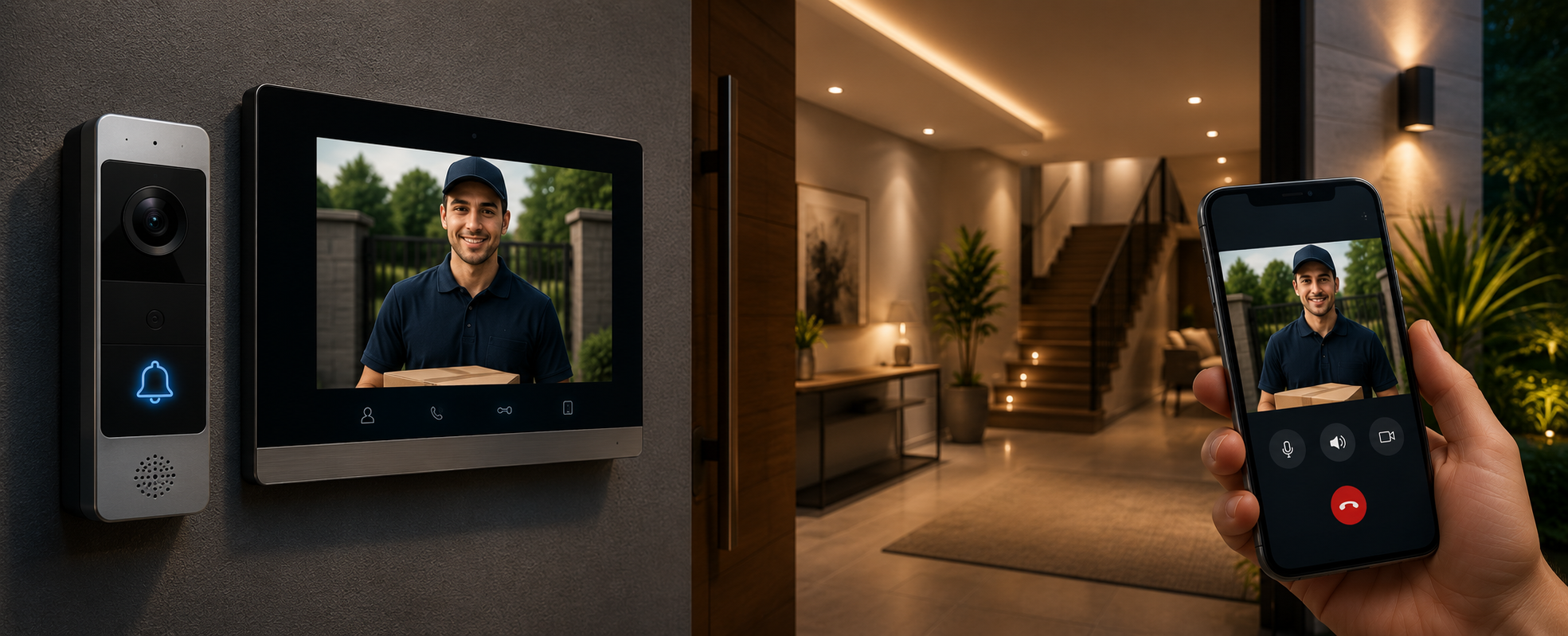
A video door phone is a security device that combines a doorbell, camera, microphone, and speaker to let you see and speak with anyone at your door — from inside your home or from anywhere via your smartphone. It is one of the most practical and increasingly affordable additions to any Indian home in 2026.
Unlike a traditional doorbell, a video door phone shows you who is at your door before you open it. This makes it particularly valuable for Indian homes, apartments, and gated communities, where knowing your visitor's identity before opening the gate or door is a daily security requirement.
At Techvault, we have installed hundreds of video door phone systems across Noida, Delhi, Gurgaon, Jaipur, and 50+ cities in India — integrated with KNX home automation, Ajax security systems, and smart digital locks. This guide covers everything you need to know before buying one.
What is a Video Door Phone?
A video door phone (also called a video door intercom or VDP) is a two-way audio-visual communication system installed at your entrance door or gate. It consists of an outdoor unit with a camera and doorbell button, and an indoor unit (monitor or app) that displays live video and allows two-way conversation.
When a visitor presses the doorbell button, the indoor monitor rings and displays a live video feed. The resident can see the visitor, speak with them, and, with smart security systems, remotely unlock the door or gate without physically going to the entrance.
In India, video door phones are used across:
- Residential apartments and independent homes
- Gated communities and housing societies
- Commercial offices and corporate buildings
- Hotels, hospitals, and educational institutions
- Villa projects and luxury residences
How Does a Video Door Phone Work?
A video door phone system works through the following process:
- The visitor arrives and presses the call button on the outdoor unit.
- The outdoor unit's camera captures a live video feed and transmits it to the indoor monitor.
- The indoor monitor rings and displays the live video — the resident sees the visitor.
- The resident speaks with the visitor via two-way audio (full-duplex).
- If satisfied, the resident presses the door unlock button on the monitor to grant access.
- In IP-based systems, all of this can also happen through a smartphone app from anywhere in the world.
In KNX-integrated systems like those Techvault installs, the video door phone is connected to the entire home automation system — meaning a visitor can trigger lighting changes, unlock a smart digital lock, and send an alert to multiple household members simultaneously, all from a single button press.
Types of Video Door Phones in India
A. Analog (2-Wire / 4-Wire) Video Door Phone
The traditional and most widely installed type in Indian homes. Uses dedicated coaxial or twisted-pair cable to connect the outdoor unit to the indoor monitor.
- Simple to install and configure
- Reliable — no internet dependency
- Lower cost than IP systems
- Limited to on-site viewing — no remote access
- Resolution typically 420-700 TVL
B. IP (Network-Based) Video Door Phone
Modern, internet-connected video door phones that transmit video over your home network (LAN/WiFi). Allows remote viewing and unlocking via smartphone from anywhere in the world.
- HD video quality — 720p to 4K available
- Remote access via smartphone app from any location
- Integration with smart home systems (KNX, Alexa, Google Home)
- Video recording capability to NVR or cloud
- Higher cost — but significantly more feature-rich
C. Wireless Video Door Phone
Connects outdoor and indoor units via WiFi — no cable required between units. Easy to install in existing homes where running new cable is difficult.
- No cable drilling required
- Easy retrofit for existing apartments
- Dependent on home WiFi strength
- Suitable for single-family homes and small apartments
Analog vs IP Video Door Phone - Key Differences
The most important difference is remote access. Analog systems work only on-site; you must be home to see and speak with a visitor. IP systems let you answer your door from your office, another city, or even another country via your smartphone app.
On video quality, analog systems deliver standard definition (420-700 TVL), while IP systems offer HD from 720p up to 4K. For nighttime identification of visitors, the higher resolution of IP systems is a clear advantage.
In terms of reliability, analog wins. There is no internet dependency — the system works on a dedicated cable regardless of your router or connection. IP systems are highly reliable on local networks but depend on the internet for remote access.
On price, analog systems for Indian homes range from Rs. 3,000 to Rs. 15,000. IP systems start at Rs. 12,000 and go up to Rs. 80,000 or more for premium installations with full KNX integration.
Techvault recommendation: For new construction or smart home projects, always choose an IP system. For budget retrofits in existing apartments, a quality analog system remains a practical and reliable choice.
Video Door Phone vs Video Doorbell - What's the Difference?
A video door phone includes a dedicated indoor monitor — typically a 7 to 10 inch screen mounted on your wall. A video doorbell like Ring or Nest uses only your smartphone as the display. There is no indoor screen.
This distinction matters in practice. A dedicated monitor always works — it rings and shows video regardless of whether your phone is charged, connected, or nearby. A video doorbell fails if your phone battery is dead, your internet is down, or you do not notice the app notification.
Video door phones also typically include a door release button on the monitor itself — you can unlock the door without picking up your phone. Most video doorbells require a compatible smart lock and app interaction for the same function.
For permanent residential installations in India, Techvault recommends a dedicated video door phone system. For renters or temporary setups where wall mounting is not possible, a WiFi video doorbell is a practical alternative.
Key Features to Look For
Video Quality
Minimum 720p (1MP) for standard use. For larger entrance areas or night-time use, opt for 1080p (2MP) or higher. A wide-angle lens — 100 to 120 degrees — captures the full entrance without blind spots.
Night Vision
Essential for Indian homes. IR night vision is standard in most systems. Colour night vision, available in premium models, provides better detail for identifying visitors after dark.
Two-Way Audio - Full Duplex
Both parties must be able to speak and listen simultaneously — this is called full duplex. Half-duplex (walkie-talkie style) is frustrating to use and unsuitable for professional or luxury installations.
Remote Door Unlock
The ability to unlock your door or gate from the indoor monitor or from your smartphone is a fundamental feature. Ensure compatibility with your door lock mechanism — electric strike, magnetic lock, or smart digital lock.
Multiple Indoor Units
For larger homes or multi-floor residences, the system should support 2 to 4 indoor monitors connected to a single outdoor unit, all ringing simultaneously when a visitor calls.
Video Recording
Premium IP systems record every visitor interaction to an NVR or cloud storage, creating a time-stamped log of all entrance activity — useful for security review and insurance claims.
Smart Home Integration
If you have or plan a smart home system, choose a video door phone that integrates with KNX, Alexa, Google Home, or Apple HomeKit. This allows visitor calls to trigger lighting, notifications across all devices, and automated access routines.
Video Door Phone Price in India 2026
For a basic analog system — standard definition video, wired connection, single indoor monitor — expect to pay Rs. 3,000 to Rs. 8,000 for supply and installation. This is suitable for standard apartments and budget security needs.
A mid-range analog system with better resolution, door release, and two indoor monitors costs Rs. 8,000 to Rs. 15,000. This is the most common specification for independent homes in Indian cities
Entry-level IP systems with 720p video and smartphone app access start at Rs. 12,000 to Rs. 20,000. Mid-range IP systems with 1080p recording and smart home integration cost Rs. 20,000 to Rs. 40,000 — suitable for 3 and 4-BHK homes and small offices.
Premium IP systems with 4K video, full KNX integration, and multiple monitors range from Rs. 40,000 to Rs. 80,000. Commercial-grade multi-tenant systems for offices, hotels, and housing societies start at Rs. 80,000 and can exceed Rs. 3,00,000 depending on scale.
These are indicative ranges for supply and installation. Actual costs depend on building type, cable routing, number of monitors, door lock compatibility, and smart home integration scope. Techvault provides a detailed, no-obligation quote after a free site assessment.
How to Choose the Right Video Door Phone
Step 1 — Define Your Use Case
- Basic security only — an analog system is sufficient
- Remote access needed — IP system required
- Smart home integration planned — premium IP with KNX support
- Multi-unit building or society — commercial grade system
Step 2 — Assess Your Infrastructure
- New construction — run dedicated cable during construction for maximum flexibility
- Existing apartment — WiFi or existing telephone wiring can be used
- Large villa or independent house — structured cabling to each entrance
Step 3 — Choose Indoor Unit Type
- Dedicated 7 to 10-inch monitor — best reliability, always on, easiest to use
- Smartphone only — lower cost, suitable for renters or temporary setups
- Both monitor and smartphone — recommended for all permanent installations
Step 4 — Plan for the Future
If you plan to implement full smart home automation in the next 3 to 5 years, invest in an IP video door phone with KNX or open API compatibility now. Retrofitting the video door phone later, when the smart home system is installed, costs significantly more than specifying it correctly at the start.
Integration with Smart Home and KNX
One of the most powerful aspects of a professionally installed video door phone is its integration with the broader smart home system. Techvault integrates video door phones with:
- KNX home automation — visitor call triggers lighting scenes across the home
- Digital door locks — remote unlock from monitor, smartphone, or KNX keypad
- Ajax security system — visitor activity logged alongside alarm events
- Multi-room audio — visitor alert played through in-ceiling speakers
- Smart gate motors — remote gate opening from the indoor monitor or smartphone
- CCTV NVR — visitor video recorded alongside the full CCTV system
A real example from Techvault's installations: In a villa in Sector 50, Noida, when a visitor presses the doorbell, the living room lights brighten automatically, the indoor monitor rings, the same call rings on the client's phone via the app, and the client can see the visitor and remotely unlock the front door — whether they are at home or at their office in Connaught Place.
Video Door Phone Installation - What to Expect
What the Installation Involves
Site survey — Techvault assesses entrance, gate, and cable routing requirements.
- Outdoor unit mounting — flush or surface mounted at the entrance.
- Indoor monitor installation — wall-mounted at 140 to 150 cm height.
- Cable routing — dedicated Cat6 or coaxial cable run from outdoor to indoor.
- Door release wiring — connection to the lock or gate mechanism.
- System commissioning — programming, testing, app setup, and user training.
How Long Does Installation Take?
A standard home installation with one outdoor unit and one indoor monitor takes 4 to 6 hours. Adding multiple indoor monitors extends this to a full day. IP systems with smart home integration typically require 1 to 2 days. Commercial multi-tenant installations take 3 to 7 days, depending on the number of units and integration complexity.
Techvault provides complete installation across Noida, Delhi NCR, Gurgaon, Jaipur, and 50+ cities in India. All installations include a 1-year warranty on workmanship and the full manufacturer's warranty on all equipment. Contact us at +91-94148-16207 for a free site assessment.
FAQs
What is the difference between a video door phone and a video doorbell?
A video door phone includes a dedicated indoor monitor with a large screen, while a video doorbell uses your smartphone as the display. Video door phones are more reliable as they work independently of internet connectivity and phone battery. For permanent residential installations in India, a dedicated video door phone system is recommended over a WiFi doorbell.
Can a video door phone work without internet in India?
Yes. Analog and wired video door phone systems work entirely without internet — they operate on a dedicated cable between the outdoor and indoor units. IP systems require the internet only for remote smartphone access. Core functionality, including seeing visitors, speaking with them, and unlocking the door, works on your local network even without internet.
What is the best video door phone for Indian apartments?
For standard 2BHK and 3BHK apartments, a mid-range IP system from Hikvision, Fermax, or Akuvox in the Rs. 15,000 to Rs. 25,000 range offers excellent value — with HD video, smartphone access, and door release. For luxury apartments with smart home automation, Techvault recommends 2N or Akuvox systems integrated with KNX or Ajax.
How much does video door phone installation cost in India?
Installation costs Rs. 2,000 to Rs. 5,000 for standard wired systems, in addition to equipment cost. IP systems with smart home integration cost Rs. 5,000 to Rs. 15,000 for installation due to additional programming and configuration. Techvault provides a combined supply-and-install quotation after a free site assessment.
Can I integrate a video door phone with my existing CCTV system?
Yes. IP-based video door phones can be integrated with an NVR to record all visitor interactions alongside regular CCTV footage. Hikvision and CP Plus have particularly strong NVR integration. Techvault designs complete security systems combining video door phones, CCTV, Ajax alarm systems, and digital locks into one unified platform.
Does a video door phone work with KNX home automation?
Yes. Premium IP video door phones from 2N, Fermax, and Akuvox have native KNX integration or open API support. Techvault integrates video door phones into KNX systems across India — enabling visitor calls to trigger lighting scenes, unlock KNX-integrated locks, and send notifications to all keypads and smartphones simultaneously.