

Summery
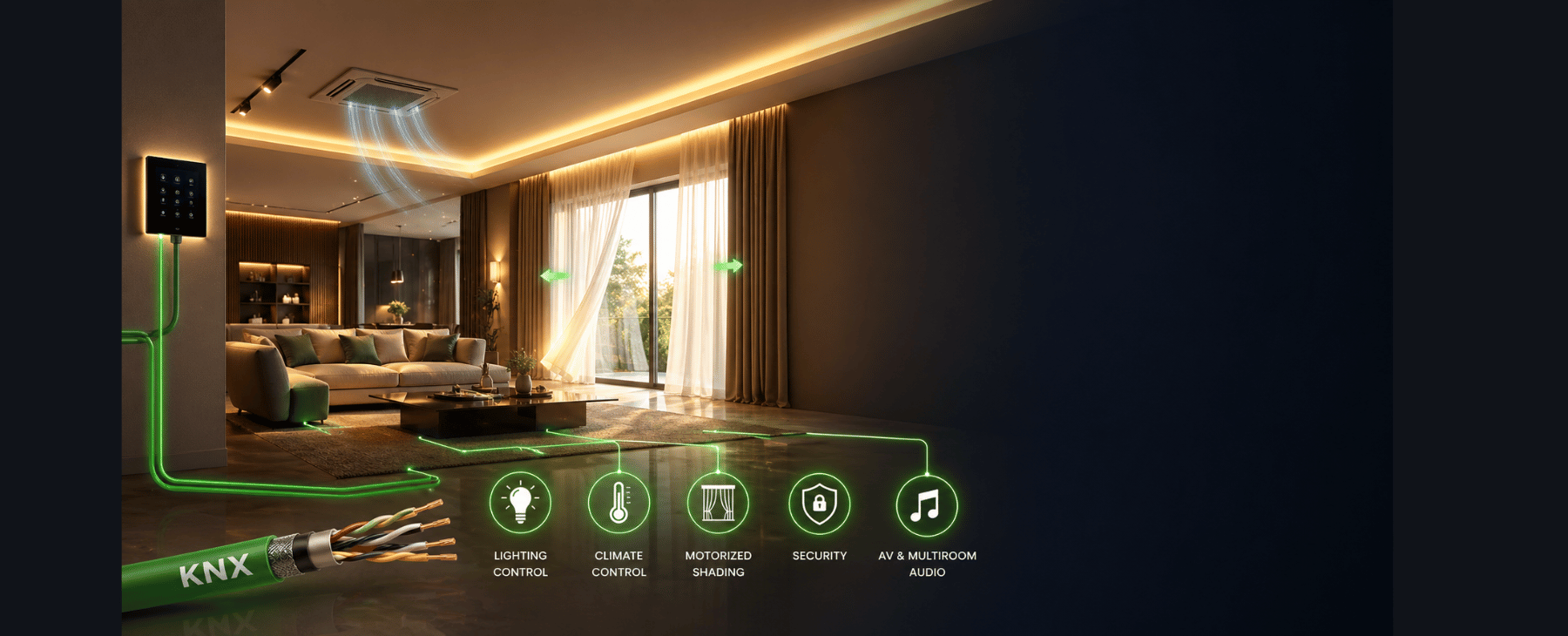
KNX cable, also known as KNX bus cable or TP1 (Twisted Pair 1) cable, is a certified, two-wire communication cable that forms the physical backbone of every KNX smart home system. It simultaneously carries 24V DC bus power and data signals to every connected device, sensors, switches, actuators, and controllers, enabling centralised, reliable control of lighting, climate, security, and AV systems without Wi-Fi or cloud dependency.
Imagine walking into your home and the lights gently brighten to your preferred level, the curtains open to match the afternoon sun, the AC silently adjusts to your ideal temperature, and you have not touched a single switch. This is not a futuristic concept. It is the everyday reality inside a KNX-automated home, and the technology that makes it possible starts with one humble but extraordinary component: the KNX cable.
What is KNX Cable?
KNX cable is a purpose-built, KNX Association-certified twisted-pair communication cable, formally known as TP1 (Twisted Pair 1) cable, that serves as the data and power bus for KNX building automation systems. It is the physical medium through which every smart device in a KNX installation communicates: motion sensors, lights and switches, dimmer actuators, thermostats, motorised curtain controllers, security detectors, and audio-video interfaces all connect to, and communicate through the same KNX bus cable.
What Makes KNX Cable Unique?
A single two-wire bus carries both 24V DC SELV (Safety Extra-Low Voltage) operating power and TP1 data telegrams simultaneously, eliminating the need for separate power wiring to each sensor and switch. This is not an ordinary electrical cable and cannot be substituted with CAT6, telephone wire, or any other generic twisted pair. KNX cable is engineered to a precise 120-ohm characteristic impedance, certified to EN 50090 and ISO/IEC 14543, and manufactured with LSHF (Low Smoke Halogen-Free) sheath material for fire safety in occupied buildings.
The KNX standard itself has been in continuous operation since 1999, supported by over 500 manufacturers worldwide, including ABB, Basalte, Core, and Panasonic. Any certified KNX device from any of these manufacturers connects to the same KNX bus cable and communicates using the same TP1 protocol, true, manufacturer-independent interoperability that no proprietary smart home platform can match.
How Does KNX Cable Work in a Smart Home?
The KNX cable runs from the main distribution board, where the KNX power supply is installed, throughout the home in a free-topology bus configuration. This means the cable can be laid in linear runs along corridors, branched into rooms in a tree structure, or organised in a star from a central distribution point, depending on the building's layout. Every device on the bus connects in parallel to the same two-wire cable.
When you press a KNX wall switch, or a presence sensor detects motion, or a schedule trigger in the ETS programming, that device sends a data telegram across the KNX bus cable. The telegram travels through the TP1 wire at 9,600 bps using CSMA/CA (Carrier Sense Multiple Access with Collision Avoidance) and reaches the relevant actuator, which executes the command instantly. There is no hub, no router, no internet connection, and no cloud server involved in this process. The entire transaction happens locally, on the cable, in under 50 milliseconds.
This is the fundamental reason KNX feels different from Wi-Fi smart home systems. When you dim a light in a KNX home, the response is instant and consistent, every time, regardless of internet status, router load, or server availability. The intelligence is distributed across the devices themselves, connected through the bus cable. If one device develops a fault, every other device on the bus continues to operate perfectly because there is no single point of failure.
What Happens Inside the KNX Bus?
Every KNX device has its own microprocessor and stores its programming locally in non-volatile memory. The lighting actuator knows which group addresses it belongs to and what to do when it receives a telegram from a specific switch. The thermostat knows the temperature setpoints for each time period. The motion sensor knows which scenes to trigger when it detects presence. None of this requires a central controller running the show.
The KNX bus cable carries the 29V DC nominal bus voltage from the KNX power supply and distributes it to every device. Each device draws approximately 10-29mA from the bus for its microprocessor and communication circuitry, separate from any load power (230V lighting, AC units), which is wired conventionally. This separation between the 24V SELV bus and 230V mains circuits is maintained throughout the installation, making the bus safe to work on without isolating the mains supply.
What Does KNX Cable Actually Control?
The scope of what KNX cable enables in a smart home is broader than most homeowners initially expect. Because everything connects to the same bus, every system can interact with every other system, creating an integrated home environment that genuinely adapts to how you live.
Lighting Automation
KNX lighting control goes well beyond simple on/off switching. Full DALI (Digital Addressable Lighting Interface) integration allows individual lamp-level dimming, colour temperature tuning, and circadian lighting programmes that gradually shift from warm morning light to bright productive white during the day and back to warm amber in the evening, automatically, without any manual adjustment. Presence detectors on the bus switch lights off in empty rooms and back on when someone enters, eliminating the wasted energy of lights burning in unoccupied spaces. A single 'Good Night' scene from the bedroom keypad simultaneously dims all lights to zero, locks the front door, arms the perimeter sensors, and lowers the bedroom curtains.
Climate Control
KNX integrates with virtually every climate system available in India, split ACs, VRV/VRF central systems, fan coil units, underfloor heating, and HVAC fresh air handling units. Room temperature controllers on the KNX bus monitor and regulate each zone independently. The system knows which rooms are occupied through presence detection and adjusts climate accordingly, actively cooling occupied rooms while allowing unoccupied rooms to drift, reducing energy consumption measurably. In large villas and commercial spaces in Delhi NCR, where cooling costs represent a significant proportion of annual electricity bills, KNX climate integration typically delivers 20-30% energy savings compared to manually operated systems.
Motorised Shading and Curtains
Motorised blinds, curtains, roller shutters, and external pergola louvres all connect to KNX actuators on the bus cable. Solar sensors measure sunlight intensity and automatically close external blinds when direct solar radiation creates heat gain, protecting interiors from overheating without blocking natural light entirely. Wind sensors retract external awnings when wind speed exceeds safe operating limits. All shading can be grouped into zones and controlled through scenes. The 'Movie' scene closes all living room curtains, and the 'Morning' scene raises the bedroom blinds at a scheduled time. Motorised shading automation is one of the features our clients in Noida and Delhi consistently report as having the greatest day-to-day quality-of-life impact.
Security and Access Control
Motion detectors, door and window contact sensors, glass break detectors, smoke sensors, video doorbells, digital door locks, and intercom systems all connect to the KNX bus. When the 'Away' scene is triggered, either manually or automatically when the last occupant leaves the geofenced area, the system locks all access-controlled doors, arms all sensors, activates perimeter camera recording, and sends a notification to the homeowner's phone. An intrusion trigger activates a configurable response: lights flash, a siren sounds, and an alert is pushed to the homeowner's device. All of this is programmed once in ETS and runs locally without cloud dependency.
Audio-Video and Home Theatre
Multi-room audio distribution, home theatre control, and distributed video systems integrate with the KNX bus through dedicated AV gateways. The 'Movie' scene in the living room dims the lights to 10%, draws the motorised projector screen, closes the curtains, activates the Dolby Atmos sound system, and sets the AC to cinema-comfortable 23 degrees, all simultaneously, triggered by a single keypad button or voice command through a KNX-compatible voice interface. The integration of AV with lighting and climate through KNX creates an experience that genuinely feels like the home is intelligent rather than simply automated.
KNX Cable Types: Which One Do You Need?
Not all KNX installations use the same cable variant. Understanding which type to specify depends on where the cable runs and what environmental conditions it faces.
Standard TP1 (2x2x0.8mm LSHF Green) is the correct cable for all internal bus wiring in walls, ceilings, and conduit inside a building. Two twisted pairs of 0.8mm solid copper conductors sit inside a Low Smoke Halogen-Free green sheath; the red-black pair carries the active bus signal and power, while the yellow-white pair is available as a spare or for door communication wiring. This is the cable Techvault uses as standard in every residential and commercial KNX project.
Shielded TP1 (STP) adds an aluminium-polyester foil screen with a tinned copper drain wire around the conductor pairs, providing EMI protection in buildings with significant electromagnetic noise, from LED drivers, Variable Frequency Drives, or large HVAC equipment. Duct Grade TP1 adds a UV-resistant black polyethene outer jacket for outdoor conduit runs and damp environments. Armoured TP1 (SWA) adds galvanised steel wire armour for direct burial in the ground or locations with physical damage risk.
KNX Cable vs Wi-Fi — The Honest Comparison
Wi-Fi smart home devices are affordable and easy to install, and for a single room or a few devices, they work fine. But for whole-home automation, 20+ lighting zones, climate control, security, and AV, their limitations show fast. The complaints we hear most from homeowners switching to Techvault: switches that respond slowly, devices dropping off the network, systems failing when the internet goes down, and five different apps that do not talk to each other. These are not user errors; they are architectural flaws of cloud-dependent systems.
KNX cable eliminates all of them. Communication travels directly on the TP1 bus, not through a router or cloud server. Response time is under 50 milliseconds, the system works without internet, and every device in the home is controlled through one unified interface. The KNX standard has run continuously since 1999 with full backward compatibility; a system installed today will accept devices made a decade from now.
The honest trade-off: KNX costs more upfront. It requires certified cable infrastructure during construction and professional ETS commissioning. But for a luxury home, that investment delivers 20-30 years of zero-fault reliability, something no Wi-Fi platform has ever matched.
For finished homes where new cable is not possible, KNX RF wireless devices offer the same standard with the same reliability, without a single metre of new wire.
Why We Recommend KNX for Luxury Homes
In our 10+ years of delivering smart home projects across India, we have worked with every major automation technology, proprietary Wi-Fi platforms, Zigbee mesh networks, Z-Wave systems, DALI standalone solutions, and KNX wired systems. For serious whole-home automation in luxury residences, there is no technology we recommend with greater confidence than KNX.
We have seen how KNX systems scale effortlessly as our clients’ needs evolve. Devices installed years ago continue to communicate seamlessly with new additions. A system installed in 2016 works perfectly with devices added in 2026. Over time, the home becomes smarter and more capable, without compromising on reliability.
FAQs
Q1. What is KNX cable?
KNX cable, also known as KNX bus cable or TP1 cable, is a certified twisted-pair communication cable that forms the backbone of KNX home automation systems. It carries both 24V DC bus power and data signals to every connected smart device on a single two-wire bus, enabling centralised control of lighting, climate, security, and AV systems without Wi-Fi or internet dependency.
Q2. How does KNX cable power a smart home?
KNX cable runs from the distribution board throughout the home, connecting every smart device, sensors, switches, actuators, and controllers- on the same two-wire TP1 bus. When a switch is pressed or an automation triggers, the device sends a data telegram across the bus cable to the relevant actuator, which responds instantly in under 50 milliseconds. All processing happens locally on the cable; no internet connection, router, or cloud server is required.
Q3. Is KNX cable the same as normal electrical wire?
No. KNX cable is a specialised, KNX Association-certified twisted-pair cable engineered to a precise 120-ohm characteristic impedance, certified to EN 50090, with LSHF fire-safe sheathing. It operates at 24V DC SELV, completely separate from 230V mains wiring, and cannot be substituted with regular electrical cable, CAT6, or any non-certified twisted pair.
Q4. How is KNX cable different from Wi-Fi smart home systems?
KNX cable provides local, wired communication with instant response times (under 50ms), no internet dependency, no cloud failure risk, and true interoperability between devices from 500+ manufacturers. Wi-Fi smart home systems are lower cost for small setups but suffer from network congestion, cloud latency, and the risk of a manufacturer discontinuing their platform. For whole-home luxury automation, KNX wired systems are significantly more reliable and future-proof.
Q5. What is the difference between CAT6 and KNX cable?
CAT6 is a data-only cable used for networking, while KNX cable (TP1) carries both data and 24V DC power on a single bus. KNX cable is designed with 120-ohm impedance and certified for automation systems, whereas CAT6 (100-ohm) cannot support KNX communication reliably.
Q6. What is KNX cable used for?
KNX cable is used in home and building automation systems to connect and control devices like lighting, HVAC, curtains, security systems, and audio-video equipment through a single unified network.
Q7. How does KNX work?
KNX works on a bus communication system, where all devices are connected through a single cable. When a command is triggered (like pressing a switch), a signal travels through the KNX cable, and the relevant devices respond instantly—without needing internet or a central controller.
Q8. What are KNX devices?
KNX devices are the components used in a KNX automation system that communicate with each other through the KNX cable. These include sensors such as motion, temperature, and light sensors that detect input; actuators like lighting controllers, dimmers, and curtain motors that perform actions; as well as keypads, switches, HVAC controllers, and security systems.
Q9. What are the disadvantages of KNX?
KNX systems come with a higher initial installation cost compared to basic smart home solutions and require professional planning along with ETS programming for proper setup. They are best suited for new construction or major renovation projects where wiring can be planned.
Q10. What gauge is KNX wire?
Standard KNX cable uses 0.8 mm solid copper conductors (typically 2x2x0.8 mm twisted pair), designed to carry both power and data efficiently across the KNX network.