

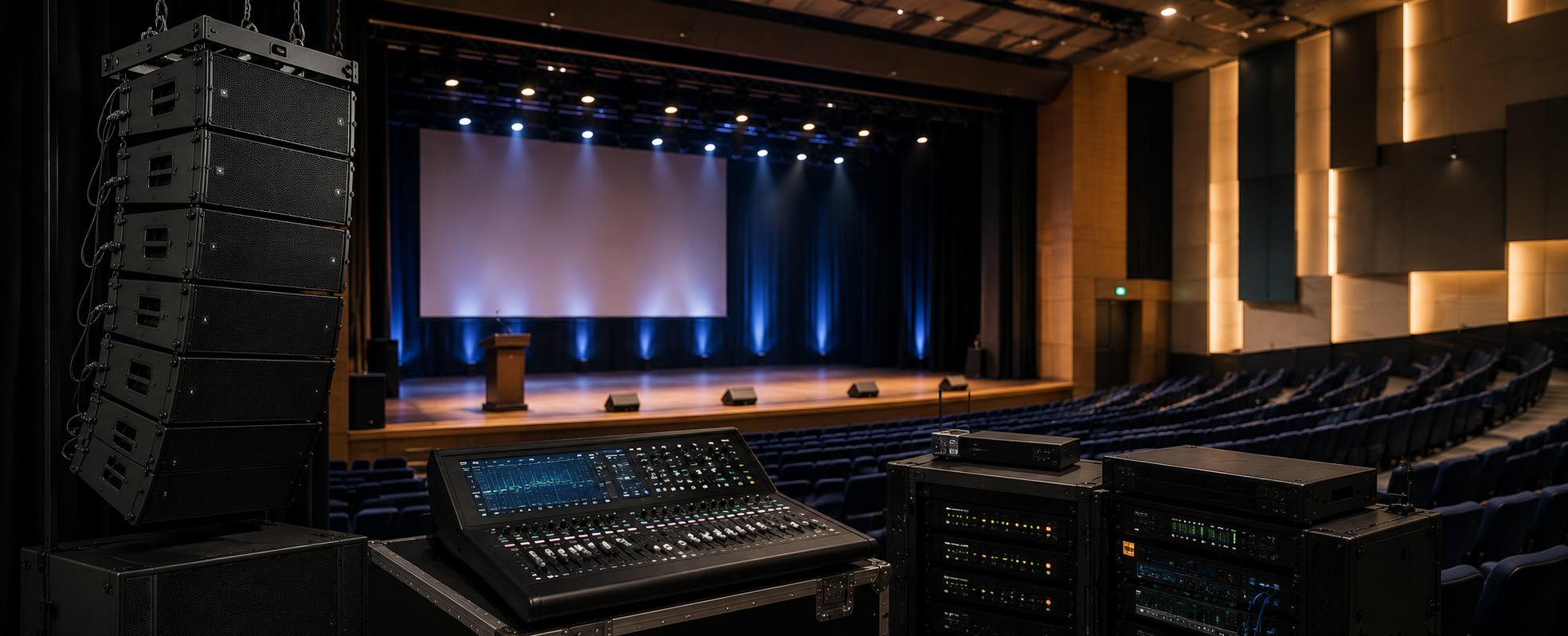
A line array speaker system is a professional audio setup consisting of multiple identical speaker enclosures arranged in a vertical column, designed to deliver even, consistent sound across large audiences from the front row to the last.
It is the standard audio solution for large auditoriums, schools, colleges, corporate events, and live performances in India, solving the biggest challenge in large-venue audio: delivering uniform sound pressure levels (SPL) across every seat, without the hotspots, dead zones, and echo that traditional speaker systems create.
At Techvault, we design and install professional line array systems for auditoriums, educational institutions, and corporate campuses across Noida, Delhi NCR, Gurgaon, Jaipur, and 50+ cities in India. This guide covers everything you need to know before specifying a line array system for your venue.
What is a Line Array Speaker System?
A line array speaker system consists of multiple speaker enclosures, typically 4 to 24 units, mounted in a vertical column and hung from a truss or ceiling structure. Each enclosure contains one or more drivers and is angled slightly relative to the unit above or below it. This curvature controls precisely where the sound is directed.
The term "line array" describes the physics of the system. When speaker units are arranged in a vertical line and driven with the same signal, they combine their sound energy in a way that produces a narrow, controlled vertical beam. This beam is aimed at the audience and avoids the ceiling, back wall, and floor, dramatically reducing echo and reverberation.
In India, line array systems are widely specified for:
- School and college auditoriums seating 300 to 2,000+ students
- Corporate auditoriums and large conference halls
- Houses of worship — temples, churches, mosques, gurudwaras
- Convention centres, banquet halls, and hotel ballrooms
- Outdoor amphitheatres and event spaces
- Performing arts centres and theatres
Techvault has installed line array systems across auditoriums in Noida, Delhi, Gurgaon, and Jaipur. Every installation begins with acoustic simulation software — so the system is designed for your room before a single speaker is hung.
How Does a Line Array Speaker System Work?
The individual enclosures in a line array are angled to create a specific vertical coverage pattern — called the splay angle. By adjusting the angle between adjacent enclosures, the system designer aims the sound beam from the front row to the back row of the audience, minimising energy directed at the ceiling and floor.
This precise control eliminates the primary source of echo in large Indian buildings — sound bouncing off hard concrete ceilings and tiled floors. This is why line arrays produce dramatically better speech intelligibility than ceiling-mounted or column speakers in large, reverberant spaces.
How Does Horizontal Dispersion Work?
Each line array enclosure typically has a wide horizontal dispersion of 90 to 120 degrees. This widespread ensures that seats on the far left and far right receive the same coverage as the centre seats — delivering uniform sound across the full width of the room.
What is the Acoustic Coupling Effect?
When multiple identical speaker enclosures are driven together in a line array, they acoustically couple — their sound energy combines coherently. A 12-box line array can deliver 10 to 12 dB more output than a single enclosure, equivalent to 10 to 16 times the acoustic power. This is why line arrays can cover large outdoor and indoor audiences at high volume levels with far greater clarity than conventional speaker stacks.
How Does DSP Work in a Line Array System?
A Digital Signal Processor (DSP) is the brain of every professional line array system. The DSP handles equalisation, delay alignment, gain management, and limiting for each enclosure in the array. For installations in India — where building dimensions and construction materials vary widely — DSP tuning after installation is essential to compensate for the specific acoustic character of each room.
Line Array vs Point Source Speakers - Key Differences
A point-source speaker is a single enclosure that radiates sound in all directions from a single point. Traditional speaker setups in Indian auditoriums — a large speaker on each side of the stage, or a cluster above the proscenium — are point source systems.
Why Does Line Array Outperform Point Source in Indian Auditoriums?
A point source speaker radiates sound in a widening cone. Rows close to the speaker receive loud, direct sound. Rows at the back receive less direct sound but more reverberant energy from ceiling and wall reflections — the result is uneven coverage and poor intelligibility.
A line array controls the vertical spread of sound to match the room's geometry. A properly designed system delivers the same SPL to the front row as to the back row — within plus or minus 3 dB across the entire seating area. In a large Indian auditorium with hard concrete surfaces, this difference in coverage uniformity is immediately and consistently audible.
Line arrays also perform significantly better in reverberant and outdoor environments — both common in India. Because they direct less energy into ceiling reflections and room boundaries, speech intelligibility is maintained even in acoustically challenging spaces like concrete-walled school auditoriums and hard-surfaced banquet halls.
Types of Line Array Systems in India
Active (Powered) Line Array
Each enclosure contains its own built-in amplifier and DSP. The system connects via digital audio networking — Dante or AES67 — rather than traditional speaker cables. Active systems are self-contained, simpler to deploy, and deliver consistent performance because the amplifier is precision-matched to the driver.
Passive Line Array
Each enclosure contains passive crossovers and drivers, powered by external multi-channel amplifiers via traditional speaker cable. Passive systems offer more flexibility in amplifier selection and are generally lower in initial cost — making them a practical choice for permanent installations in Indian schools, colleges, and auditoriums where budget management is important.
Compact and Column Line Array
For smaller venues — conference rooms, training halls, and worship spaces seating up to 200 people — compact line array and column speaker systems offer many of the directivity benefits of full line arrays in a smaller, more affordable format. Systems like the Bose Panaray, JBL CBT series, and d&b column speakers are widely used across India for corporate meeting rooms, small auditoriums, and house of worship applications.
Key Components of a Line Array System
- Line array enclosures — the main speaker cabinets, hung in a vertical column
- Flying hardware — rigging frames, shackles, chain hoists, and safety cables for suspended installation
- Subwoofer cabinets — for bass frequencies below 100 Hz; ground-stacked or flown below the main array
- Amplifier racks — multi-channel power amplifiers for passive systems
- DSP processor — digital signal processor for system tuning, EQ, delay, and protection limiting
- Network audio infrastructure — Ethernet switches and cabling for Dante-based active systems
- Rigging points — structural attachments in the ceiling or truss capable of supporting the array's weight
- Measurement microphone and software — EASERA, Smaart, or similar for commissioning and tuning
Techvault uses acoustic simulation software during the design phase of every line array project — modelling speaker coverage against your room geometry before installation begins. This predictive design process ensures the installed system performs exactly as designed.
Where is Line Array Used in India?
Why is Line Array Used in Auditoriums?
Any auditorium seating more than 300 people benefits significantly from a line array system. Speech intelligibility — the ability to understand spoken content clearly — improves dramatically compared to traditional point source clusters. For educational institutions in India, where student comprehension of lectures, debates, and presentations is the primary function of the auditorium, this improvement is critical.
Why is Line Array Used in Houses of Worship?
Temples, churches, mosques, and gurudwaras across India have acoustically challenging environments — high ceilings, reflective marble and stone surfaces, and irregular shapes. Line arrays manage these environments far better than conventional systems, ensuring religious discourse and devotional music are heard clearly by every worshipper.
Why is Line Array Used in Corporate Venues?
Large corporate auditoriums, training centres, and conference facilities require audio that supports speech clarity for all-hands meetings, investor presentations, and executive events. Line arrays deliver the intelligibility and coverage uniformity that modern corporate facilities in India demand.
Why is Line Array Used for Outdoor Events in India?
Line arrays are the industry standard for outdoor stages, amphitheatres, and festival events across India. Their high output and controlled directivity project clear, loud audio across large outdoor audiences while minimising sound spillage into surrounding areas.
Line Array for School and College Auditoriums in India
School and college auditoriums in India present specific acoustic challenges. Most are built with concrete walls, tiled floors, and hard ceilings — creating high reverberation times (RT60 of 1.5 to 2.5 seconds is common) that severely impair speech intelligibility. Traditional speaker systems amplify this problem by directing energy into the room boundaries.
- A well-designed line array for an Indian school or college auditorium:
- Delivers even SPL coverage from the front to the back of the seating area
- Minimises energy directed at the ceiling and back walls — reducing reverberation and echo
- Maintains speech intelligibility (STI score above 0.60) across the full audience
- Handles music and cultural performances as well as spoken content and debates
- Operates reliably with school and college AV teams without specialist training
For a standard school auditorium seating 500 to 800 students, Techvault typically specifies a dual-hang line array configuration — one column of 6 to 10 enclosures per side — combined with a ground-stacked subwoofer system and a professional DSP for acoustic optimisation and feedback management.
For college auditoriums seating 800 to 1,500 or more — which frequently host technical symposiums, cultural festivals, TEDx events, and convocation ceremonies — larger format systems with 10 to 16 enclosures per side and dedicated subwoofer arrays are specified to deliver the output levels and audio quality that demanding events require.
Line Array for Corporate Events and Conferences in India
Corporate auditoriums and conference facilities in India — particularly across Noida, Gurgaon, Delhi, and Jaipur — increasingly specify professional line array systems as standard. The shift is driven by growing awareness that poor audio undermines the effectiveness of all-hands meetings, investor briefings, and executive town halls.
For corporate installations, Techvault focuses specifically on:
- Speech intelligibility at all seating positions — including seats near side walls and at the back
- Seamless video conferencing integration — Zoom Rooms, Microsoft Teams Rooms
- One-touch AV control — preset scenes that allow executives to operate the system without a dedicated technician
- Architectural integration — speakers that complement the room aesthetics rather than dominating them
- Redundancy — backup signal paths so technical failures do not disrupt critical events
How to Design a Line Array System for an Indian Venue — Step by Step
A professional line array design follows a structured process. Skipping any step results in a system that underperforms and requires expensive post-installation correction.
- Acoustic site survey — measure room dimensions, ceiling height, seating layout, and reverberation time (RT60).
- Acoustic simulation — model the line array in software such as EASE or the manufacturer's GLL software against the actual room geometry to predict SPL coverage maps.
- Array sizing — determine the number of enclosures, splay angles, and hanging position based on simulation results.
- Subwoofer design — specify subwoofer quantity, placement, and configuration for the required low-frequency coverage and SPL.
- Amplifier and DSP specification — match amplification to speaker requirements; configure DSP presets for primary use cases.
- Rigging design — specify structural rigging points, flying hardware, chain hoists, and safety systems rated for the array weight.
- Installation and commissioning — install, rig, measure with a calibrated measurement microphone, and tune the DSP for the actual installed acoustic environment.
- User training — train the venue AV team on system operation, preset selection, and basic troubleshooting.
Techvault performs acoustic simulation for every line array project before finalising the specification. This predictive process eliminates post-installation surprises and protects the client's investment.
Line Array Speaker System Price in India 2026
Line array system costs vary significantly based on system scale, brand tier, installation complexity, and rigging requirements. The ranges below are for complete installed systems — including enclosures, subwoofers, amplifiers, DSP, rigging, installation, and commissioning.
For small conference halls and training rooms seating up to 300 people, a compact line array system costs approximately Rs. 5 to Rs. 12 lakhs installed. These systems use smaller format enclosures — typically 8-inch or 10-inch drivers — in a compact hang of 4 to 6 boxes per side.
A medium-scale school or college auditorium seating 400 to 800 people requires a mid-format line array system in the Rs. 12 to Rs. 30 lakh range. This specification covers professional-grade enclosures with 10 or 12-inch woofers, a full subwoofer system, and professional multi-channel amplification and DSP.
Large college auditoriums and corporate facilities seating 800 to 1,500 or more require larger format systems starting at Rs. 30 lakhs and ranging to Rs. 80 lakhs or more for premium international brands with full rigging, digital audio networking, and control system integration.
Outdoor event systems for amphitheatres, campus open-air stages, and permanent outdoor venues range from Rs. 20 lakhs to Rs. 1 crore or more, depending on output requirements and specification.
FAQs
What is a line array speaker system?
A line array speaker system is a professional audio setup consisting of multiple identical speaker enclosures arranged in a vertical column. The enclosures are angled to control sound dispersion precisely — delivering even volume and clarity from the front to the back of a large audience without the hotspots, dead zones, and excessive reverberation created by traditional speaker systems.
What is the difference between a line array and a normal speaker system?
A traditional point source speaker radiates sound in all directions, creating uneven coverage and feeding energy into ceiling and wall reflections. A line array controls the vertical spread of sound to match the room geometry — delivering consistent SPL within plus or minus 3 dB at every seat. In large Indian auditoriums with hard concrete surfaces, this difference is immediately and consistently audible.
How many speakers are in a line array?
A typical line array installation uses 4 to 24 enclosures per side, depending on venue size and coverage requirements. A small conference hall may use 4 enclosures per side. A standard college auditorium typically uses 8 to 12 enclosures per side. Large outdoor concert systems can use 16 to 24 or more enclosures per side.
What is the minimum ceiling height required for a line array in India?
Line arrays require sufficient ceiling height for the necessary hang length and aim angle. Techvault recommends a practical minimum ceiling height of 6 metres for line array installations. Ideally, 8 to 10 metres or more is preferred for medium to large auditoriums. For rooms with lower ceilings, compact line array or column speaker systems are a more appropriate specification.
How much does a line array speaker system cost in India?
Complete installed line array systems for Indian venues range from Rs. 5 lakhs for small conference halls to Rs. 80 lakhs or more for large professional auditoriums. The cost depends on system scale, enclosure brand, installation complexity, and rigging requirements. Techvault provides a detailed, no-obligation quotation after a free site assessment at your venue.
Does a line array speaker system need a subwoofer?
Yes, in virtually all applications. Line array enclosures reproduce frequencies from approximately 80 to 100 Hz upward. A dedicated subwoofer system is required for low-frequency reproduction below this point. For speech-only applications, a single pair of subwoofers is typically sufficient. For music performances and full-range event audio, a more substantial subwoofer array is specified.
Can Techvault install a line array system outside Noida and Delhi?
Yes. Techvault designs and installs professional line array and auditorium AV systems across India — including Jaipur, Gurgaon, Chandigarh, Dehradun, Agra, Meerut, and many other cities. We conduct site surveys in person or remotely and manage complete project delivery from acoustic design through installation and commissioning.
Plan a Line Array System for Your Auditorium or Venue?
Techvault designs and installs professional line array speaker systems for auditoriums, schools, colleges, corporate facilities, and event venues across Noida, Delhi NCR, Jaipur, and 50+ cities in India. Every project begins with acoustic simulation — so you know exactly what you are getting before installation begins.