

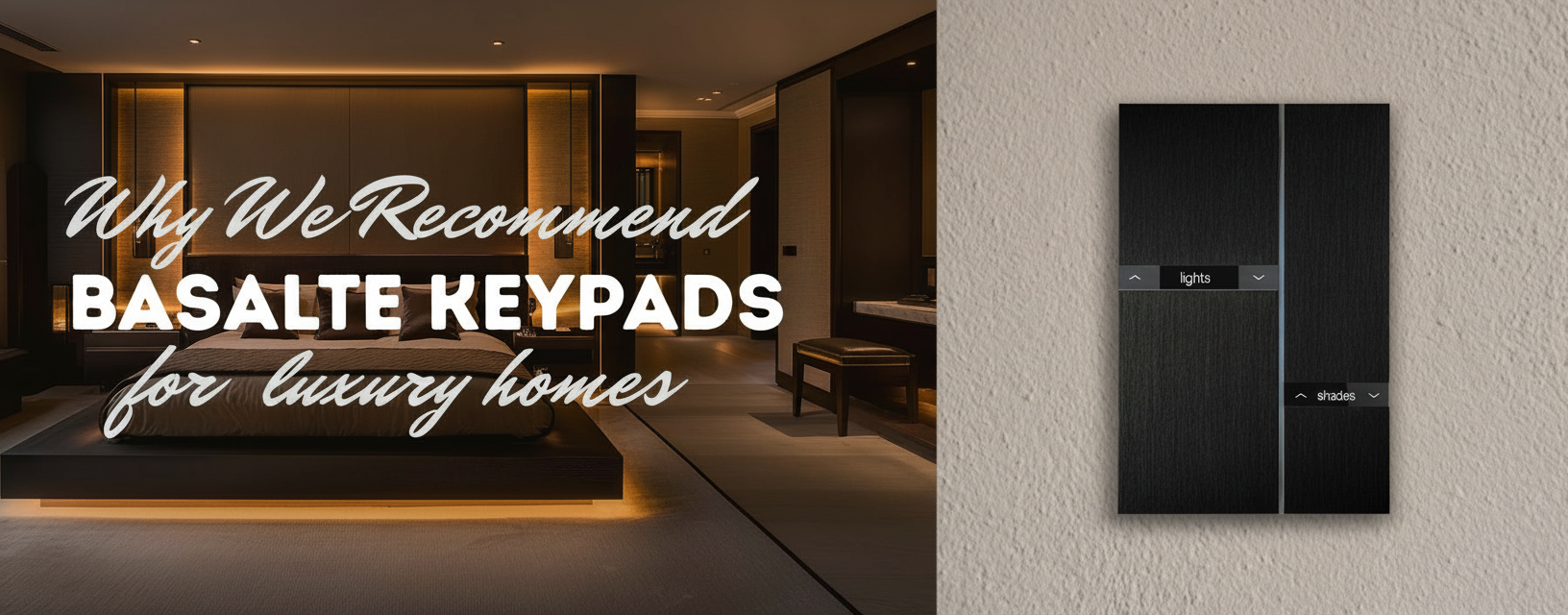
We recommend Basalte's smart keypad range for luxury Indian
homes because it combines gesture-based touch control, KNX-certified
integration, and a minimalist design language that disappears into
architect-designed interiors — letting homeowners control lighting, curtains,
climate, and AV scenes from a single elegant panel instead of rows of
conventional switches.
At Techvault, we've installed this Belgium-designed keypad system across villas, premium apartments, and architect-led residences in Delhi NCR, Gurgaon, and Jaipur. This blog covers what makes these panels different, where we've used them, and how our integration process ensures they work exactly as intended on day one — and for years after.
What Makes These Keypads Different from Standard Smart Switches?
Most "smart switches" sold in India are essentially conventional switches with a Wi-Fi chip added — they look and feel like traditional switches, just with app control bolted on. Basalte's keypad range takes a different approach entirely: capacitive touch surfaces, gesture-based sliders for dimming and volume, and a flush-mounted design available in anodised aluminium, glass, and wood-veneer finishes that architects can specify to match a project's material palette.
Functionally, every keypad runs on the KNX protocol — the same open standard (ISO/IEC 14543-3) we use across all our automation projects — meaning these keypads aren't a separate "smart" layer sitting awkwardly alongside the rest of the home's systems. A single keypad press can simultaneously dim lights, lower blinds, switch on the AV system, and adjust the thermostat, because all of it runs on the same KNX bus programmed through ETS6.
What Is Our Experience Working with This Brand as Luxury Automation Integrators?
We work directly with Basalte as a certified KNX integration partner, which means our scope goes well beyond mounting a panel on a wall. For every project, we:
- Design the keypad layout and button/scene mapping based on how the homeowner actually moves through the house
- Programme each scene (lighting levels, curtain positions, AV inputs, climate setpoints) into the KNX system via ETS6
- Coordinate with architects and interior designers on finish selection (aluminium, glass, wood) so the panels align with the design intent of the space
- Test every scene end-to-end before handover, including edge cases like power restoration after an outage
This is the difference between "installing a product" and integrating a system — and it's why design-focused luxury projects specifically ask for an experienced KNX integrator rather than a general electrician for this kind of work.
How Do We Plan Installations in Real Luxury Homes?
On a recent villa project in Vasant Vihar, Delhi, the brief was to replace nearly 40 conventional switch points across the home with a unified keypad-based control layer — without increasing the visual footprint on the walls. Our approach:
- Keypad placement: We mapped each room's entry points and identified the 1-2 locations per room where a single panel could realistically replace 4-6 conventional switches, based on how residents actually move through each space.
- Scene creation: Rather than a 1:1 switch replacement, we grouped functions into scenes — "Arrival," "Evening," "Movie Night," "Away" — so a single gesture activates a coordinated set of actions rather than requiring multiple individual toggles.
- Integration with other systems: Each panel was wired into the same KNX bus controlling lighting and Switches, curtain motors, and the home's audio visual system, so scenes could span all of these simultaneously.
- Minimal visual impact: Panels were specified in a finish matched to the home's existing hardware (matte black, in this case) so they read as part of the interior design rather than an add-on.
How Do These Keypads Compare to Other Premium Switch Options?
For homeowners weighing keypad-style control against other
premium switch formats, here's how the categories typically compare on the
factors that matter most in luxury projects:
|
Factor |
Conventional Premium Switches |
Touch-Panel Smart Switches (WiFi) |
Gesture-Based KNX Keypads (Basalte-type) |
|
Visual footprint |
Multiple switch plates per room |
Single panel, but app-dependent |
Single panel, fully scene-integrated |
|
Protocol |
None / basic wiring |
Proprietary WiFi |
Open KNX standard (ISO/IEC 14543-3) |
|
Scene control |
Not possible |
Limited, app-based |
Full scene logic via ETS6 |
|
Material finishes |
Standard plastic/metal |
Mostly plastic/glass |
Aluminium, glass, and wood-veneer options |
|
Long-term serviceability |
High (simple wiring) |
Depends on manufacturer support |
High (KNX is vendor-independent, 25-30 yr lifespan) |
|
Best suited for |
Budget/mid-range homes |
Apartments, retrofit projects |
Architect-designed villas, premium apartments |
For a feature-by-feature look at how this brand stacks up
specifically against ABB and CORE keypads on real project examples, see our Basalte vs ABB vs CORE comparison.
How Do These Keypads Enhance Day-to-Day Living in Refined Spaces?
In the homes where we've installed this system, the most-used scenes tend to be:
- One-touch arrival/departure scenes — lighting, climate, and security adjust automatically based on a single gesture near the entrance
- Curtain and blind grouping — multiple motorised curtains across a room or floor respond to one slider gesture rather than individual controls
- Home theatre activation — lights dim, blinds close, and the AV system switches to the correct input from one panel, integrated with the home's theatre setup
- Day/night mode switching — lighting colour temperature and intensity shift automatically based on time of day, supporting circadian lighting goals without manual adjustment
What Does Our Installation and Integration Process Involve?
- Lifestyle assessment — understanding how the household uses each room before finalising panel locations
- Design coordination — working with architects/interior designers on finish, placement, and how panels sit within the overall material palette
- Scene programming in ETS6 — building the actual automation logic that the panels will trigger
- Installation — clean, precise mounting with concealed wiring to KNX bus lines
- Testing and handover — verifying every scene works as intended, with documentation (including the .knxproj project file) provided to the client
Conclusion
What makes this keypad range worth recommending isn't the
hardware alone — it's how it fits into a properly designed KNX automation
system. The gesture controls, premium finishes, and scene logic only deliver
real value when the placement, programming, and integration are planned around
how a household actually lives. That's the part of the process we focus on for
every luxury project we take on.
FAQs
Why do you recommend this brand specifically for luxury homes?
The combination of KNX-based reliability, premium material
finishes, and gesture-based scene control matches the expectations of
architect-led luxury projects — where both the technology and its physical
appearance need to meet a high design standard.
Do you install these keypads only in luxury villas?
Most of our installations are in villas and premium
apartments where interior design is a priority, but the same KNX-based approach
works in any home where the owner wants unified, scene-based control rather
than individual switches.
Can the scenes be customised after installation?
Yes. Since everything runs on KNX and is programmed via
ETS6, scene logic can be adjusted or expanded later — for example, adding a new
lighting zone or integrating a new AV device — without replacing the keypads
themselves.
Who should handle installation and programming?
We recommend working with a KNX-certified integrator for
this type of system. Incorrect programming or panel placement is difficult to
fix after walls and ceilings are finished, so getting the design and scene
logic right at the planning stage matters more than with conventional switches.