

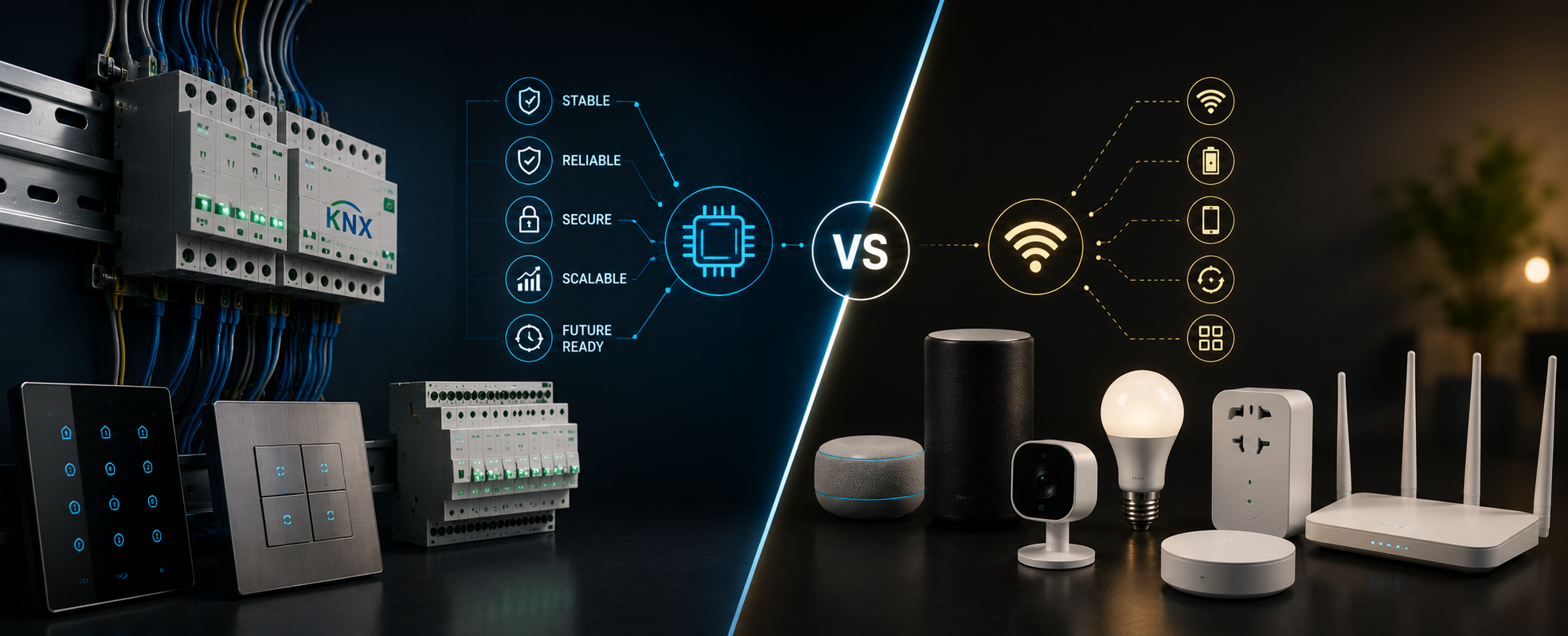
After installing both wired KNX and wireless smart home systems across India for over a decade, the long-term pattern is consistent: wired KNX systems installed 8-10 years ago are still running on their original infrastructure with only minor component upgrades, while wireless systems from the same period have typically needed at least one full ecosystem replacement due to discontinued hubs, deprecated apps, or unsupported protocols.
This isn't a theoretical comparison- it's based on what
we've actually seen happen to systems we and others have installed since the
early days of smart home adoption in India. This guide looks specifically at
the long-term outcomes, not just the day-one feature comparison that most
"wired vs wireless" articles cover.
What Does "Long-Term" Actually Mean for a Smart Home System?
Most comparisons focus on installation cost, setup time, and
initial features — all relevant, but they don't address what happens 5, 8, or
10 years later:
- Is
the original hardware still supported by the manufacturer?
- Can
the system be serviced by a different company if the original installer is
unavailable?
- Has
the underlying protocol/standard remained stable, or has it been replaced
by something incompatible?
- What's
the realistic lifespan of the core infrastructure versus individual
devices?
These questions matter more for wired vs wireless than
almost any day-one feature, because they determine whether a system is a
long-term investment or a recurring replacement cost.
How Have Wired KNX Systems Held Up Over 8-10 Years?
KNX, as a standard, has existed since the 1990s and is maintained by the KNX Association as an
open, vendor-independent protocol (ISO/IEC 14543-3). In practical terms, this
means:
- The
bus infrastructure itself doesn't become obsolete: KNX cabling and
bus topology installed a decade ago is still compatible with current KNX
devices
- Individual
components can be replaced or upgraded independently: a keypad or
actuator from 2016 can be swapped for a current model without rewiring or
replacing the rest of the system
- No
dependency on a single manufacturer's continued existence: because
KNX is multi-vendor, a system isn't at risk if one brand discontinues a
specific product line
In the projects we've maintained over many years, the most
common "maintenance" has been replacing individual keypads or
actuators after 8-10+ years of use — not because the KNX bus failed, but as a
routine hardware refresh, similar to replacing any electrical component after a
long service life.
How Have Wireless Smart Home Systems Held Up Over the Same Period?
The pattern with wireless systems installed in the
early-to-mid 2010s has been notably different:
- Hub/bridge
discontinuation — several early wireless smart home hubs (proprietary
bridges tying together bulbs, plugs, and sensors) have been discontinued
by their manufacturers, sometimes with cloud services shut down entirely,
making the connected devices non-functional even if the hardware still
works
- App
and protocol changes — wireless ecosystems have gone through multiple
generations of underlying protocols; devices on an older protocol
generation often can't be added to newer hub generations
- Battery
and connectivity maintenance — sensors and battery-powered devices
require ongoing battery replacement, and signal reliability in larger
homes has been a recurring issue as more devices were added over time
This doesn't mean wireless systems "fail" outright
— but the practical reality has often been a full or partial ecosystem
replacement at some point during 10 years, rather than the incremental
component-level upgrades typical of KNX installations.
How Do Wired KNX and Wireless Systems Compare Over 10 Years?
Factor |
Wired KNX |
Wireless Smart Home |
|
Core infrastructure lifespan |
20-30+ years (bus cabling/topology) |
Tied to hub/ecosystem generation, often 5-8 years |
|
Component-level upgrades |
Individual devices replaceable independently |
Often requires ecosystem-wide compatibility |
|
Vendor dependency |
Multi-vendor, open standard |
Often single-vendor or single-ecosystem |
|
Risk of discontinued services |
Low — KNX standard maintained independently |
Moderate-to-high — cloud services/hubs have been
discontinued historically |
|
Typical 10-year maintenance pattern |
Periodic individual component replacement |
Higher likelihood of full or partial ecosystem replacement |
|
Best suited for |
New construction, long-term ownership |
Rentals, short-term ownership, budget-conscious retrofits |
Does This Mean Wireless Systems Are a Bad Choice?
Not necessarily — the right choice still depends on the
situation, and wireless systems remain genuinely useful in specific contexts:
- Rented
homes — where a 10-year horizon isn't relevant, since the system may
move with the tenant
- Smaller
budget retrofits — where the lower upfront cost outweighs long-term
considerations for that specific use case
- Supplementing
a wired core — many of our projects use a wired KNX backbone for core
functions (lighting, climate, security) with wireless devices added for
specific, lower-priority needs
The long-term reliability difference matters most when the
home is a long-term residence, and the system represents a significant
investment, which is the situation where most of our clients' concerns about
"will this still work in 10 years?" actually apply.
A Real Example: A 9-Year-Old KNX Installation in Greater Noida
We originally installed a KNX system in a Greater Noida villa in 2017, covering lighting, climate, and curtain automation across the home. In 2026, the only changes made to the system have been replacing two keypads (normal wear after 9 years of daily use) and adding new KNX-compatible devices in a renovated section of the house — both integrated into the existing bus without any need to replace or reconfigure the original 2017 installation. The original ETS project file, maintained and updated over the years, made both changes straightforward.
Conclusion
The wired vs wireless decision looks different when viewed
over 10 years rather than at the point of installation. Wired KNX systems have,
in our experience, required mostly incremental component-level maintenance
while remaining compatible with their original infrastructure — wireless
systems from the same era have more often required ecosystem-level replacements
due to discontinued hubs or protocol changes. Neither is universally
"better" — but for homeowners planning a long-term residence, the
10-year outcome is worth weighing as heavily as the installation-day
comparison. For more on the day-one feature differences between these
approaches, see our wired
vs wireless home automation guide, or explore curtain and gate
automation options as part of a wired KNX system.
FAQs
If I install a wired KNX system now, will it still be supported in 10 years?
KNX has been an actively maintained open standard since the
1990s, with no indication of this changing — the standard's longevity is one of
its core advantages over proprietary wireless ecosystems, which have
historically had much shorter generational cycles.
Can I mix wired KNX and wireless devices in the same home?
Yes — many practical installations use a wired KNX backbone
for core functions with wireless devices integrated via gateways for specific
additional features. The long-term reliability considerations above apply most
directly to the core infrastructure, not necessarily every individual device.
Is the higher upfront cost of wired KNX justified for a 10-year horizon?
Based on the maintenance patterns we've seen, the total cost
of ownership over 10 years often favours wired KNX once you account for the
likelihood of partial or full ecosystem replacement with wireless systems —
though this depends on the specific systems being compared and how the home is
used.
What should I ask an installer about long-term support for either system?
For wireless systems, ask specifically what happens if the manufacturer discontinues the hub or app — is there a fallback? For wired KNX, ask whether documentation (the ETS project file) will be provided, since this is what makes future changes straightforward, as in the Greater Noida example above.