
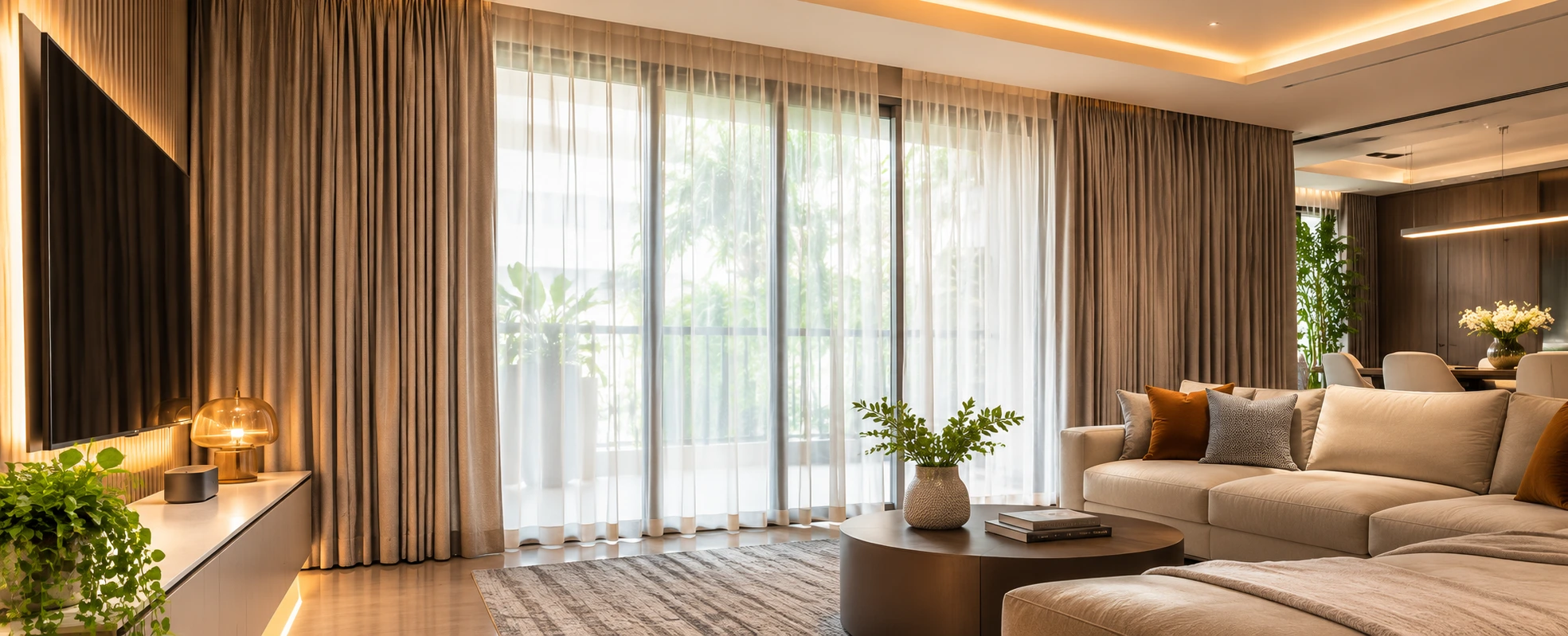
An automatic curtain opener is a motorised device that opens and closes your curtains for you — by remote, app, voice, schedule, or sensor — instead of pulling them by hand. It can be a retrofit add-on motor fitted to your existing track or rod, or a fully motorised curtain track built into the home. In a smart home, it connects to scenes and the sun, so the curtains open gently in the morning, close against the afternoon heat, and shut for movie night — all on their own.
Pulling curtains by hand, twice a day, across every window, is one of those small chores a smart home quietly removes. An automatic curtain opener does exactly that — and does much more once it's part of the wider automation. This guide explains what an automatic curtain opener is, the types available, how it works, and how to choose the right one.
What is an Automatic Curtain Opener?
An automatic curtain opener is a motor-driven system that moves your curtains open or closed without you touching them. Instead of a cord or a hand-pull, a quiet motor does the work, triggered by a remote, a wall keypad, your phone, your voice, a timer, or a sensor.
At its simplest, it's a convenience. At its best — integrated into a smart home — it's a curtain that knows when to move: open with your morning alarm, close as the sun gets harsh, shut at sunset for privacy. For the mechanics behind it, our guide to how curtain automation works goes deeper into motors and tracks.
Types of Automatic Curtain Openers
There are a few ways to motorise curtains, suited to different homes:
- Retrofit add-on curtain motors — a motor unit that attaches to many existing tracks or rods, motorising curtains you already have. Easiest to add to a finished home or a rented flat, with minimal disruption.
- Fully motorised curtain tracks — a purpose-built motorised track that replaces the existing one, giving the smoothest, quietest and most reliable result. Best planned during an interior fit-out.
- Motorised roller, Roman and blind systems — the same idea applied to blinds and shades rather than fabric curtains.
- Motorised rods — a rotating rod mechanism for certain curtain styles.
The right type depends on your windows, your curtains' weight, and whether you want a quick retrofit or a built-in system.
How Does an Automatic Curtain Opener Work?
The principle is simple: a small, quiet motor drives the curtain along its track (or turns the rod) to open or close it. What makes it "smart" is how the motor is controlled. It can respond to:
- a remote or wall keypad,
- a mobile app,
- voice (Alexa, Google Home),
- a schedule or timer, and
- a light, sun, or motion sensor.
In an integrated home on a standard like KNX, all of these work together, and the curtains also join scenes — so a single "Good morning" or "Movie" command moves every curtain in the home at once.
Why Use an Automatic Curtain Opener?
The benefits go well beyond not pulling a cord:
- Convenience — curtains open and close themselves, on schedule or at a touch.
- Better sleep & privacy — wake gently to daylight, and close automatically at dusk; our guide on curtains, sleep, privacy and energy covers this.
- Heat & energy control — closing against the afternoon sun keeps rooms cooler and cuts cooling costs, especially when curtains and AC work together and with motorised shading for summers.
- Safety — curtains that move while you're away make a home look occupied.
- Access — a real help for large, high, or hard-to-reach windows you can't easily pull by hand.
Retrofit Add-On vs Integrated Motorised System
This is the key decision. A retrofit add-on opener is the quick, lower-cost route — ideal if you want to motorise existing curtains without changing the track, or you're renting. A fully integrated motorised track is the premium route — smoother, quieter, more reliable, and able to handle heavier curtains and whole-home scenes — best fitted during a renovation or new build. Many homes start with a retrofit and move to an integrated system later.
How to Choose an Automatic Curtain Opener
A few things to get right:
- Track and rod compatibility — will it fit (or replace) your existing setup?
- Curtain weight and width — the motor must be rated for heavy or wide curtains.
- Control — remote, app, voice, schedule, sensor, or all of them.
- Power — mains-wired (reliable, best planned in) or battery/rechargeable (easy retrofit).
- Integration — can it join your wider smart home, or does it stay a standalone gadget?
- Noise — quality motors are near-silent; cheap ones can be intrusive.
Integrating Curtain Openers Into a Smart Home
A standalone curtain opener is useful; an integrated one is transformative. On an open standard like KNX, motorised curtains join the rest of the home — dimming the lights, closing the blinds and starting the AV together for a "Movie" scene, or waking the house with light and the right temperature. Everything runs from one app, and the curtains respond to the sun and your routines, not just a button. See our curtain & gate motors and automation services for how we deliver this.
How TechVault Does Motorised Curtains
We design and install motorised curtains — retrofit or fully integrated — as part of a home's automation, matching the motor and track to your curtains, wiring it in cleanly, and connecting it to scenes, the sun and a single app. The result is curtains that simply move at the right moments, quietly and reliably.
If you'd like curtains that open and close themselves, the best first step is a quick look at your windows and how you'd like them to behave. Book a consultation with TechVault.
FAQs
What is an automatic curtain opener?
An automatic curtain opener is a motorised device that opens and closes your curtains automatically — by remote, app, voice, schedule or a sensor — instead of pulling them by hand. It can be a retrofit add-on motor fitted to your existing curtain track or rod, or a fully motorised curtain track built into the home. In a smart home, it connects to scenes and routines so curtains move on their own at the right times.
How does an automatic curtain opener work?
A small motor drives the curtain along its track (or rotates the rod), moving it open or closed. The motor is controlled by a remote, a wall switch, a mobile app, a voice assistant, a timer/schedule, or a light or motion sensor. In an integrated smart home, the control runs on a standard like KNX, so the curtains can respond to the time of day, the sun, or a scene such as "Good morning" or "Movie".
Can I add an automatic curtain opener to my existing curtains?
Often, yes. Retrofit add-on curtain motors can attach to many existing tracks or rods, motorising curtains you already have without replacing them — a popular, less disruptive option for finished homes and rented flats. For a more seamless, reliable and premium result, a fully motorised curtain track is better and is easiest to fit during an interior fit-out. A site check confirms what suits your windows.
Can automatic curtains be controlled by voice or an app?
Yes. Motorised curtains can be controlled by a mobile app, by voice assistants such as Alexa or Google Home, by a wall keypad, or automatically on a schedule or sensor. In an integrated system, they also work within scenes — so one tap, or a set time, can open or close every curtain in the home together.
Do automatic curtain openers work with heavy curtains?
Yes, provided the motor is rated for the weight and width. Lightweight retrofit openers suit lighter curtains, while proper motorised tracks handle heavy, wide or layered curtains (including sheer-plus-blackout setups) smoothly and quietly. Matching the motor and track to the curtain is part of getting it right, which is why professional specification matters for larger or heavier curtains.
Are automatic curtain openers worth it?
For most homes, yes. Beyond the convenience of never pulling a curtain by hand, they improve sleep and privacy, help manage heat and energy by closing against the sun, add safety by making a home look occupied while you're away, and are a genuine help for large, high, or hard-to-reach windows. Whether a simple retrofit or a fully integrated system is right depends on your home and how far you want to take it.