

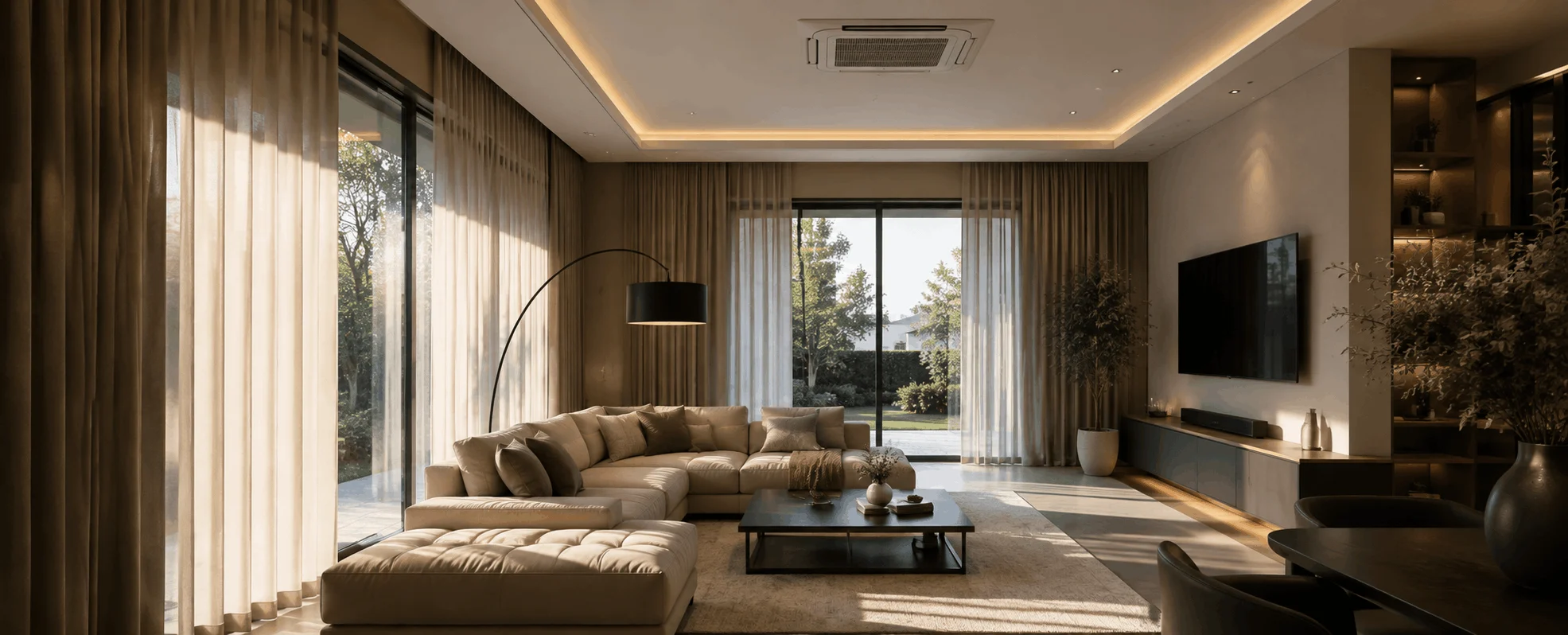
Your motorised curtains and your air conditioning are both running. But are they aware of each other?
Most people buy them separately. Curtains from one vendor, AC from another, controlled by two different apps on the same phone. That works, technically. It just skips the part where these two systems make each other considerably better.
The Problem With Systems That Don't Talk
An air conditioner only knows one thing: the temperature at its sensor.
It doesn't know the afternoon sun just landed on your west-facing windows and turned the living room into a greenhouse. It doesn't know the curtains closed twenty minutes ago and the room is already coming down. It's reacting to a number from one point in the room, with no idea why that number is moving.
Curtains have the same blind spot. A schedule set to "close at 4 pm" doesn't know whether it's an overcast July afternoon or a brutal one in May. It closes either way. Useful, but not intelligent.
Put both on one system and that changes. On KNX, curtains and climate share information and respond together, instead of each running its own routine and hoping.
How They Actually Work Together
Once both sit on the same system, you can build logic instead of just schedules.
Curtains close before the AC has to work harder. When a room's temperature starts climbing, or when the sun reaches a particular facade at a particular time of year, the curtains draw first. Blocking heat is cheaper than removing it after it's arrived.
Winter mornings work the other way. In Delhi NCR, Lucknow, or Jaipur, a January morning has usable free heat. The curtains open, the sun does some of the work, and the heating setpoint eases off accordingly.
Rooms nobody's using stop being managed intensely. A guest bedroom, a home office you haven't sat in this week - the system runs a relaxed schedule for both curtains and climate rather than treating every room as occupied.
One "Away" scene handles everything. Curtains to position, every zone's climate to away mode, in one press. Not five zones checked individually on the way out of the door.
Curtains stop at positions, not just open or closed. Half-closed cuts glare and heat while keeping the view and the daylight. A schedule can't judge that. A system reading the room can.
None of this needs your attention day-to-day. That's the entire point - you set the logic once, and the house runs it.
Why This Matters More in India Than Most Places
Solar heat gain is the single largest thing working against your AC through summer, and Indian sun is not gentle about it.
A west-facing living room in Delhi in May is essentially unusable between three and six unless something intervenes. Most households handle this manually - someone gets up and draws the curtains, every day, in every affected room. It works. It's also a small chore repeated a few hundred times a year.
The other half is what it does to the AC. Every degree of solar gain that reaches the room is a degree the compressor has to remove. Blocking it at the glass is far less work than cooling it out afterwards.
And in north India, where winters are genuinely cold, the same coordination runs in reverse for a few months - which a cooling-only setup can't do.
What You'll Actually Notice
The energy side is real, though the honest answer is that the savings depend entirely on your building - orientation, glazing area, how many hours the AC currently runs against a sunlit room. Anyone quoting a percentage without seeing the house is guessing.
What people report noticing first is different: how much less they're managing the house.
Nobody's adjusting three thermostats before bed. Nobody's crossing the room at four in the afternoon to draw curtains against the glare. Nobody's protecting artwork or wooden flooring from direct sun by remembering to. The system has handled it before you noticed it needed handling.
What This Needs
Motorised curtains or blinds, on a control system rather than a standalone remote. We work with Somfy and NICE for motors, and Renson and Hunter Douglas where external shading or specialist blinds suit the project.
Climate control on the same system - KNX actuators controlling your AC zones, rather than each unit on its own remote.
A shared platform. This is the part that's usually missing. Two smart systems that can't talk are two systems, not one. KNX is what puts them on the same bus so a temperature reading in one room can move a curtain in it.
Cabling is planned during construction. Curtain motors need a power point at the pelmet, and climate actuators need to reach the AC units. Both are straightforward before plastering and awkward afterwards.
Our guides on how curtain automation works and KNX cable cover the technical side in more detail.
Can This Be Added to an Existing Home?
Partly, and it's worth being straight about which parts.
Motorised curtains retrofit reasonably well where there's a power point at the pelmet, or one can be run. Climate control depends on your AC units and whether they can be integrated. Getting both onto one system in a finished home is harder, because that's the part needing cable.
Where full integration isn't practical, a wireless setup gets you most of the convenience without the coordination. It's a real trade-off rather than a lesser version of the same thing - our comparison of wired vs wireless explains where each fits.
FAQs
Do motorised curtains actually reduce cooling costs?
They reduce solar heat gain, which is what your AC spends most of its summer working against. How much that translates to depends on window orientation, glazing area, and how many hours the room is in direct sun. The savings are real but building-specific - a figure quoted without seeing the house isn't meaningful.
Can my existing AC be integrated, or do I need new units?
Many can. It depends on the make and whether the unit supports external control. This is worth checking early, because it affects whether full coordination is possible or whether you're limited to running the two systems in parallel.
What happens on a cloudy day - do the curtains still close on schedule?
Not if the system is reading conditions rather than following a clock. Logic based on room temperature or light levels responds to the actual day. A pure schedule closes regardless, which is exactly the limitation this setup removes.
Is this only useful in summer?
No. In north India, the same coordination runs in reverse through winter - curtains open on cold mornings for free solar heat, with the heating setpoint easing accordingly. A system set up only for cooling gets manually overridden for a few months a year.
Does it work if the internet goes down?
On KNX, yes. The logic runs locally on the bus, so curtains, climate, and scenes keep working through an outage. Remote app access needs connectivity, but the house itself doesn't stop.
Can individual rooms be controlled differently?
Yes, and this is usually how it's set up. Each room is a zone with its own curtain positions and climate settings. A west-facing living room needs very different logic from a north-facing bedroom.
Curious What This Would Look Like in Your Home?
Every home takes the sun differently. Orientation, window size, which rooms matter most, and how the family actually uses the house all change what makes sense.
If you're in Noida, Delhi NCR, Gurgaon, or Jaipur and want to see how connected curtains and climate would work in your space, talk to our team. No pressure - just a look at your layout and an honest view on whether it's worth doing.
You can also explore our curtain and gate motors and home automation services.