

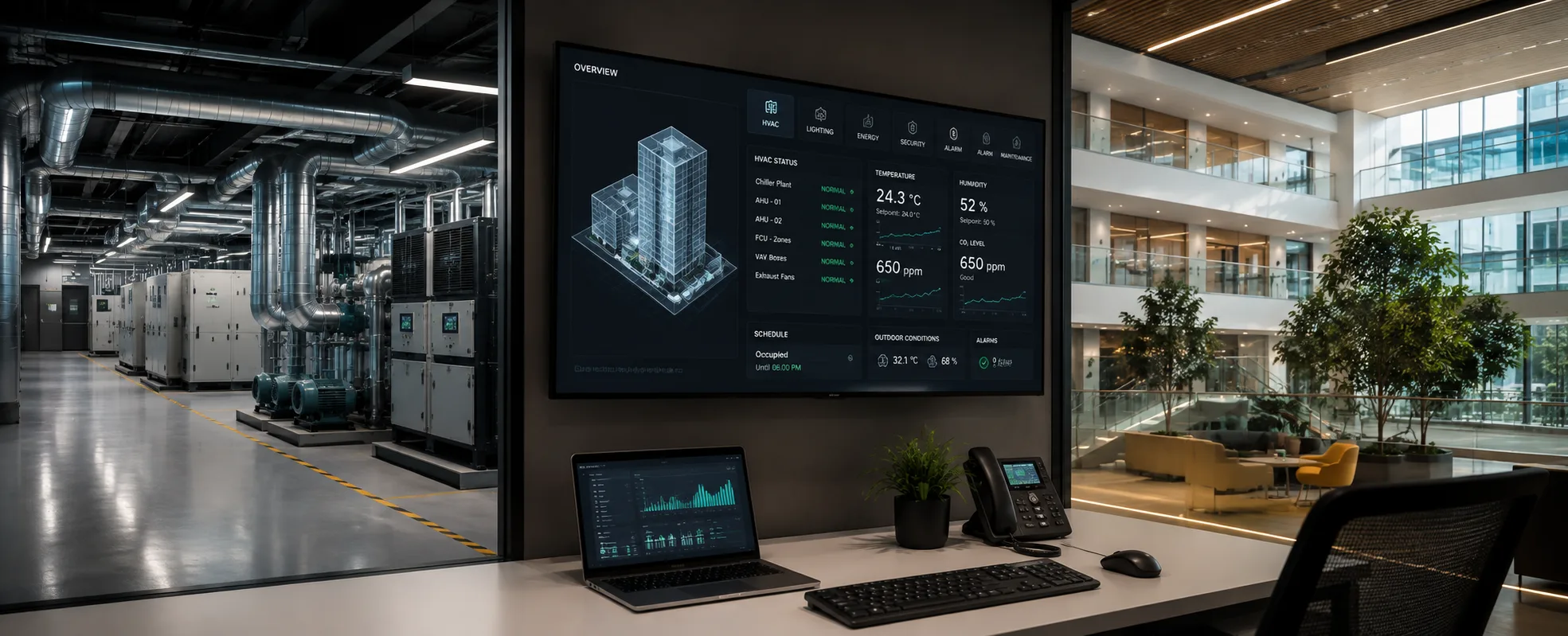
A BMS HVAC control solution centralises a commercial building's heating, ventilation and air-conditioning — chillers, air-handling units, fan-coil units, VAV boxes and sensors — on one platform. It automates temperature, airflow, and scheduling to cut energy use, hold comfort steady, and give facility teams live visibility and control from a single dashboard.
At TechVault, we design and install KNX-based building automation for commercial and institutional projects across Delhi NCR, Noida, Gurgaon, and Jaipur. HVAC is almost always the first system we bring under control, and this guide explains why, how it works, and what it costs.
What is BMS HVAC Control?
A Building Management System is the central brain of a building, and HVAC is usually the first system it takes charge of.
BMS HVAC control means the system continuously monitors sensors and drives the HVAC equipment automatically - adjusting cooling, heating, and fresh air to match occupancy, schedule, and outside conditions, instead of running everything flat out all day.
As integrators, we treat the BMS as the layer that turns separate HVAC machines into one coordinated system. The equipment doesn't change. What changes is that something is deciding how hard each piece needs to work, moment to moment.
Why is HVAC the Priority in Any BMS?
Because HVAC is typically the largest single energy load in a commercial building, and often a major share of the electricity bill in Indian offices, hotels, and hospitals.
It also drives comfort and air quality directly, which means it's the system occupants notice when it isn't working properly. Controlling HVAC well is where a BMS delivers its biggest and fastest return, which is why it's almost always the first subsystem we automate.
What HVAC Equipment Does a BMS Control?
A BMS can control the full chain, from the plant room to the individual zone:
Equipment | What the BMS Does |
|---|---|
| Chillers | Staging, sequencing, setpoint optimisation |
| Cooling towers and pumps | Runtime control, load matching |
| Air-handling units (AHUs) | Fan speed, damper position, temperature control |
| Fan-coil units (FCUs) | Zone-level temperature and fan control |
| VAV boxes | Airflow modulation per zone |
| Dampers and exhaust fans | Fresh-air intake, extraction control |
| Sensors | Temperature, humidity, CO₂, occupancy |
On the control side, we typically build this using KNX with confirmed partners such as Core and ABB, and KNX HVAC devices where the design calls for them.
How Does a BMS Actually Control HVAC?
It's a simple loop, repeated everywhere in the building:
Sensors read conditions → the BMS logic decides → actuators adjust the equipment.
So a zone runs to a target temperature. Ventilation follows CO₂ or occupancy rather than a fixed rate. Setpoints shift by schedule, so cooling eases off in empty areas and ramps up before people arrive.
Occupancy and presence sensors - for example, from B.E.G. let the building respond to actual use rather than to a timer someone set two years ago. That distinction is where most of the savings come from.
The underlying mechanism is the same one described in our guide to how KNX works in building and home automation, scaled up.
Which Protocols Connect HVAC to a BMS?
Integration is the whole game, and it runs on open protocols.
| Protocol | Where It's Used |
|---|---|
| BACnet | Widely used across HVAC plant equipment. An ASHRAE standard |
| Modbus | Common on chillers, meters, and older plant equipment |
| KNX | Ties the wider building-automation layer together |
Because all three are open, a well-designed BMS can bring multi-vendor chillers, AHUs, and controls onto one platform over a reliable building network — rather than locking the building to one manufacturer's ecosystem.
That matters more than it sounds. A closed system means every future addition, replacement, or expansion goes through one vendor at their price, for the life of the building.
How Much Energy Can BMS HVAC Control Save?
Meaningful savings are the main reason buildings invest, and they come from three specific behaviours rather than from anything magical.
Over-cooling stops. Most buildings run cooler than they need to, in more places than they need to.
Unoccupied areas stand down. Meeting rooms, training rooms and administrative floors sit empty for large parts of the day while being conditioned as though they aren't.
Consumption becomes visible. Metering by floor or zone turns "the third floor seems to use a lot" into a number someone can act on.
The size of the savings depends entirely on how the building currently operates. A facility already running tight manual protocols will see less improvement than one where HVAC runs at full load by default. We size the opportunity per project rather than promise a fixed percentage — anyone quoting one without seeing the building is guessing.
In India, this also supports energy-efficiency objectives under the ECBC and BEE framework for commercial buildings. Specific compliance requirements should be confirmed with the applicable code and your consultant.
Can a BMS Integrate HVAC With the Rest of the Building?
Yes, and this is where it becomes a genuine smart building rather than an HVAC upgrade.
The same platform can bring lighting, access control, energy metering, and security alongside HVAC, so subsystems work together instead of separately. Lights and cooling follow the same occupancy signal. One dashboard runs the building. An access event can trigger conditioning in the area someone just entered.
Our guides to building automation systems and smart office automation cover the wider platform.
Does BMS HVAC Control Change for Offices, Hotels and Hospitals?
The principles stay the same. The priorities shift considerably.
| Building Type | HVAC Control Priority |
|---|---|
| Offices | Occupancy-based zoning, schedules around working hours, meeting-room control |
| Hotels | Guest-room control, standing down unoccupied rooms, public-area zoning |
| Hospitals | Tighter control of temperature, humidity and air changes in clinical areas |
| Retail | Zoning by trading hours, entrance air curtains, back-of-house separation |
Hospitals are the clearest example of why templates don't work. Clinical areas generally don't get setback logic applied at all — they're maintained continuously, and the BMS role there is monitoring and alerting rather than reduction. Operating theatre HVAC and cleanroom systems are specialist installations outside a standard BMS scope.
Hotels sit at the other end: guest rooms are the single largest opportunity, because occupancy is genuinely variable and rooms are frequently conditioned when empty. Our guide on hotel automation covers the guest-experience side.
Standalone HVAC Controls vs BMS-Integrated Control
| Standalone Controls | BMS-Integrated | |
|---|---|---|
| Control | Per-unit, manual | Centralised, automated |
| Visibility | Local only | Whole-building dashboard |
| Scheduling | Fixed or manual | Occupancy and schedule driven |
| Energy optimisation | Limited | Continuous |
| Fault detection | Reactive — you find out when it fails | Alarms and trend data |
| Scalability | Difficult | Zones and subsystems added easily |
Fault detection is the one facility teams tend to underrate before they have it. Knowing an AHU is drifting before it fails is a different job from responding to complaints after it has.
What Does BMS HVAC Control Cost in India?
Cost scales with building size, number of control points, and how deep the integration goes. Commercial BMS is usually priced by points and scope rather than by area alone.
Scope | What It Includes | Indicative Cost |
|---|---|---|
| Monitoring only | Sensors, dashboard visibility, basic scheduling, alarms | ₹4,00,000 – ₹12,00,000 |
| HVAC control — small building | Under ~10,000 sq ft, automated zone control | ₹8,00,000 – ₹25,00,000 |
| HVAC control — mid-size | 10,000–50,000 sq ft, full plant and zone control | ₹25,00,000 – ₹80,00,000 |
| HVAC control — large building | 50,000+ sq ft, chiller plant optimisation | ₹80,00,000 – ₹2,50,00,000+ |
| Integrated smart building | HVAC + lighting + access + metering, analytics | Project-based |
⚠️ These are planning ranges, not quotes. They exclude HVAC equipment itself, electrical work, and civil work. Confirm against validated project pricing before publishing or quoting.
Can It Be Retrofitted Into an Existing Building?
Often, yes — and retrofits are a large share of commercial BMS work in India, because most buildings that need this are already operating.
Existing chillers, AHUs, and FCUs can usually be brought under BMS control by adding sensors, controllers, and integration to open protocols. What determines feasibility is whether the existing plant can be controlled externally, which varies by age and manufacturer.
The practical constraint isn't technical; it's operational: a working building can't be shut down for the installation. Retrofits are phased floor by floor or zone by zone around occupancy, which extends the programme but keeps the building running.
We assess the current plant first, then design a retrofit that phases in — rather than quoting a scope that assumes an empty building.
FAQs
What's the difference between BMS and HVAC?
HVAC is the physical heating, cooling, and ventilation equipment. A BMS is the control system that manages that equipment automatically. HVAC does the work; the BMS decides when, where, and how much — so together they deliver comfort with considerably less wasted energy.
Does BMS HVAC control really save energy?
Yes, mainly by cutting over-cooling and idle runtime and matching HVAC to actual occupancy. The exact savings vary by building, age, and usage, so we assess each site rather than quote a fixed percentage — but reduced HVAC waste is consistently the largest efficiency gain available.
Which protocol is best — BACnet, Modbus or KNX?
There's no single best one. BACnet and Modbus are common across HVAC plants, while KNX unifies the wider building-automation layer. Because all three are open, the aim is integration across vendors rather than committing to one protocol.
Can BMS HVAC control be retrofitted into an existing building?
Often yes. Existing chillers, AHUs, and FCUs can usually be brought under control by adding sensors, controllers, and open-protocol integration. We assess the current plant first, then design a retrofit that phases in without shutting the building down.
Is a BMS worth it for a smaller commercial building?
It can be, if HVAC energy and comfort matter — which they usually do. Smaller buildings often start with monitoring and core HVAC control and expand later. We scope to the building's size and likely payback rather than over-specifying.
Does BMS HVAC control help with ECBC compliance?
It supports building energy-efficiency objectives under the ECBC and BEE framework by enabling controlled, monitored HVAC operation. Specific compliance requirements should be confirmed with the applicable code and your consultant — we design the control strategy to align with your energy targets.
How long does a BMS HVAC installation take?
For a new build, controls installation runs alongside MEP work through the construction programme, with commissioning in the final weeks. For a phased retrofit in an operating building, the timeline depends on how much of the building can be worked on at once.
Planning HVAC Control for Your Building?
Every building's HVAC is different, and the useful answer comes from looking at the plant you actually have rather than from a specification sheet.
Talk to our team for a site assessment, or about integrating HVAC, lighting and access on one platform. You can also explore our building automation, office automation and hotel automation services.