

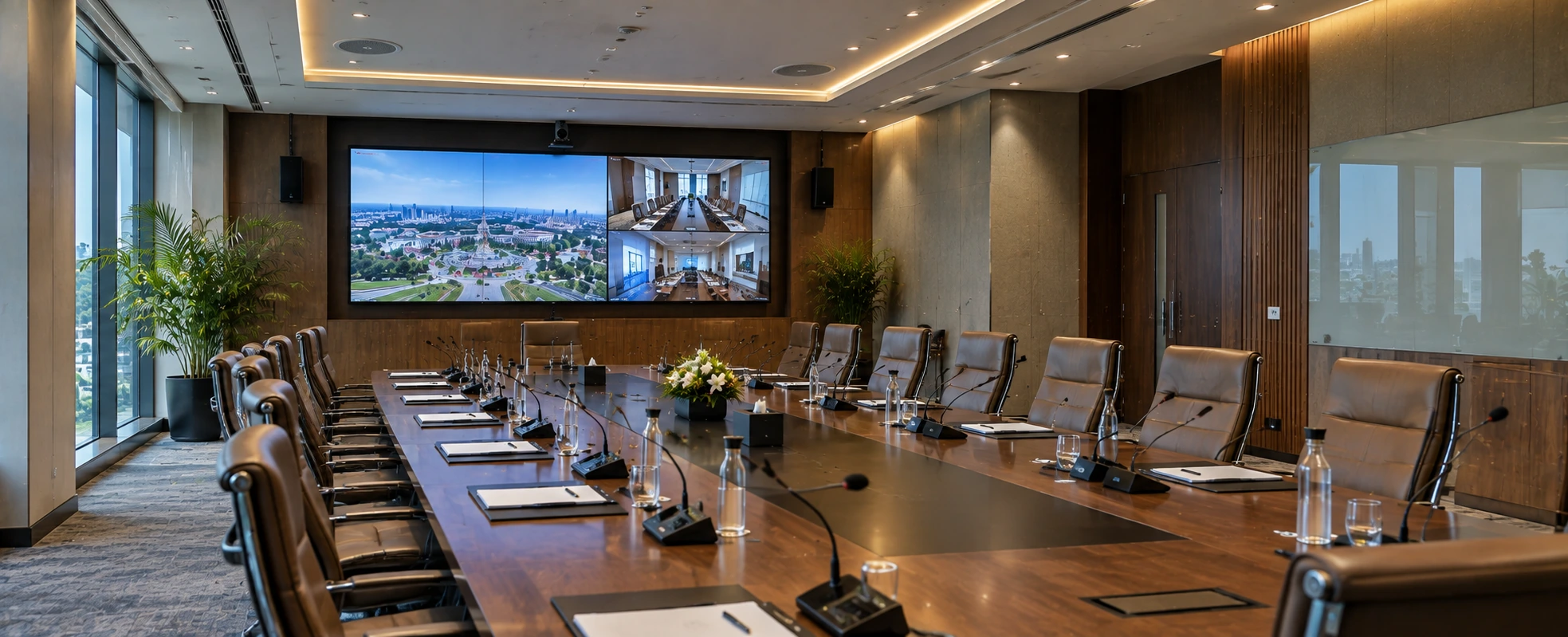
Government AV and lighting solutions are the audio, visual, lighting, and automation systems that public buildings need to function, communicate, and meet energy norms. They cover announcement and conferencing audio, video walls and displays, energy-efficient lighting to ECBC standards, and building automation for control and reporting. What sets government AV integration apart from commercial work is the demand for reliability, compliance, accessibility, and long-term serviceability - systems that must work every day for years, meet public-sector norms, and be supported well after handover. We design and integrate these systems for public buildings across India.
What makes government AV and lighting different?
Government AV and lighting solutions carry requirements that commercial projects rarely face all at once: strict energy compliance, accessibility obligations, tender and procurement rules, security integration, and the need to keep working reliably for many years with proper after-sales support. A public building cannot treat its systems as disposable — they must be specified to last and to be serviced.
The core differences from private commercial work:
Compliance is mandatory, not optional. Public buildings must meet energy norms and accessibility requirements, and lighting and automation specifications are shaped by those codes rather than by preference alone.
Reliability is non-negotiable. A railway announcement system or a control-room video wall cannot fail. Government AV integration is specified for continuous, dependable operation, with redundancy where the function demands it.
Procurement is structured. Public projects run through defined procurement — tenders, technical specifications, and platforms like GeM — so systems must be specified precisely and transparently, and the integrator must be able to work within that process.
Serviceability matters for decades. A public building is a long-term asset. Open standards, documented systems and a clear AMC matter more here than anywhere else, because the system must be maintainable long after installation.
Audio systems for government buildings
Government audio-visual solutions start with clear, reliable sound — because in public buildings audio is often about safety and information, not entertainment. From railway station announcements to a council chamber's conferencing, the audio system has to be intelligible in every seat and every corner, and dependable every single day.
Government audio typically covers:
- Public address (PA) and announcement — intelligible, zoned announcements across stations, terminals and campuses, with emergency-messaging capability
- Conferencing audio — clear microphone and speaker systems for council chambers, courtrooms and meeting halls
- Auditorium and hall audio — full sound systems for public auditoriums and event spaces
- Voice reinforcement — ensuring a speaker is heard clearly in large chambers without strain
Intelligibility is the measure that matters — a PA system that is loud but unclear fails at its actual job, which in a transport hub or emergency is a safety issue, not an inconvenience. For public-address and large-venue audio, we specify professional systems from brands such as Electro-Voice and Crown by Harman, chosen for reliability and coverage in demanding public environments.
Visual solutions: video walls, displays and signage
In government buildings, visual solutions inform, direct and support decision-making. A command-and-control room lives on its video wall; a metro station runs on its passenger displays; a government office guides visitors with digital signage. Public sector AV integration has to deliver visuals that are legible, durable, and readable all day, every day.
The visual layer typically includes:
| Application | Visual solution |
|---|---|
| Command/control rooms | Video walls for real-time monitoring |
| Stations, terminals, offices | Passenger and visitor digital signage |
| Auditoriums, chambers | Large displays or projection for proceedings |
| Public information points | Wayfinding and information displays |
| Council/courtrooms | Displays for evidence, presentations, records |
Command-and-control room AV is a discipline of its own: video walls that run continuously, show many sources at once, and stay legible under control-room lighting. Government displays are also specified for durability — commercial-grade panels built for all-day operation, not consumer screens. We specify video walls, displays, and projection from BenQ, Epson, Panasonic, and LG based on the environment, brightness, and viewing conditions of each public space.
Government lighting solutions and energy compliance
Government lighting solutions carry a responsibility private buildings do not: public money and public energy. Energy-efficient lighting for government buildings is often a compliance requirement under India's energy conservation norms, and lighting control is one of the most direct ways a public building reduces its running cost and meets those obligations.
A complete government lighting solution addresses:
- Energy-efficient fixtures and control — LED lighting with occupancy and daylight-based control to cut consumption
- ECBC-aligned specification — lighting and controls specified to meet the Energy Conservation Building Code and BEE norms
- Architectural and facade lighting — for monuments, civic buildings and public landmarks
- Zoned and scheduled control — lighting that follows building occupancy and hours, not left running
- Emergency and egress lighting — safety lighting integrated and maintained
The compliance angle is central here. India's Energy Conservation Building Code (ECBC), administered under the Bureau of Energy Efficiency (BEE), sets requirements for commercial and public building energy performance, and lighting controls are part of meeting its higher tiers. A government lighting specification is written against these codes — so the integrator has to understand them, not just supply fixtures. We specify energy-efficient lighting using fixtures from Deltalight, LUXUS and LAFIT, with DALI and B.E.G for control and sensing, designed to align with the applicable energy norms.
Note: energy codes and their thresholds must be confirmed against the current ECBC/BEE requirements and the specific project's compliance tier by a qualified consultant — they are not fixed figures to assume.
Automation and centralised control
Government building automation ties a public building's systems together so they can be monitored, controlled and reported centrally — essential when a facility team manages large or multiple buildings. Automation is also how a public building proves and improves its energy performance, which matters for both compliance and public accountability.
Government automation typically brings together:
- Centralised control — lighting, HVAC and AV managed from one interface across a building or campus
- Energy monitoring and reporting — measured consumption data for compliance and cost control
- Security integration — access control, surveillance and alarms tied into the wider system
- Scheduling — systems that follow public building hours automatically
- BMS integration — bringing all services under one management platform
We build automation on the open KNX standard, integrated with BMS protocols where the project requires, so a government building runs as one coordinated system rather than disconnected parts. Security integration — with surveillance and access control from established brands such as Hikvision and Honeywell — is frequently part of the same scope. Our building automation guide covers the wider platform, and our access control guide covers the security layer.
Applications across the public sector
Government AV and lighting solutions apply across a wide range of public buildings, each with its own priorities. The right design always follows the function of the space.
- Government offices and secretariats — conferencing, signage, energy-efficient lighting, automation
- Command and control rooms — video walls, continuous monitoring, high reliability
- Council chambers and assemblies — conferencing audio, displays, recording, voice reinforcement
- Courtrooms — clear audio, evidence displays, recording, accessibility
- Railway and metro stations — PA and announcements, passenger signage, robust operation
- Airports — large-scale AV, signage and PA across terminals
- Public auditoriums — full AV and stage lighting for civic events
- Smart city projects — integrated AV, lighting and monitoring across public spaces
- Museums and exhibitions — display, lighting and interpretive AV
An honest note: public projects vary enormously, and not every building needs every system. A district office needs efficient lighting, conferencing and signage — not a command-centre video wall. The value of an experienced integrator on a government project is scoping precisely to the building's real function and compliance obligations, within the procurement framework, rather than over-specifying.
Why compliance and serviceability decide government projects
On a government project, the systems that win are not the flashiest — they are the ones that comply, that keep working, and that can be serviced for years. This is where public-sector AV integration differs most from commercial work: the specification is judged on standards met, reliability, and long-term supportability, not on novelty.
What this means in practice:
Open standards protect public investment. Specifying open standards like KNX means the building is not locked to a single vendor for its life, and can be maintained and extended by any competent integrator.
Documentation and AMC matter. A government building needs its systems documented and a clear maintenance contract, because the people running it in five years may not be the people who commissioned it.
Energy compliance is designed in. Lighting and automation are specified against ECBC/BEE norms from the start, with monitoring to prove performance.
This is the approach we bring to public-sector work — systems designed to comply, to last, and to be supported, delivered within the procurement process and backed after handover.
FAQs
What are government AV and lighting solutions?
They are the audio, visual, lighting and automation systems public buildings need — public-address and conferencing audio, video walls and signage, energy-efficient lighting to ECBC norms, and centralised automation. They differ from commercial systems in their demand for compliance, reliability, accessibility and long-term serviceability.
Why is energy-efficient lighting important for government buildings?
Because public buildings must meet India's energy conservation norms and are accountable for public energy use. Energy-efficient lighting for government buildings, with occupancy and daylight control specified to ECBC/BEE requirements, reduces running costs and is often a compliance obligation rather than a choice.
What is command and control room AV?
It is the AV for rooms that monitor operations continuously — primarily video walls that display many live sources at once and stay legible under control-room conditions, with the reliability to run without interruption. It is a specialised discipline within government AV integration.
How do government AV projects handle procurement?
Public projects run through structured procurement — tenders, precise technical specifications, and platforms such as GeM. Systems must be specified transparently, and the integrator must work within that framework, which is why clear, standards-based specification matters more on government work than on private projects.
Do government buildings need open-standard automation?
Open standards like KNX are strongly preferred for public buildings because they protect long-term investment — the building is not locked to one vendor, and can be maintained and extended by any competent integrator over its decades-long life. This serviceability is a core requirement, not a preference.
Do you provide government AV and lighting solutions in Delhi NCR and across India?
Yes. We design and integrate public-sector AV, lighting and automation — audio and PA, video walls and signage, energy-efficient lighting and building automation — for government buildings in Delhi NCR and across India, within the procurement framework and with long-term support.
Planning AV and lighting for government buildings
Government AV and lighting projects are won on the things that do not show in a demo - compliance with energy norms, reliability that lasts for years, and systems that can be serviced long after handover. The right partner scopes precisely to the building's function and obligations, specifies against the applicable standards, and supports the system for its full life.
We design and integrate government AV and lighting solutions across India — audio-visual, lighting, and automation, built to comply, to last, and to be supported. Explore our commercial services, or talk to us about your project.