

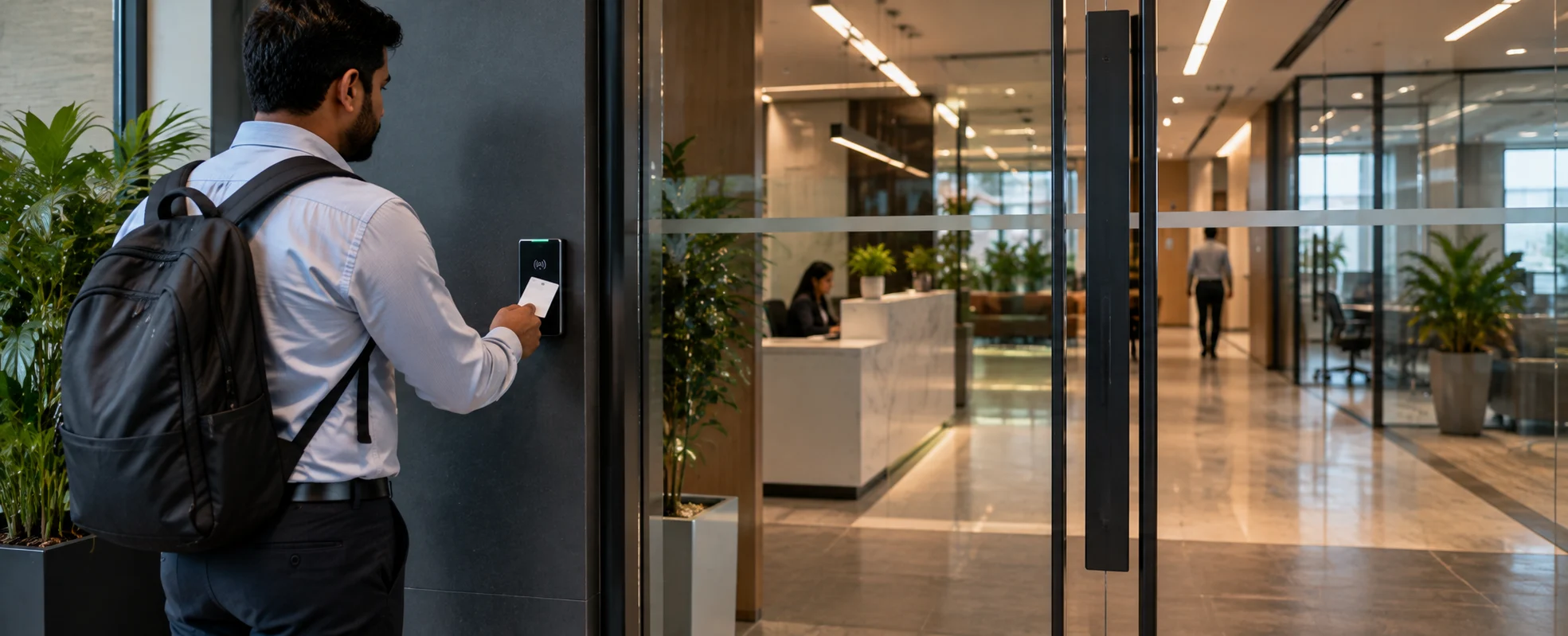
An access control system decides who can open which door, when, and keeps a record of it. Instead of a key that works for anyone holding it and tells you nothing, each person carries a credential - a card, a PIN, a phone, or a fingerprint - that the system checks against a set of rules before releasing the lock.
The record is the part most people underestimate. Knowing who entered the server room at 11 pm is often more useful than having stopped them.
How Does an Access Control System Work?
Four components, and the same sequence every time.
A credential identifies the person - a card, a PIN, a mobile phone, a fingerprint.
A reader at the door captures it and sends it on.
A controller checks it against the rules: is this person permitted at this door, at this time, today?
A lock releases if the answer is yes. If not, it stays locked, and the attempt is logged.
The rules are the system. The hardware just enforces them.
What Credential Types Are There?
| Credential | Strengths | Limitations |
|---|---|---|
| Card or fob | Familiar, easy to issue and revoke, works with gloves | Can be lent, lost, or cloned depending on the type |
| PIN | No hardware to issue, no cost per user | Gets shared. No way to know who actually entered |
| Mobile | Nothing to carry, issued and revoked remotely | Depends on the phone being charged and present |
| Fingerprint | Tied to the person, can't be lent | Reader reliability varies with dust, moisture, and worn fingers |
| Face | Hands-free, fast throughput | Lighting conditions affect it |
The one that matters most in practice: cards are still the default for most commercial buildings because issuing and revoking them is simple, and a lost card is a two-minute administrative task rather than a security incident.
Two credentials together - a card plus a PIN, for instance are standard where a door genuinely matters. Server rooms, cash handling, pharmacy storage.
A note on biometrics in Indian conditions: fingerprint readers are affected by dust, humidity, and worn fingertips. On a site with manual work — a factory floor, a construction office, a warehouse - read failure rates are noticeably higher than in an air-conditioned office. This is worth testing rather than assuming.
What Does It Actually Give You?
Control that changes without changing locks. Someone leaves, you revoke their credential. With keys, you either rekey the building or accept that a key is still out there.
Time-based rules. A cleaning contractor's card works between 6 and 9 in the morning and not otherwise. A key works at 2 am.
A record. Who opened which door and when. For most clients, this becomes the feature they use most — not for catching people, but for answering questions. Who was last in the storeroom. Whether the contractor actually arrived.
Zone restriction. Staff reach the areas they need and no others, without anyone having to police it.
Integration. Access events can trigger other systems — lighting and air conditioning coming on in the area someone just entered, rather than running all day.
Where Is It Used?
Offices. Main entry, server and comms rooms, records storage, management areas, after-hours access.
Hotels. Guest rooms, back of house, plant rooms, staff areas. Guest room access is usually part of a wider guest room management system.
Hospitals. Restricted clinical areas, medication storage, records. Entry logging is often an operational requirement rather than a preference.
Industrial and warehouse. Perimeter, stores, plant rooms, and areas with safety restrictions.
Residential. Villa gates and main doors, servant quarters, and increasingly society common areas. Our guides to digital locks and video door phones cover the residential side.
Which Doors Should Actually Be Controlled?
Fewer than most initial specifications assume, and this is where budget gets wasted.
Worth controlling:
Main entry, because it's the boundary. Server and comms rooms. Anywhere valuables, cash, records, or medication are held. Plant rooms. Areas with a genuine operational reason to restrict — a trading floor, a lab, a kitchen.
Usually not worth it:
Internal doors between areas the same people already reach. Meeting rooms. Doors that stand open all day anyway — a controlled door that's propped open is decorative.
The test: if the answer to "what changes if this door is unlocked" is nothing, it doesn't need a reader.
What Needs Deciding Before Doors Are Finalised?
This is where access control projects go wrong, and it's always the same stage.
The door schedule. Which doors are controlled, and at what level. Needs to be agreed before doors and frames are ordered, because controlled doors need different hardware.
Door hardware. Electric locks, strikes, and maglocks all need specific preparation in the door and frame. Retrofitting into an already-fitted door is possible but visibly worse and often weaker.
Cable routes. Reader, lock, and door position sensor all need cabling to the controller. Through the frame and above the ceiling, planned before finishing.
Fire and egress. This is the one that cannot be improvised. Doors on escape routes have specific requirements for how they behave when a fire alarm activates and how people exit without a credential. Requirements vary by building type and jurisdiction - confirm these with your fire consultant and the applicable code at the design stage. This is not a decision to leave to the access control vendor.
Power and backup. Controllers and locks need supply, and they need to behave correctly when it fails. Which way a given door should fail — locked or unlocked — is a safety decision tied to the point above.
Who administers it. Adding and removing users is a daily task once the building is occupied. Someone has to own it.
Fail-Safe or Fail-Secure?
Worth understanding because it's a safety decision and it gets treated as a technical one.
Fail-safe locks release when power is lost. The door opens. Used where egress matters more than security.
Fail-secure locks stay locked when power is lost. Used where security matters more, and where there is another means of exit.
Which applies to which door is determined by fire and egress requirements, not preference. Get this specified by someone qualified against the applicable code for the building. Guessing it is genuinely dangerous.
How Does Access Control Integrate With Other Systems?
With building automation. An access event can bring lighting and air conditioning up in the area entered, rather than running to a fixed schedule. On a large floor plate, this is a meaningful part of the energy case.
With surveillance. Access events and camera footage are tied together, so a log entry has a picture against it. This turns "someone used this card" into something verifiable.
With fire systems. Controlled doors on escape routes releasing on alarm. This is a requirement rather than a feature, and it's specified against the fire strategy.
With HR or visitor systems. Credentials issued and revoked as part of joining and leaving, rather than as a separate manual task that gets forgotten.
We handle access control alongside building automation and security and surveillance, using Hikvision, Honeywell and Texecom for system hardware, BasIP for video intercom, and Yale and Dorset for door hardware. Our guide on wired versus wireless access security covers the connection method.
What Does Access Control Cost in India?
| Scope | Approx. Cost |
|---|---|
| Single door, card reader and electric lock | ₹25,000 – ₹80,000 |
| Single door with biometric reader | ₹40,000 – ₹1,50,000 |
| Small office, 5–10 doors | ₹2,00,000 – ₹8,00,000 |
| Mid-size building, 20–50 doors | ₹8,00,000 – ₹35,00,000 |
| Large or multi-building, 100+ doors | ₹35,00,000 – ₹1,50,00,000+ |
| Annual support and administration | ₹30,000 – ₹3,00,000 |
Indicative planning ranges covering readers, controllers, locks, cabling, and commissioning. Door hardware modification and any civil work are usually separate. Cost scales with door count more than building size.
What moves the figure most: door count, whether doors need hardware modification, and whether cable routes exist. A retrofit into finished doors and ceilings costs substantially more than the same door count planned during fit-out.
Can It Be Retrofitted?
Yes, and most Indian commercial access control work is retrofit.
What's straightforward: standalone or wireless locks on existing doors, and readers where cable can be routed through an accessible ceiling.
What's harder: doors not prepared for electric hardware, cable routes through finished frames, and any door where the fire requirement changes what's permitted.
What to check first: whether the existing doors and frames can take electric locking at all. Some can't without replacement, and that discovery late in a project is expensive.
FAQs
What is an access control system?
A system that decides who can open which door, when, and records it. Each person carries a credential — card, PIN, phone, or fingerprint — which a reader captures and a controller checks against permission rules before releasing the lock.
What is the difference between access control and a digital lock?
A digital lock is a standalone device controlling one door, usually with codes or fingerprints stored in the lock itself. An access control system manages many doors centrally, with rules, time schedules, and a single record across all of them. For one or two doors, a digital lock is often enough; beyond that, central management matters.
Are biometric readers suitable for Indian conditions?
They work well in clean, air-conditioned environments. Dust, humidity, and worn fingertips all raise read failure rates, so on factory floors, warehouses, and outdoor positions, they perform noticeably worse than in an office. Worth testing on site rather than assuming.
What is fail-safe versus fail-secure?
Fail-safe locks release when power is lost; fail-secure locks stay locked. Which applies to a given door is determined by fire and egress requirements, not preference, and should be specified by someone qualified against the applicable code for the building.
How many doors should be on access control?
Fewer than most initial specifications assume. Control the main entry, server and comms rooms, anywhere valuables or records are held, and areas with a genuine operational restriction. If nothing changes when a door is left unlocked, it doesn't need a reader.
What does access control cost in India?
Roughly ₹25,000 to ₹80,000 per door with a card reader, and ₹40,000 to ₹1,50,000 with biometrics. A small office with five to ten doors typically runs ₹2,00,000 to ₹8,00,000. Retrofitting into finished doors costs substantially more than planning during fit-out.
Can access control be added to an existing building?
Usually, and most commercial work in India is retrofit. The first thing to check is whether existing doors and frames can take electric locking — some can't without replacement, and finding that out late is expensive.
Who manages the system after installation?
Someone named, internally. Adding and removing users is a daily task once a building is occupied, and a system nobody administers drifts within months — with credentials still active for people who left.
Planning Access Control System?
The decisions that matter — which doors, what hardware, how they behave in a fire — all happen before doors and frames are ordered. After that, options narrow, and costs rise.
Talk to our team for a door schedule review, or explore our security and access control, security and surveillance, and building automation services.