

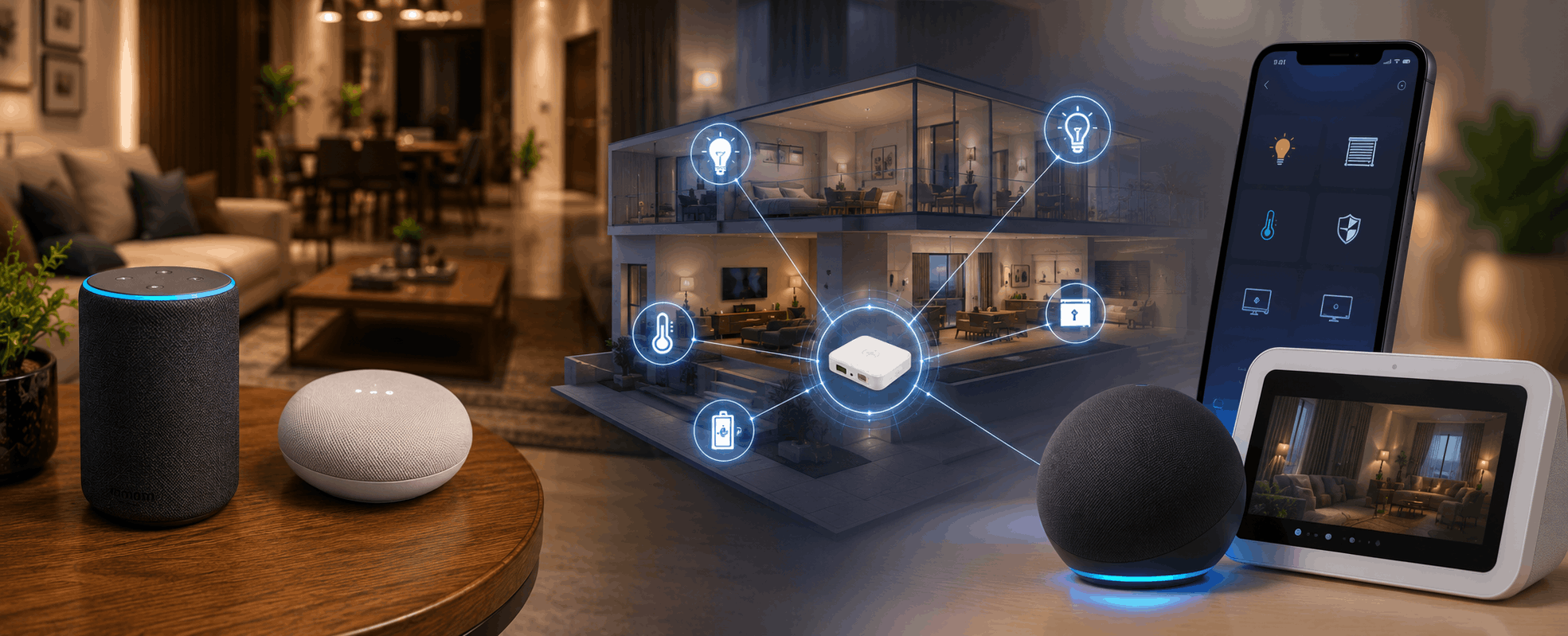
KNX integrates with Alexa and Google Home through a KNX-IP gateway device that links the home's KNX bus to the homeowner's Amazon or Google account, allowing voice commands to trigger the same scenes and devices already programmed into the system. Both Echo (Alexa) and Nest/Google Home devices are readily available in India, and the integration process is largely the same regardless of which ecosystem a household already uses.
This guide focuses specifically on what's different between
the two platforms, what the setup process actually involves, and a few
India-specific considerations worth knowing before choosing one.
How Does the KNX-IP Gateway Connect to Alexa or Google Home?
The underlying mechanism is the same for both platforms:
- A
KNX-IP gateway is installed as part of the home's automation system,
alongside the existing KNX devices on the bus
- The
gateway is configured (via ETS6) to
expose specific devices and scenes — lights, climate zones, scenes like
"Good Night" — as things the gateway can report to a cloud
service
- The
homeowner links their Amazon or Google account to the gateway, typically
through a setup app provided by the gateway manufacturer
- Once
linked, the assistant can discover the exposed devices/scenes and respond
to voice commands for them
This is covered in more general detail in our guide on voice control and KNX integration
— this piece focuses specifically on the differences between Alexa and Google
Home.
What's Different Between Setting Up Alexa vs Google Home with KNX?
While the overall process is similar, there are a few
practical differences worth knowing:
Step |
Alexa |
Google Home |
|
Account linking |
Done via the Alexa app, linking a third-party
"skill" provided by the gateway manufacturer |
Done via the Google Home app, linking the gateway as a
"works with Google" partner integration |
|
Device naming |
Devices/scenes need to be named in the Alexa app for voice
recognition |
Devices/scenes need to be named in the Google Home app,
with support for Google's room/group structure |
|
Routines |
Alexa "Routines" can combine a voice trigger
with the KNX scene and additional Alexa-specific actions |
Google Home "Routines" work similarly, with
tighter integration if other Google ecosystem devices are present |
|
Multi-user households |
Each family member's Alexa profile can have personalized
routines |
Similar personalization available through Google's voice
match feature |
In practice, neither platform is meaningfully harder to set
up than the other — the bigger factor is usually which ecosystem a household
already has more devices in.
Are Alexa and Google Home Devices Easily Available in India?
Yes — both Amazon Echo (various models) and Google Nest
devices are sold through standard retail and online channels in India, and both
companies actively support the Indian market with localized features like Hindi
language support on select devices. This wasn't always the case in the earliest
years of smart speakers in India, but availability and language support have
both improved significantly.
A few India-specific points worth knowing:
- Hindi
and regional language support varies by device generation — newer Echo
and Nest devices generally have broader language support than older models
- Internet
dependency — since voice commands route through the assistant's cloud
service, a stable home internet connection matters more in areas with less
reliable connectivity
- Data
processing location — voice data processing for both platforms is
generally handled through international cloud infrastructure; homeowners
with specific data residency concerns should review each company's current
privacy documentation directly, as this can change
Which Should You Choose — Alexa or Google Home — for a KNX System?
Since the core KNX integration works similarly with both,
the choice usually comes down to factors outside the automation system itself:
- Existing
ecosystem — if the household already uses Android phones and other
Google services, Google Home often feels more integrated; similarly for
existing Amazon/Alexa device owners
- Other
smart devices in the home — some non-KNX smart devices (TVs,
soundbars) may have better native support for one platform over the other
- Family
preference — for households with multiple residents, whichever
platform feels more natural to use daily tends to get used more
consistently
We don't have a strong technical reason to recommend one
over the other purely for KNX integration purposes — the meaningful differences
are mostly about the broader ecosystem a household is already part of.
A Real Example: Running Both Platforms Side-by-Side
For a villa project in Gurgaon, we set up a KNX-IP gateway exposing the same set of scenes to both Alexa and Google Home simultaneously, since different household members preferred different ecosystems. Both assistants successfully triggered the same underlying KNX scenes ("Good Night," "Movie Time") without conflict — the gateway simply reports the same devices/scenes to both cloud accounts independently. This confirmed that choosing one platform over the other isn't a permanent commitment if a household's preferences are mixed.
Conclusion
Both Alexa and Google Home integrate with a KNX system
through essentially the same gateway-based approach, and both are
well-supported in the Indian market today. The choice between them is less a
technical decision and more about which ecosystem a household is already
invested in — and as the Gurgaon example shows, it doesn't have to be an
exclusive choice either. For homeowners planning a new home automation system, this
is a detail worth discussing during the initial scene design phase, alongside
the broader voice integration planning covered in our main voice control guide.
FAQs
Can I use both Alexa and Google Home with the same KNX system at once?
Yes, as shown in the Gurgaon example above, a KNX-IP
gateway can typically be linked to both platforms simultaneously, exposing the
same scenes and devices to each independently.
Does using Alexa or Google Home with KNX require an ongoing subscription?
The voice assistant services themselves (Alexa, Google
Assistant) are free to use. Any cost is in the KNX-IP gateway hardware and its
initial setup as part of the automation system — there's typically no recurring
subscription fee specifically for the voice integration itself.
Will my KNX system still work if Alexa or Google's servers are down?
Voice commands wouldn't work during an outage because they rely on the assistant's cloud service. However, keypads, schedules, and
locally-programmed KNX logic continue to function independently, since they
don't rely on either company's cloud infrastructure.
Is one platform more reliable than the other for Indian users specifically?
Both platforms are widely used and well-supported in India at this point. Reliability differences, where they exist, tend to be more about general internet connectivity at a specific location than about one platform being inherently better suited to India.