

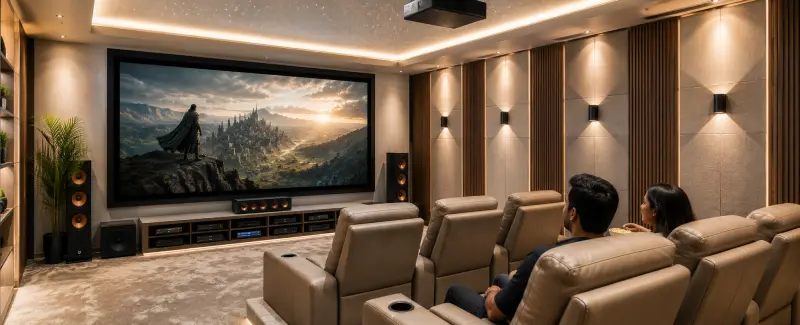
The same pair of speakers can sound excellent in one room and disappointing in another. That's because you never hear only what the speaker produces, you hear the speaker plus everything the room does to that sound on its way to your ears. In a bare room with hard walls and a marble floor, a large share of what reaches you has bounced off a surface first. That reflected sound is what makes dialogue hard to follow, bass uneven from seat to seat, and expensive systems sound ordinary.
We design and install home theatres across Delhi NCR, Noida, Gurgaon and Jaipur, and room acoustics is the single most common reason a well-funded theatre underperforms. This guide explains what the room actually does to your speakers, why Indian homes make it harder, and what genuinely fixes it.
What Does a Room Actually Do to Sound?
When a speaker plays, sound travels in every direction, not just towards you. Some reaches your ears directly. The rest hits walls, ceiling, floor and furniture, bounces off, and arrives a fraction of a second later.
Your ears receive both — and can't separate them. What you perceive as "the sound of your speakers" is really the combination.
In a room with soft furnishings, carpet and curtains, much of that reflected energy is absorbed and the direct sound dominates. In a room with tile or marble flooring, plastered walls and glass windows, very little is absorbed. The reflections stay loud, arrive from every direction, and blur what you're hearing.
This is why speaker upgrades often disappoint in untreated rooms. A better speaker produces better direct sound — but the room is still doing the same thing to it.
What Specifically Goes Wrong in an Untreated Room?
Four things, and most people experience all four without knowing what they're called.
Dialogue gets harder to follow. Reflections arrive slightly after the direct sound and overlap with it. Consonants smear together. You end up turning the volume up, which makes everything louder without making speech clearer.
The soundstage collapses. In a well-treated room you can point to where a sound is coming from — a voice from the centre, a car from the left. Strong early reflections confuse that positioning, and everything seems to come from "somewhere in front" rather than a specific place.
Bass becomes uneven. Low frequencies interact with room dimensions in a way higher frequencies don't. The result is that bass can be overpowering in one seat and almost absent in another, a few feet away. Moving the subwoofer changes the pattern but doesn't remove it.
High frequencies turn harsh. Two parallel hard walls let sound bounce back and forth repeatedly. It adds a brittle edge to the top end that people often blame on the speakers or the receiver.
Why Are Indian Homes Harder Acoustically?
Most Indian homes are built in ways that happen to be acoustically unhelpful:
Common Feature | Acoustic Effect |
|---|---|
| Marble, granite or tile flooring | Reflects almost everything; very little absorbed |
| Plastered brick or concrete walls | Hard, reflective surfaces on all sides |
| Large glass windows and balcony doors | Highly reflective, and thin against outside noise |
| Minimal soft furnishing in formal rooms | Nothing to absorb reflections |
| Rectangular rooms with parallel walls | Encourages repeated back-and-forth reflection |
| False ceilings with hard finishes | Another reflective surface directly overhead |
None of this is a design flaw for normal living — it's practical for Indian climate and maintenance. But it means a home theatre room in India usually needs more acoustic attention than the equivalent room elsewhere.
Soundproofing and Acoustic Treatment Are Not the Same Thing
This is the most common confusion we encounter, and it costs people money.
Soundproofing | Acoustic Treatment | |
|---|---|---|
| Purpose | Stops sound entering or leaving the room | Improves how sound behaves inside the room |
| Problem it solves | Neighbours complaining, traffic noise intruding | Echo, muddy dialogue, uneven bass |
| Typical measures | Heavy doors, sealed gaps, dense wall layers, floating construction | Absorption panels, bass traps, diffusers, carpet, curtains |
| Involves | Mass and airtightness | Surface materials and placement |
Buying acoustic foam panels will not stop sound reaching your neighbours. Building a soundproof room will not automatically make it sound good inside. Most theatre rooms need both, and they are separate line items in a quote.
What Does Acoustic Treatment Actually Do?
Three jobs, using three different approaches:
Absorption soaks up reflected energy so less of it reaches your ears. Panels at the points where sound bounces off the side walls, rear wall and ceiling. This is what fixes muddy dialogue and restores clear imaging.
Bass traps deal with low frequencies, which behave differently and collect in room corners. These are usually thicker and placed in corners rather than on flat wall areas.
Diffusion scatters reflections rather than absorbing them. Used mainly on rear walls, so the room doesn't end up sounding unnaturally dead — you want reflections controlled, not eliminated.
A common mistake is over-absorbing. A room with panels on every surface sounds lifeless and closed-in. The aim is balance, which is why treatment is planned per room rather than applied uniformly.
How Do You Find Where Treatment Should Go?
The most useful practical technique is the mirror method, and it costs nothing:
- Sit in your main viewing seat
- Have someone slide a small mirror along the side wall at ear height
- Wherever you can see a speaker in the mirror from your seat, that's a point where sound bounces directly to you
- Mark it — those are your first reflection points
Repeat for both side walls, the ceiling and the rear wall. These marked points are where absorption does the most work, and treating them is usually a larger improvement than treating a much greater area at random.
What Changes After Treatment?
Clients consistently describe the same three things:
Dialogue becomes clear at lower volume. Because reflections aren't competing with speech, you no longer push the volume up to understand what's being said.
Sounds have a location. Effects move across the room properly. Voices come from the screen. The system starts doing what surround sound was supposed to do.
Bass tightens. Instead of a general boom that fills the room, low notes have definition and shape — and the difference between seats reduces.
None of this requires changing the speakers. It's the same equipment, in a room that's no longer working against it.
Does Speaker Placement Still Matter?
Very much — and placement and acoustics work together rather than substituting for each other.
Placement decides where sound arrives from and when. Acoustics decides how much reflected sound comes with it. Getting placement right in an untreated room helps, but reflections still blur the result. Treating a room where speakers are badly placed also helps, but the fundamental imaging is still wrong.
We cover positioning in detail in our guide on home theatre speaker placement, which follows CEDIA's RP-1.1 recommendations for placement and calibration.
What Does Acoustic Work Cost in India?
Item | Approx. Cost |
|---|---|
| Acoustic wall panels (per room, dedicated theatre) | ₹1,50,000 – ₹6,00,000 |
| Bass traps | ₹40,000 – ₹1,50,000 |
| Diffusers (rear wall) | ₹50,000 – ₹2,00,000 |
| Soundproofing — doors, walls, ceiling | ₹2,00,000 – ₹8,00,000 |
| Heavy curtains and carpet | ₹50,000 – ₹2,00,000 |
| Acoustic design consultation | ₹25,000 – ₹1,00,000 |
Cost depends heavily on room size, whether treatment is decorative or purely functional, and how much soundproofing is needed. These are indicative estimates — an accurate figure comes from a room assessment. For the full picture including equipment, see our home theatre cost guide.
What If You Don't Have a Dedicated Theatre Room?
Most Indian homes don't, and there's a lot you can still do in a living room without turning it into a studio:
- Carpet or a large rug across the seating area — the floor is usually the largest reflective surface
- Heavy curtains on windows, especially on the wall behind or beside the speakers
- Fabric seating rather than leather or hard-backed furniture
- A bookshelf on the rear wall — irregular contents scatter sound naturally
- Anything soft on the wall opposite the speakers — art on fabric backing, wall hangings
- Avoid a fully bare wall directly behind the seating
None of this looks like acoustic treatment, and the improvement is genuine. It won't match a treated room, but it addresses the worst of the problem in a space that also has to work as a living room.
A Real Project: Dedicated Theatre Room, Ozone City, Aligarh
In a dedicated theatre room within a 75,000 sq ft luxury farmhouse at Ozone City, Aligarh, we installed a 7.1.4 Dolby Atmos layout — TruAudio in-ceiling speakers for the four height channels, in-wall front left, right and centre flanking a 4K motorised screen, side and rear surrounds, and dual subwoofers in the front corners.
The acoustic work was planned alongside the speaker layout, not after it. Absorption at the first reflection points on both side walls and the ceiling, bass traps in all four corners, diffusion on the rear wall behind the seating, thick carpet, and fabric-upholstered recliners. Because the room was treated as part of the build rather than retrofitted, panels were integrated into the wall design instead of mounted onto finished surfaces.
The practical outcome the client noticed first was dialogue clarity — being able to follow speech comfortably at a volume that doesn't fill the rest of the house.
FAQs
Why does my expensive home theatre sound bad?
The most common cause is an untreated room rather than the equipment. In a room with hard floors, bare walls and glass, a large share of what you hear is reflected sound rather than direct sound from the speakers — which blurs dialogue, weakens imaging and makes bass uneven from seat to seat.
Will acoustic treatment fix bad speakers?
No. Treatment lets speakers perform as they were designed to. It cannot add capability that isn't there. But in practice, most disappointing home theatres have adequate speakers in a poor room rather than the reverse.
What's the difference between soundproofing and acoustic treatment?
Soundproofing controls sound entering or leaving the room — it solves neighbour and traffic problems. Acoustic treatment controls how sound behaves inside the room — it solves echo, unclear dialogue and uneven bass. They use different materials and solve different problems.
Can I treat a living room without it looking like a studio?
Yes. Carpet, heavy curtains, fabric seating and a bookshelf on the rear wall all absorb or scatter reflections while looking like normal furnishing. Fabric-wrapped panels can also be made in finishes that read as wall panelling rather than acoustic products.
Is acoustic foam from online marketplaces useful?
Thin foam absorbs some high frequencies but does very little for the midrange and almost nothing for bass — which is where most room problems sit. It also does nothing for soundproofing. It can help slightly with flutter echo, but it isn't a substitute for properly specified treatment.
When should acoustics be planned in a project?
At the design stage, alongside speaker layout and before the room is finished. Treatment planned early can be built into the wall construction and finished to match the interior. Retrofitting means mounting panels onto completed surfaces, which is more visible and usually more expensive.
Planning a Home Theatre?
The most reliable way to get a room that sounds good is to plan the acoustics and the speaker layout together, before the room is finished. If you're building or renovating a home theatre in Noida, Delhi NCR, Gurgaon or Jaipur, talk to our team for a room assessment. You can also explore our home theatre and audio-video services, or read our guide on building your first home theatre.