

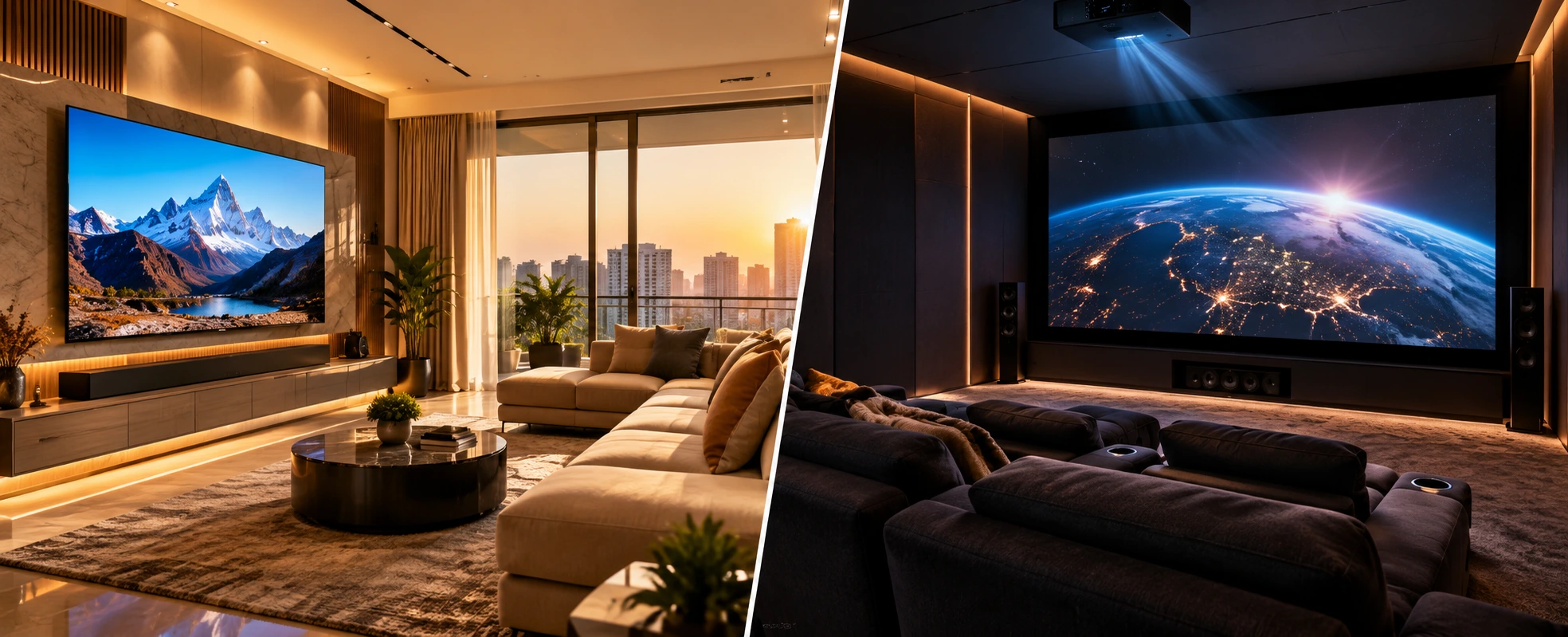
A projector is better when you can control the room's lighting and want a screen above 100 inches. A large-screen TV is better in a bright living room, for everyday viewing, and where nobody wants to dim the lights to watch something. The deciding factor isn't picture quality; both are excellent now; it is how much daylight hits the screen and how big the image needs to be. In most Indian homes, the honest answer is both: a TV in the living room, a projector in a dedicated room.
The Question Behind the Question
Almost everyone who asks us this has already decided they want a home cinema. What they are really asking is whether a projector is worth the trouble.
It is a fair question. A television arrives in a box, sits on a wall, and works. A projector needs a screen, a throw distance, a mounting point, cable routing, and a room that can be darkened. One is an appliance. The other is an installation.
So rather than declare a winner, this guide works through the five things that actually decide it - light, size, lifespan, cost, and use - and tells you plainly which rooms suit which. In a fair number of homes, we specify a television, not a projector, and we will explain exactly when.
Which Is Better for a Home Cinema - Projector or TV?
For a dedicated home cinema room, a projector. Nothing else gives you a 120-inch image at a sane cost, and a dedicated room solves the projector's one real weakness by removing ambient light.
For a living room that doubles as a cinema, a large-screen TV. It stays watchable at 4 p.m. with the curtains open, and it does not ask the family to change the room's lighting in order to use it.
That is the short version. The detail is below, because the gap between those two cases is where most buying mistakes happen.
How Much Does Room Light Matter?
More than any other factor, and it is the one Indian buyers underestimate.
A television produces its own light. A projector reflects light off a screen, so every competing light source in the room - a window, a tube light, a glass door - subtracts from the contrast of the image. A projected image in a bright room does not look dimmer so much as washed out: blacks turn grey, and the picture loses depth.
Projector brightness is measured in ANSI lumens, and the published guidance maps to room conditions roughly like this:
| ANSI lumens | Suits |
|---|---|
| 1,500 – 2,500 | Smaller screens in a room with low ambient light |
| 2,500 – 4,000 | Medium screens with some ambient light |
| 4,000+ | Very large screens, or rooms without light control |
Now apply that to an Indian home. Living rooms here are typically designed for daylight - large windows, balcony doors, often more than one aspect. A north-facing drawing room in Delhi at midday carries a great deal of ambient light, and a 2,500-lumen projector will struggle in it no matter what the box claims.
The practical test: stand in the room at the time of day you will actually watch. If you cannot comfortably darken it then - not at 9 p.m., but at 4 p.m. on a Sunday - a television will make you happier. If you can, a projector will outperform anything a TV can do at that size.
This is also why basements are so well suited to cinema rooms, a point we covered in our Delhi home theatre guide - no windows means complete control.
What About Screen Size?
This is where projectors win decisively and where the cost logic inverts.
Televisions scale in price steeply with size. Projectors do not - the screen is fabric and a frame, so going from a 100-inch to a 120-inch image costs comparatively little. The projector itself does not change.
| Image size | Television | Projector |
|---|---|---|
| Up to 75" | Comfortable, widely available | Possible, but a TV is simpler |
| 75" – 100" | Available, cost rises sharply | Projector becomes competitive |
| 100" – 150" | Very limited and very expensive | Projector's natural territory |
| Above 150" | Not realistic for homes | Routine for projectors |
There is a second consideration people forget: seating distance. A large image in a small room is uncomfortable rather than impressive — you end up scanning the screen instead of seeing it whole. As a rough working guide, we size the image to the seating distance rather than to the biggest number the budget allows, and in a typical 12–14 ft deep Indian cinema room that often lands around 100–120 inches rather than the 150 the client first asked for.
TV vs Projector Lifespan - What Lasts Longer?
A genuine difference, and the answer depends entirely on which kind of projector.
Lamp projectors are the weak case. Lamps lose brightness quickly and need replacement - published figures range from as little as 1,000–2,000 hours of use up to Philips' claim of over 10,000 hours for its UHP lamps, which tells you how much the figure varies by lamp and by how hard it is driven. Lamps are also a consumable cost, not a one-time purchase.
Laser projectors changed this. Typical laser light sources used in projectors are rated for around 20,000 hours before light output falls to 50%. At four hours of viewing a day, that is well over a decade before the image is at half brightness. No lamp to replace.
Televisions are generally rated for longer still, and in practice a TV is usually replaced because it has become obsolete rather than because the panel failed.
Two honest caveats. First, panel-life and light-source figures are manufacturer ratings under test conditions, not guarantees - check the specific model rather than trusting a category. Second, "50% brightness at 20,000 hours" is not a failure point; it is a gradual decline you may not notice until you see a new unit beside it.
The practical takeaway: if you are buying a projector in 2026 for a room you intend to use regularly, specify laser. The lamp-versus-laser decision matters far more to your long-run cost than the projector-versus-TV decision does.
Is a Projector Better Than a TV for Your Eyes?
This question comes up constantly, and the honest answer is more careful than what you will read elsewhere.
What is actually true: a television emits light directly at you. A projector's image reaches you as light reflected off a screen. That is a real optical difference, and it is the basis of the claim.
What is not established: that this difference produces a measurable eye-health benefit. When we looked for independent evidence, effectively every source making the "better for your eyes" claim was a projector manufacturer or a site earning affiliate commission on projectors. We found no ophthalmological body or peer-reviewed work supporting it. That does not make the claim false - it means it is unproven and commercially motivated, and we are not going to repeat it to you as fact.
What does affect viewing comfort, regardless of display type:
- Screen brightness relative to the room. A very bright screen in a dark room is the uncomfortable combination, whichever technology produces it. Bias lighting behind the screen helps.
- Viewing distance. Too close is tiring on any display.
- Duration. Long unbroken sessions cause more strain than the hardware does.
- Calibration. Most displays leave the factory far brighter than a dark room needs. Reducing brightness to suit the room is one of the easiest improvements available, and it is part of our commissioning on every cinema install.
If eye comfort is a genuine medical concern for someone in the household, that is a question for an eye-care professional, not for an AV integrator or a product page.
The same applies to the question about babies and young children. We are not going to give you a medical answer. What we can say practically: sit children further back rather than closer, keep the room softly lit rather than fully dark, keep sessions short, and set screen brightness down. Those are sound for any screen. The projector-versus-TV distinction is not the thing that matters here.
LED TV or Projector - Which Is Best?
Worth separating, because "LED TV" covers a wide range.
Modern premium televisions - including LG's OLED range, which we specify regularly - produce genuinely excellent contrast and perfect blacks, because each pixel can switch off entirely. In a bright room, no projector matches that. In a fully dark room, a good projector on a large screen delivers a scale and a cinema quality that a 65-inch panel simply cannot, even with better per-pixel contrast.
So the comparison resolves by room, not by specification sheet:
| Bright room | Dark room | |
|---|---|---|
| Large-screen TV | Clear winner | Very good, but small by comparison |
| Projector | Washed out | Clear winner |
One real TV-side consideration for Indian homes: static content and OLED. News tickers and sports scoreboards sit in the same place for hours, and OLED panels can be susceptible to image retention with heavy static content. Manufacturers include mitigation features, and for most viewing it is a non-issue - but a household that watches news channels all day is a case we would discuss rather than default to OLED.
Smart TV or Projector - Which Is Better for Everyday Use?
For everyday use, the TV, and it is not close.
A television turns on instantly, works in any light, needs no screen to lower, and anyone in the house can operate it. Projectors take a moment to reach full brightness, and in a properly integrated room the sequence involves a screen, lighting, and sources moving together.
That sequence is exactly what automation is for. In the rooms we build, one keypad press lowers the screen, dims the lights, closes the curtains, and switches the projector to the right input. Done properly, it takes a couple of seconds and one button - which removes most of the day-to-day friction people associate with projectors. We cover how that logic is built in our guide to AV receivers and sources.
But the honest framing is this: a projector rewards intent. You decide to watch something. A television suits ambient viewing - background cricket, the news while eating, a child's cartoons on a weekday morning. Most households want both behaviours, which is why most of our clients end up with both devices in different rooms.
What Does Each Cost in India?
Indicative planning ranges only, not quotations, and excluding the automation and acoustic work around them. Confirm current pricing for the specific model and finish.
| Setup | What it includes | Indicative range |
|---|---|---|
| Large-screen TV, 65"–77" | Premium panel, wall mount, basic calibration | ₹2,00,000 – ₹6,00,000 |
| Large-screen TV, 83"+ | Flagship panel, mount, calibration | ₹6,00,000 – ₹15,00,000+ |
| Entry laser projector + screen | Projector, fixed-frame screen, mount, cabling | ₹3,50,000 – ₹7,00,000 |
| Premium home cinema projector + screen | 4K laser projector, acoustically transparent screen, masking | ₹8,00,000 – ₹25,00,000+ |
Two costs buyers routinely omit from the projector column: the screen — a good acoustically transparent screen is a significant line item, not an accessory - and the room, meaning the acoustic treatment, blackout, and seating that make the projector worth having. Our home theatre cost guide breaks the full room budget down, and acoustics explains why the room matters as much as the display.
A television needs none of that to be useful on day one. That is a real part of its value, and we would rather say so than pretend otherwise.
So Which Should You Choose?
| Your situation | Our recommendation |
|---|---|
| Dedicated room, light controllable | Laser projector, 100"–130" screen |
| Basement or windowless room | Projector — the ideal case |
| Living room, large windows | Large-screen TV |
| Daily mixed viewing, news and sport | Large-screen TV |
| Occasional film nights in a living room | TV, with a retractable projector screen only if you will actually use it |
| Terrace or garden screening | Projector — see our outdoor cinema guide |
| Cricket with a crowd | Projector if the room darkens, otherwise a TV — see our cricket screening guide |
| Budget under ₹3,00,000 total | TV. A cheap projector in a bright room disappoints. |
That last row matters. The most common disappointment we are called to fix is not a bad projector — it is a reasonable projector in a room that was never going to suit one.
A Note on Two Projectors, Not Two Technologies
If you have already settled on a projector, the next decision is throw type — a long-throw projector mounted behind the seating versus an ultra-short-throw unit sitting just below the screen. That is a different comparison with its own trade-offs, particularly around screen matching, and we treat it separately in our ultra-short-throw guide.
Frequently Asked Questions
Is a projector better than a TV for a home cinema?
In a dedicated room where you can control the light, yes — a projector delivers a 100-inch-plus image at a cost no television can match at that size. In a bright living room, a large-screen TV is better, because a projected image loses contrast as soon as ambient light hits the screen. The room decides, not the technology.
Which lasts longer, a TV or a projector?
Televisions generally last longer and are usually replaced for obsolescence rather than failure. Among projectors, the difference is large: lamp units need lamp replacement, with published figures ranging from 1,000–2,000 hours up to manufacturer claims above 10,000, while typical laser light sources are rated around 20,000 hours before output falls to 50%. For a regularly used room, specify laser.
Is a projector better than a TV for your eyes?
A TV emits light directly while a projector reflects it off a screen, which is a real optical difference — but we could find no independent clinical evidence that it produces a health benefit, and effectively every source making that claim sells projectors. What genuinely affects comfort is screen brightness relative to the room, viewing distance, session length, and calibration. For a medical concern, ask an eye-care professional.
Is an LED TV or a projector best?
In a bright room, a premium TV wins on contrast and convenience. In a dark room, a projector wins on scale. Modern OLED panels give perfect blacks that projectors cannot match per pixel, but a 65-inch panel cannot produce the presence of a 120-inch image. Choose by room light first.
Can I use a projector in a normal Indian living room?
You can, but manage expectations. With large windows and daytime viewing, you need high brightness, good blackout, and ideally a screen suited to ambient light. Many clients who start here end up happier with a TV in the living room and a projector in a dedicated room. Stand in the room at the hour you will actually watch before deciding.
Do I need a screen, or can I project onto a wall?
A wall works and will show a picture, but a proper screen has a controlled surface and gain that a painted wall cannot match, and it fixes the image geometry. If you are spending meaningfully on a projector, the screen is not the place to economise — it is part of the display, not an accessory.
Planning a Home Cinema?
The display is one decision inside a larger one — room, light, acoustics, seating and control all shape the result. Our team assesses the actual room before recommending either, and will tell you when a television is the better answer.
Talk to our team about a room assessment, or explore our home theatre and audio-video services.