

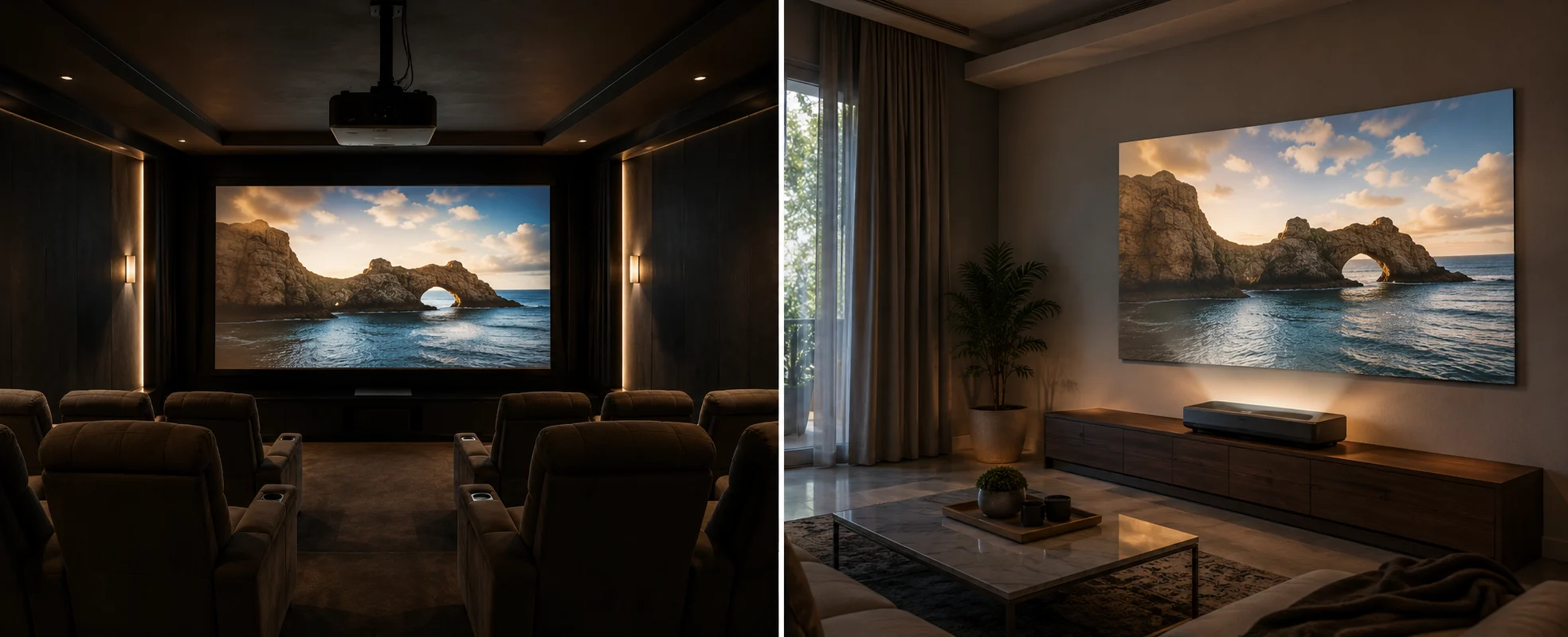
A standard projector sits several metres from the screen, usually ceiling-mounted behind the seating. An ultra-short-throw projector sits on a cabinet directly beneath the screen, a few inches from the wall. Both put a large image on a wall, but they suit quite different rooms — and choosing between them is a decision about the room, not about which technology is better.
If you have a dedicated cinema room that can be made dark, a standard projector will generally give you a better result at large screen sizes. If you're putting a cinema into a living room with windows and no way to run a ceiling mount, ultra-short throw is often the more sensible answer.
Here's how to work out which applies to you.
What's Actually Different?
The difference is throw distance — how far the projector has to sit from the screen to produce a given image size.
A standard projector needs distance. Depending on the model and its zoom range, a 120-inch image typically requires the projector to sit several metres back, which usually means ceiling-mounting it behind or above the seating position.
An ultra-short-throw projector uses a specialised lens to produce the same size image from a few inches away, sitting on furniture directly below the screen.
Everything else that follows — cabling, light handling, screen choice, installation — comes from that single difference.
Which Room Suits Which?
This is the question that actually decides it.
Standard projector | Ultra short throw | |
|---|---|---|
| Best in | Dedicated cinema room | Living room, multipurpose space |
| Light control needed | High — works best in a dark room | Moderate, with a matched screen |
| Ceiling mount | Required | Not required |
| Cable run | Long, to ceiling position | Short, to a cabinet |
| Beam obstruction | Possible — people walking through | None |
| Maximum image size | Larger sizes readily achievable | More limited at the top end |
| Ceiling height | Matters for mounting | Not a factor |
| Positioning tolerance | Fixed once mounted | Sensitive — cabinet movement shifts geometry |
Choose a standard projector if the room is dedicated to cinema, can be made properly dark, has ceiling access for mounting and cabling, and you want the largest possible image.
Choose ultra short throw if the room is also a living room, ceiling mounting isn't practical or wanted, there's ambient light you can't fully control, or you're effectively replacing a television.
Why Does the Screen Matter So Much?
This is the part most often skipped, and getting it wrong undoes the projector choice entirely.
Screens are matched to the projector type. An ambient light rejecting screen rejects light arriving from certain angles while reflecting light arriving from the projector. That means the screen structure has to match where the projector actually is.
A screen designed for a standard projector expects light from the front, at a distance. A screen designed for ultra-short throw expects light arriving from steeply below. They are not interchangeable.
Put a UST projector on a screen designed for long throw, and you lose most of the ambient light rejection you paid for. It is one of the more expensive mismatches in home cinema, and it happens regularly.
For a dedicated dark room, a standard matte white screen is often the better choice than an ALR screen — with no ambient light to reject, ALR adds cost and can narrow the viewing angle for no benefit.
In a living room, the screen does as much work as the projector. Budget for it accordingly rather than treating it as an accessory.
How Much Light Control Do You Actually Need?
Both technologies want darkness. One tolerates its absence better.
A standard projector in a room with daylight will produce a washed-out image regardless of how bright the projector is. Blackout curtains or blinds are not optional in a dedicated room — they're part of the system.
An ultra-short throw paired with a matched ALR screen handles moderate ambient light considerably better. It is not the same as a television in a bright room, and anyone claiming otherwise is overselling — but it is usable in daylight in a way a ceiling-mounted projector on a white screen is not.
Motorised blackout blinds solve this in either case, and when they're on the automation system, they close as part of the movie scene rather than being something someone has to remember. Our home theatre cost guide covers what that layer adds.
What's Different About Installing Them?
Standard projector
Ceiling mount, with a bracket rated for the projector's weight and fixed into the slab rather than false ceiling board alone.
Cable run from the rack to the ceiling position — HDMI and power, plus control if it's integrated into scenes.
Position determined by throw calculation, not by where it looks tidy. The mount position follows the required distance for the screen size.
Screen positioning and masking, if used.
All of this needs deciding before the false ceiling closes. Retrofitting a ceiling mount and cable run into a finished ceiling is possible but disruptive.
Ultra short throw
Cabinet position is the installation. It has to sit at the correct distance and height from the screen, and it has to be level.
Cable run is short — to the cabinet rather than the ceiling.
The critical point: the cabinet must not move. A UST projector is geometrically sensitive. A cabinet nudged a couple of centimetres during cleaning shifts the image noticeably and needs realignment. A fixed or heavy console is a better choice than a light, movable one.
What About Sound?
Worth noting because it affects the room layout more than people expect.
With a standard projector, the screen wall is free for speakers — front left, centre and right can sit behind an acoustically transparent screen or immediately around it, which is the ideal arrangement.
With an ultra-short throw, the cabinet occupies the space directly below the screen where a centre channel would normally go. That doesn't rule out proper audio, but it does need planning — an in-wall centre channel, or a centre positioned above the screen, or a soundbar arrangement if the room is more casual.
Our speaker placement guide covers where the front channels should ideally sit.
What Do They Cost?
| Item | Approx. Cost |
|---|---|
| Standard 4K projector | ₹1,50,000 – ₹15,00,000+ |
| Ultra-short-throw projector | ₹2,00,000 – ₹8,00,000 |
| Fixed frame screen (matte white) | ₹40,000 – ₹2,00,000 |
| ALR screen for standard throw | ₹1,00,000 – ₹4,00,000 |
| ALR screen matched to UST | ₹1,50,000 – ₹5,00,000 |
| Motorised screen | ₹80,000 – ₹4,00,000 |
| Ceiling mount, cabling and installation | ₹25,000 – ₹1,00,000 |
Indicative estimates. Projector pricing spans a very wide range depending on brightness, contrast and light source, so these are planning figures rather than quotes.
The point worth taking from this table: the screen is a significant share of the budget, particularly for UST. A projector and a poorly chosen screen is a worse outcome than a more modest projector and the right one.
We work with BenQ, Epson, Panasonic and LG for projection, selected against room size, ambient light and mounting constraints rather than by default.
Which Should You Choose?
Three questions settle it in most cases.
Is the room dedicated to cinema, or does it have another job? Dedicated room, and you can make it dark — standard projector. Living room that also hosts a cinema — ultra-short throw.
Can you ceiling-mount? If ceiling access, slab fixing, or cable routing rules it out, ultra-short throw removes the problem entirely.
How large does the image need to be? At the largest sizes, standard projectors are more readily available and generally more economical. If you want a genuinely large screen, that points toward long throw.
A note on the middle case: a dedicated room with poor light control is the awkward one. Fixing the light control — blackout blinds, dark surfaces — is usually a better investment than switching technology, because a properly dark room improves everything about the result rather than just working around one problem.
FAQs
Is an ultra short throw projector as good as a standard projector?
Neither is better in general. In a dedicated dark room, a standard projector typically produces a better result, particularly at large sizes. In a living room with ambient light and no ceiling mount, a UST with a matched screen is usually the better outcome. The room decides.
Can I use any screen with an ultra short throw projector?
No, and this is the most costly mistake in this category. Ambient light rejecting screens are designed around where the light comes from. A screen made for a standard projector will not perform correctly with a UST, because the light arrives at a completely different angle.
Does an ultra short throw work in a bright room?
Better than a standard projector, when paired with a matched ALR screen. It is not equivalent to a television in full daylight, and claims to that effect are overstated — but it is genuinely usable in moderate ambient light.
Which is easier to install?
Ultra short throw, clearly. No ceiling mount, no long cable run, no throw distance calculation. The trade-off is that it's geometrically sensitive — the cabinet has to stay exactly where it was aligned.
Can either be integrated into a home automation system?
Both can. Power, input selection, and screen control can all be part of a single "Movie" scene alongside lighting and blinds, so one press sets the room up. This needs planning at the cabling stage.
Do I still need blackout blinds with an ultra short throw?
Not strictly, which is much of the appeal. But the result improves with them, and if they're motorised and on the automation system, they close as part of the scene rather than being a chore. For a dedicated room with a standard projector, they aren't optional.
Which is better for watching sport or gaming?
Both handle it. For daytime sport in a living room, UST with an ALR screen is the more practical choice because the room doesn't need darkening. For a dedicated room used in the evening, either works.
Planning a Private Home Cinema?
The projector is usually the last decision that should be made, not the first. Room, light control, seating distance, and screen size come first — and once those are settled, which projector type suits becomes fairly obvious.
If you're planning a home cinema in Noida, Delhi NCR, Gurgaon, or Jaipur, talk to our team — we'd rather look at the room before recommending anything. You can also explore our home theatre and audio-video services, or read our guide to building your first home theatre.