

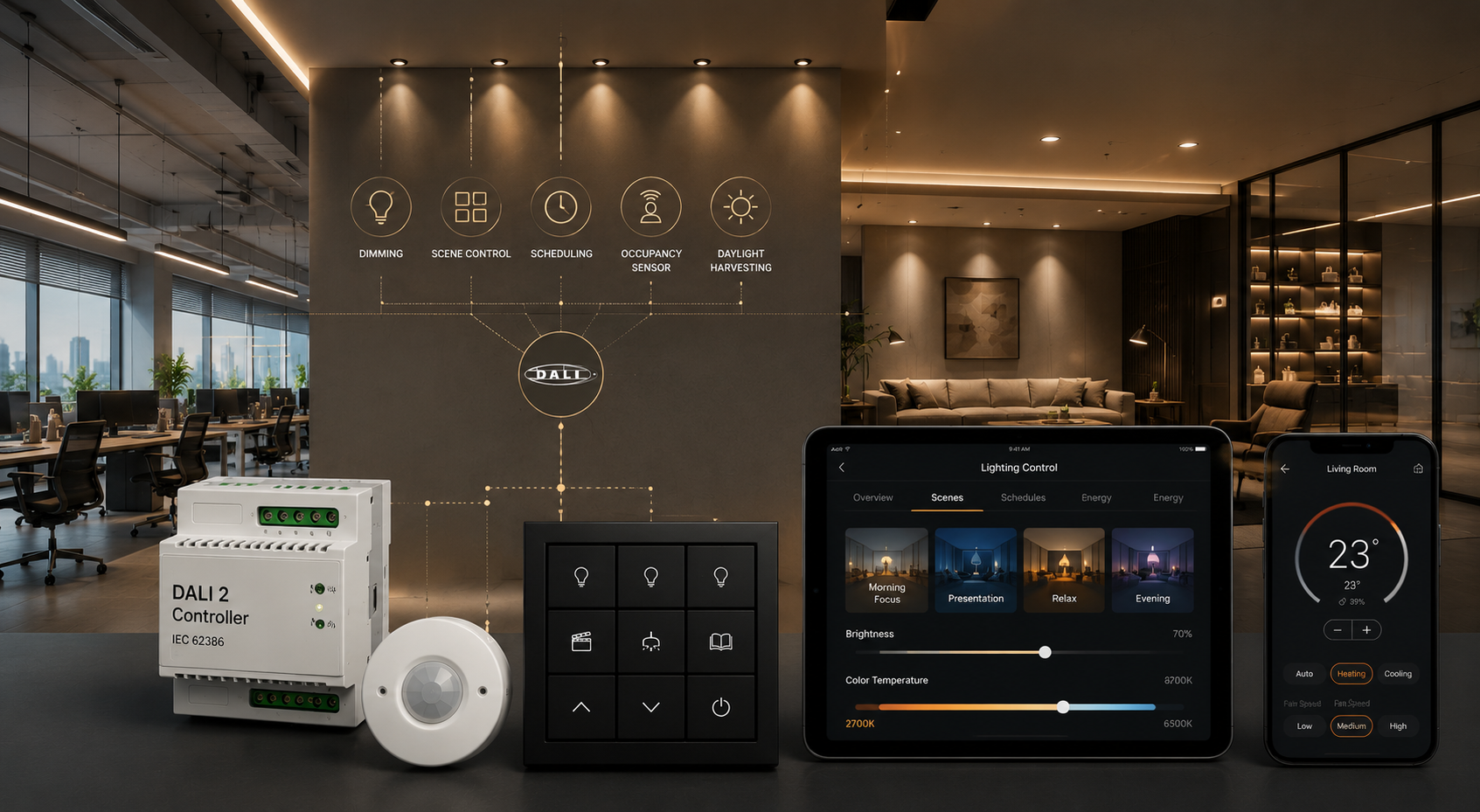
In today's modern world, whether it's a smart home in
Noida, a corporate office in Gurgaon, or a hospital in Jaipur, lighting plays
a crucial role not just in visibility but in comfort, productivity, and
well-being. DALI lighting India deployments are growing rapidly as
architects, interior designers, and facility managers shift from basic
switch-based control to intelligent, addressable lighting systems.
DALI (Digital Addressable Lighting Interface) is leading the way in revolutionizing lighting control, especially when combined with human-centric lighting (HCL) and precision dimming. In our projects across Delhi NCR and Rajasthan, we have installed DALI systems in luxury homes, hotel properties, and corporate offices where individual fixture control, energy savings, and long-term scalability were the primary requirements.
What is DALI - Lighting Automation in a Smart Home or Commercial Space?
DALI is a standardized protocol (IEC 62386) used in lighting automation systems to enable two-way communication between lighting
drivers, sensors, and controllers. Every DALI device has its own unique
address, meaning each luminaire can be individually dimmed, grouped, and
monitored without any additional control wiring.
DALI automation refers to programming lighting behaviour
based on pre-set schedules, occupancy sensors, daylight sensors, or user
commands. Unlike traditional on/off switching, DALI gives the system
intelligence; it knows when a room is occupied, what the ambient light level
is, and what scene should be active at any point in the day.
Core DALI capabilities:
- Bi-directional
communication, the controller sends commands AND receives status feedback
from each device
- Scene-setting
and dynamic lighting adjustment across multiple zones simultaneously
- Individual
addressing of up to 64 devices per DALI line (expandable with multiple
lines)
- Full
integration with Building Management Systems (BMS) and KNX protocols
- Real-time energy metering per circuit
DALI vs DALI 2 - What is the Difference in India?
DALI 2 is the upgraded version of the original DALI
standard, ratified by the DALI Alliance and now the international benchmark for
professional lighting installations. For anyone planning a DALI lighting
control upgrade in India, understanding this difference is essential before
specifying equipment.
|
Feature |
DALI (Original) |
DALI 2 (Current Standard) |
|
Standard |
IEC 62386 Part 1-3 |
IEC 62386 Part 1-3 + extended parts |
|
Device certification |
Not mandatory |
Mandatory - all devices tested |
|
Interoperability |
Manufacturer-specific quirks common |
Full cross-brand interoperability guaranteed |
|
Input devices (sensors) |
Not standardised |
Standardized - occupancy, light, push-button |
|
Energy reporting |
Basic |
Per-device power and energy metering |
|
Diagnostic capability |
Limited |
Full fault reporting and driver diagnostics |
|
Wireless extension |
Not supported |
DALI+ (wireless) available |
|
India availability |
Legacy systems |
All current suppliers - ABB, Tridonic, OSRAM, Helvar |
For new installations in India, always specify DALI 2.
Original DALI devices from different manufacturers often have subtle
compatibility issues that only appear during commissioning. DALI 2
certification eliminates this problem - a DALI 2 certified driver from
Tridonic will behave identically to one from OSRAM when addressed by the same
DALI 2 controller.
How Does DALI Dimming Work?
Dimming is not just about mood lighting - it is the
foundation of energy efficiency and occupant comfort in any professional space.
DALI dimming operates on a logarithmic scale that matches human perception of
brightness:
- Range:
0.1% to 100% brightness - smooth, flicker-free, at any point in the range
- Energy
reduction: A room dimmed to 50% brightness consumes approximately
40–45% less electricity
- Luminaire
longevity: Operating at 70% average brightness can extend LED driver
life by 30–40%
- Daylight
harvesting: Linked to a daylight sensor, DALI dimmers automatically
reduce artificial light when sufficient natural light is available - a
standard feature in DALI lighting India installations for LEED-rated
buildings
Traditional phase-cut dimmers (the type used in residential
buildings) cause flicker, are incompatible with LED drivers, and provide no feedback to
the control system. DALI dimming eliminates all three problems because it
communicates digitally with each driver individually.
Human-Centric Lighting and DALI - Why India's Workplaces Need It
Human-Centric Lighting (HCL) is the practice of
designing lighting that aligns with the natural human circadian rhythm —
adjusting colour temperature and intensity throughout the day to support
alertness, focus, and rest at biologically appropriate times.
|
Time of Day |
Colour Temperature |
Intensity |
Effect |
|
7–9 AM |
5,000–6,500K (cool white) |
300–500 lux |
Activates alertness, suppresses melatonin |
|
10 AM–3 PM |
4,000–5,000K |
400–600 lux |
Supports focus and concentration |
|
4–6 PM |
3,000–4,000K |
200–300 lux |
Transition to relaxed alertness |
|
Evening |
2,200–2,700K (warm white) |
50–150 lux |
Promotes relaxation, melatonin production |
A DALI 2 system with tunable white LED drivers handles this
entire schedule automatically — no manual adjustment required. The controller
changes both colour temperature and intensity on a pre-programmed curve, or
links the schedule to sunrise/sunset data for the specific Indian city.
Application in Indian spaces:
Corporate offices (Delhi NCR): Dynamic lighting
schedules linked to shift timings increase focus and reduce afternoon fatigue.
In our Gurgaon DLF project, employees reported noticeably less eye strain after
HCL installation.
Healthcare facilities (Hospitals): Patient wards use
warmer, dimmer lighting in the evening to support natural sleep.
DALI-controlled bedside luminaires allow nurses to adjust individual bed
lighting without disturbing other patients.
Hospitality (Jaipur, Udaipur hotels): DALI scenes
create a distinct ambiance for breakfast service, lunch, sunset dining, and
evening bar — all activated by a single keypad at the restaurant entrance.
Residential (Luxury villas): Smart homes equipped
with DALI-controlled lighting automation can deliver personalized comfort — from a
"Good Morning" scene that gradually brightens the bedroom to a
"Cinema" scene that dims all lights to 5% warm white.
DALI Lighting Control Upgrade India - Planning Your Retrofit
One of DALI's most commercially significant advantages for
the Indian market is retrofit compatibility. Thousands of commercial buildings
in Delhi-NCR, Mumbai, and Bangalore have existing fluorescent or basic LED installations that can be upgraded to DALI 2 without changing the light fittings or conduit—only the drivers and controllers need to be replaced.
What a DALI Lighting Control Upgrade Involves
Step 1 — Audit existing installation: Map every
circuit, every driver, and every switch. Identify which areas justify upgrade
investment based on usage hours and energy consumption.
Step 2 — Specify DALI 2 drivers. Replace existing
drivers with DALI 2-certified LED drivers from brands such as Tridonic, Helvar,
OSRAM, or Philips Advance. All certified devices are on the DALI Alliance
product database.
Step 3 — Install DALI controller and gateway: A DALI
gateway or standalone controller is installed in the electrical panel. For KNX
integration, a KNX-DALI gateway (such as ABB DG/S or Schneider SpaceLogic) allows full integration
with the building automation system.
Step 4 — Commission in DALI commissioning software: Each device is addressed, grouped, and assigned scene values. For DALI 2, this
process also configures energy metering and fault reporting thresholds.
Step 5 — Integrate with BMS or KNX: Once commissioned,
DALI scenes are mapped to KNX group addresses or BMS schedules. The lighting
system then responds to occupancy, time schedules, and user scene commands from
keypads, apps, or voice control.
DALI Lighting Upgrade Cost in India
|
Scope |
What's Replaced |
Approximate Cost |
|
Small office / 500 sq ft |
20–30 DALI 2 drivers + controller |
₹65,000–1,10,000 |
|
Medium office / 2,000 sq ft |
80–120 DALI 2 drivers + gateway |
₹2,50,000–4,50,000 |
|
Large commercial / 5,000 sq ft |
300+ drivers + KNX-DALI integration |
₹8,00,000–18,00,000 |
|
Luxury villa/home |
DALI for all circuits + KNX gateway |
₹1,50,000–5,00,000 |
Costs include supply, installation, commissioning, and one
year of support. Existing cabling and light fittings are retained.
Merging DALI, Human-Centric Lighting, and Smart Home Automation
When DALI, HCL, and smart home KNX automation are combined, they create a lighting ecosystem where every
fixture, every zone, and every scene responds intelligently to how the space is
actually being used.
How the synergy works in practice:
Dynamic Lighting Schedules: DALI systems simulate
natural daylight patterns, cool bright light in the morning, transitioning to
warmer dimmer tones in the evening, automatically, every day.
Sensor-Driven Adjustments: Occupancy sensors (PIR or
radar) and daylight sensors (photocell or colour sensor) feed real-time data to
the DALI controller. An unoccupied room dims to 10% after 5 minutes. A sunny
room near a window reduces artificial light automatically.
Scene Setting: "Focus Mode" activates
4,500K at 80% for desk work. "Presentation Mode" dims the ambient to 20%
and increases the display area lighting. "Relax Mode" shifts to 2,700K at
30%. Each scene activates with one keypad button or app command.
Energy Metering: DALI 2 reports actual energy
consumption per circuit, visible on the BMS dashboard. Facility managers can
identify circuits that are over-consuming and investigate accordingly.
Application Areas for DALI Lighting India
Offices and Workplaces: Dynamic lighting promotes
employee productivity. Circadian-aligned schedules reduce afternoon fatigue — a
measurable benefit in call centres, IT offices, and co-working spaces across
Delhi NCR.
Educational Institutions: DALI scenes tailored to
lesson type — bright cool light for active learning, dimmer warmer light for
screen-based or creative work — improve student focus and reduce teacher eye
strain.
Healthcare Facilities: DALI provides precise,
programmable lighting for operating theatres (100% cool white), patient wards
(warm, dimmable), and corridors (occupancy-triggered low-level at night).
Hospitality and Retail: Hotels and restaurants use
DALI-controlled tunable white and RGB luminaires to create distinctive lighting
experiences across different service periods and areas — without any rewiring
between scenes.
Residential Smart Homes: DALI lighting automation for Indian homes integrates with KNX keypads,
motorized blinds, and HVAC on a single platform — the basis of TechVault's
complete smart home offering across Delhi NCR, Noida, Jaipur, and Chandigarh.
Challenges of DALI Implementation in India
DALI offers significant advantages, but implementation
requires proper planning. Common challenges in the Indian market include:
Contractor awareness: Most electrical
contractors are familiar with traditional wiring but not DALI commissioning.
Proper integration requires a trained DALI commissioning engineer - not a
general electrician.
Component procurement: DALI 2 certified drivers from
Tridonic, Helvar, and OSRAM are available through authorized distributors in
India, but require advance ordering for large projects.
Integration complexity: Connecting DALI with KNX or a
BMS adds a programming layer that requires both DALI commissioning software and
ETS6 skills that must exist in the same installation team.
Techvault - DALI Lighting India Solutions
At TechVault, we deliver DALI lighting automation solutions for luxury homes, corporate offices,
hospitality properties, and commercial spaces across Delhi NCR, Noida, Gurgaon,
Jaipur, and Chandigarh.
Our DALI installations include:
- DALI
2 commissioning for new construction and retrofits
- KNX-DALI
integration — scenes, schedules, and occupancy-linked control on one
platform
- Human-centric
lighting programmes for offices, healthcare, and hospitality
- Energy
metering and reporting for BMS dashboards and LEED documentation
- DALI
lighting control upgrade in India for existing commercial buildings
Every TechVault DALI project includes a commissioning file,
group address documentation, and system handover training so your facilities
team can manage scenes and schedules independently.
FAQs
What is DALI lighting India used for?
DALI lighting
India is used in smart homes, corporate offices, hotels, hospitals, and
commercial buildings to individually control, dim, and group every light
fixture from a central system — enabling scene-based automation, energy
savings, and human-centric lighting without additional control wiring.
What is the difference between DALI 2 and DALI India?
DALI
2 is the current certified standard — all devices must pass interoperability
testing, which the original DALI did not require. For any new DALI lighting India
installation, specify DALI 2 to ensure cross-brand compatibility, standardized
sensor integration, and energy metering capabilities not available in original
DALI.
What does a DALI lighting control upgrade in India involve?
A DALI lighting control upgrade replaces existing LED drivers with DALI 2-certified drivers and adds a DALI controller or KNX-DALI gateway — retaining
existing light fittings and cabling. Cost ranges from ₹65,000 for a small
office to ₹18 lakh+ for large commercial spaces.
How does DALI integrate with KNX home automation?
A
KNX-DALI gateway (ABB DG/S, Schneider SpaceLogic, or similar) bridges the two
protocols. DALI scenes are mapped to KNX group addresses — so a single KNX
keypad button can activate a specific DALI lighting scene across multiple
circuits, simultaneously with blinds, HVAC, and AV control.
Is DALI lighting suitable for Indian residential homes?
Yes. DALI 2 lighting is increasingly installed in luxury homes and villas
across Delhi NCR, Noida, and Jaipur — particularly in new construction where
cabling is planned from the start. Retrofit installations are also possible by
replacing drivers only.
What is DALI kya hai?
DALI ek lighting control
protocol hai jo har light fixture ko alag se address, dim, aur group karne ki
suvidha deta hai — ek central controller se. Ghar, office, ya hotel mein DALI
system lagane se aap ek button se poore room ki lighting ka mood, brightness,
aur schedule set kar sakte hain.