

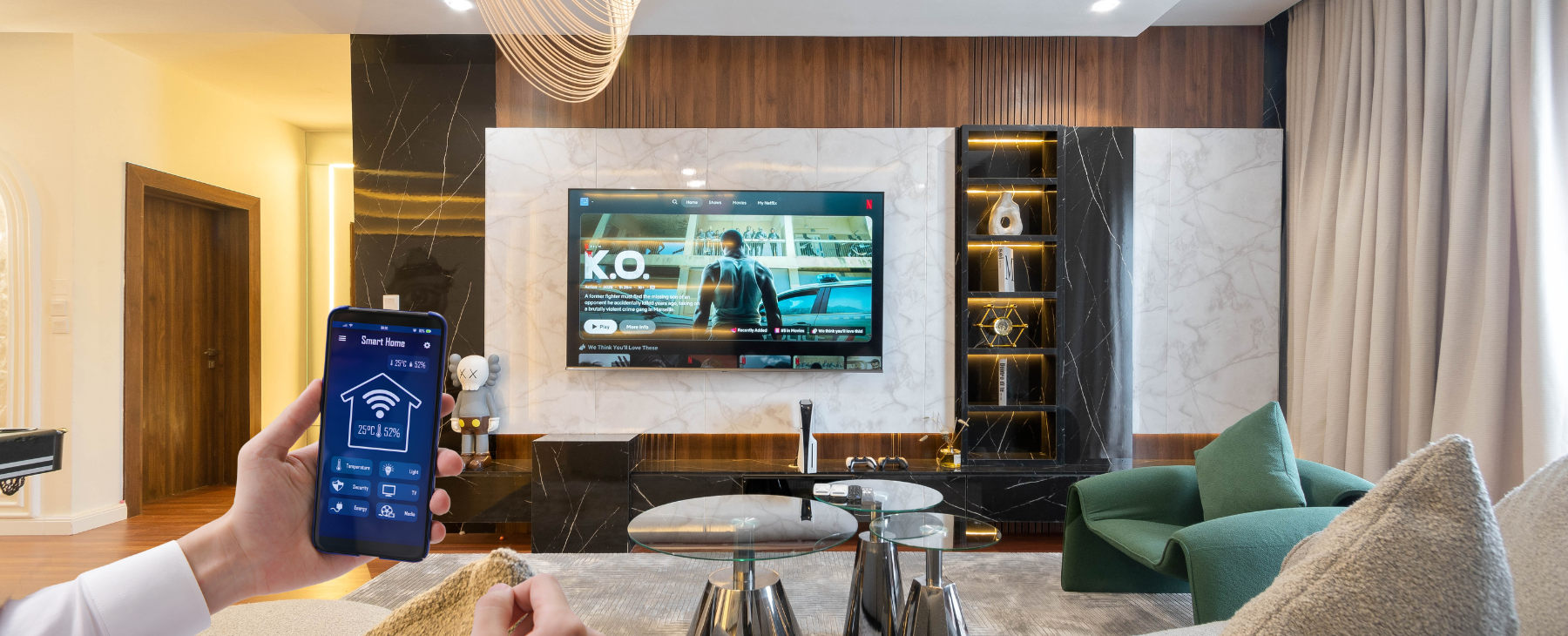
A smart home automation system connects your lighting, climate, security, blinds, and AV into one coordinated system you can control from a wall panel, an app, or your voice — and that can also run on its own using sensors and schedules. In a professionally integrated home, that coordination is handled by a reliable backbone such as KNX, rather than a loose set of standalone gadgets.
Imagine walking into your house after a long day. As you step through the door, the lights soften to your favourite evening glow, the air conditioning settles to a comfortable 22°C, and your music begins to play through the rooms — without you touching a single switch.
This isn't a scene from a futuristic movie. It's what a properly designed smart home automation system does every day. But what exactly is it, and how does it all fit together? Let's break it down.
What is Smart Home Automation?
At its simplest, home automation is the ability to control the features of your home — lighting, climate, security, curtains, entertainment — automatically or remotely. A smart home connects these systems into one coordinated setup you can manage from a single panel or your phone.
There's an important difference between remote control and true automation. Remote control lets you switch a light off from your phone. True smart home automation means the home responds on its own — systems talk to each other and act together to make daily life easier, safer and more efficient. The more reliably those systems communicate, the "smarter" the home actually feels, which is why the underlying platform matters as much as the devices.
How Does Smart Home Technology Work?
You don't need to be an engineer to understand it. A smart home works in three layers:
- The brain (control system): The central logic that ties everything together — in an integrated home this is typically a KNX system with wall-mounted keypads and a touch panel or app, rather than a single plug-in speaker. It's what lets one action trigger many.
- The senses (sensors): Devices that detect what's happening — motion, occupancy, temperature, daylight, or whether a door or window is open.
- The hands (actuators): The parts that do the physical work — switch and dimmer actuators that control lighting, motors that move curtains and blinds, and relays that manage power to appliances.
When the sensors, the brain and the actuators are on one common system, a single trigger — the time of day, someone entering a room, sunset — can set off a whole sequence automatically.
Key Components of a Home Automation System
Most smart homes bring together a few core systems:
- Smart lighting: Beyond on/off — lighting that dims for a movie, brightens to help you wake, and sets scenes for dinner or entertaining, all from one keypad.
- Automated climate control: Heating, cooling and fans that follow your routine and ease off when a room is empty, to save energy.
- Security & access: Smart locks, video door phones, cameras and alarm sensors that alert you the moment something unusual happens.
- Switches & keypads: The everyday interface on the wall — elegant KNX keypads that replace rows of ordinary switches and run whole scenes with one press.
- Curtains & shading: Motorised curtains and blinds that move on schedule, with the sun, or as part of a scene.
Why Invest in a Smart Home?
Moving to a home automation system is about more than gadgets. It delivers three real upgrades:
- Convenience: Automate the repetitive — one "Leave Home" press that switches off lights, sets back the AC and arms security as you walk out.
- Security: Real-time alerts and the ability to check on your home from anywhere.
- Energy efficiency: Using lighting and cooling only when and where they're needed meaningfully reduces running costs over time.
Is Your Home Ready for an Upgrade?
Whether you start with automated lighting in a few rooms or a full-home system, the goal is the same: a home that works for you, rather than you working for your home. The best results come from planning the system properly — ideally at the design or renovation stage — on a reliable platform that can grow with you.
Planning a new home or renovation in Noida, Delhi NCR or Gurgaon? Talk to the TechVault team about designing a KNX-based automation system for your space. You may also want to read how KNX works in home and building automation and wired vs KNX home automation.
FAQs
1. What is home automation?
Home automation is a system that lets you control your home's features — lighting, climate, security, curtains, and more — automatically or remotely from one coordinated setup, instead of operating each device separately.
2. How does smart home technology work?
Sensors detect changes (motion, temperature, daylight), a central control system decides what should happen, and actuators carry it out — dimming lights, moving curtains, adjusting the AC. In an integrated home, these are linked on one reliable system such as KNX, which can run over a wired bus or, for retrofits, wireless KNX RF.
3. Do I need to rewire my house?
For a new build or renovation, a wired KNX system is usually recommended because it's the most reliable and future-proof, and it's planned into the electrical work. For an existing home where rewiring isn't practical, wireless KNX RF and retrofit options let you add automation with minimal disruption. The right choice depends on your property — it's worth a professional assessment.
4. Where should I start with home automation?
Start with the systems you use most — lighting and climate usually deliver the biggest everyday difference — and build out from there. Rather than buying individual gadgets that may not work together, it's best to plan the system around one platform from the start so everything stays on a single, coordinated backbone as you expand.
5. Are smart home systems expensive?
Costs vary widely with the size of the home and how much you automate. You can begin with a few rooms and expand over time, or plan a full system during construction. A good integrator will scope it to your budget and priorities rather than a fixed package.