

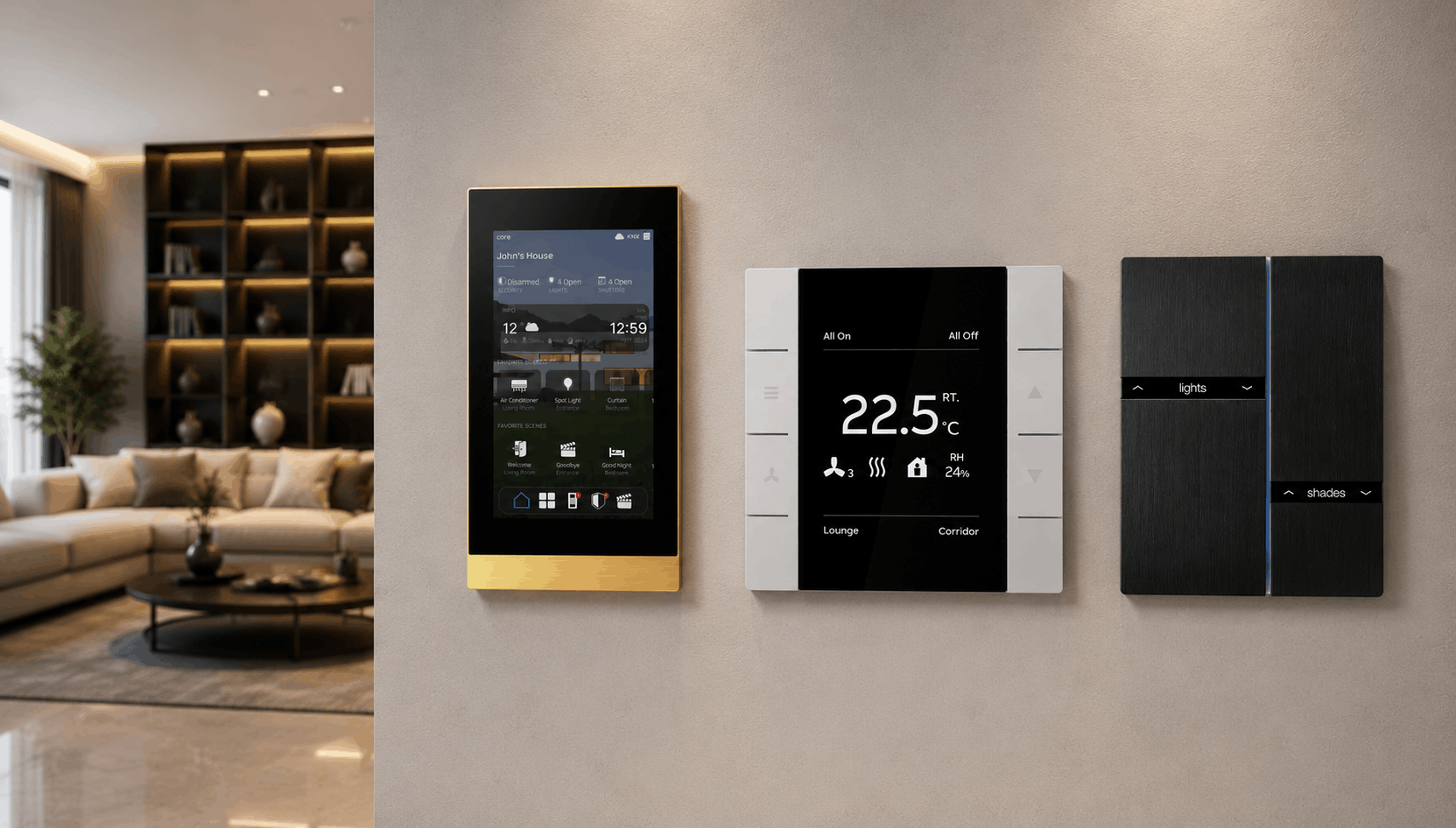
Basalte, ABB, and CORE are three of the most widely
specified KNX keypad brands for Indian smart homes, each suited to a different
priority: Basalte for minimalist, design-led residential interiors, ABB for
durability and tactile reliability across both residential and large-scale
commercial projects, and CORE for homeowners wanting flexible, value-oriented
customisation. All three run on the same open KNX standard, so the right choice
depends more on design fit and use case than on technical capability.
As a KNX system integrator, TechVault doesn't sell one
keypad brand exclusively — our role is to design, specify, install, and program
whichever combination of brands actually suits a given project, then integrate
everything into one working system. This comparison is based on what we've
specified and programmed across residential and commercial projects in Delhi-NCR, Noida, Gurgaon, and Jaipur — not on manufacturer spec sheets alone.
Quick Verdict
- Choose
Basalte if interior design integration is the top priority
(architect-led villas, premium apartments)
- Choose
ABB if you need commercial-grade durability or tactile button feedback
(offices, hospitality, high-traffic zones)
- Choose
CORE if you want premium KNX functionality with more budget
flexibility (mid-to-premium residential)
- Most full-home projects use a mix — different brands for different zones, based on each zone's actual use
Comparison Scorecard
|
Criteria |
Basalte |
ABB |
CORE |
|
Design / Aesthetics |
★★★★★ |
★★★★ |
★★★★ |
|
Durability (high-traffic use) |
★★★ |
★★★★★ |
★★★★ |
|
Commercial suitability |
★★ |
★★★★★ |
★★★ |
|
Budget flexibility |
★★ |
★★★ |
★★★★ |
|
Long-term parts availability (India) |
★★★★ |
★★★★ |
★★★ |
|
Best for |
Architect-led luxury homes |
Offices, hospitality, large villas |
Mid-premium homes, modular needs |
What Do Basalte, ABB, and CORE Keypads Have in Common?
Before getting into the differences, it's worth being clear
about what doesn't change between these three brands: all of them are KNX-certified devices that communicate over the
same open bus standard. This means:
- Any
of the three can be programmed via ETS6 to trigger the same
scene logic (lighting, climate, blinds, AV)
- They
can be mixed within the same project — a home isn't locked into one brand
exclusively
- None
of them requires a proprietary hub; they all operate as inputs on the
shared KNX bus
- As
an integrator, we can specify and program any of the three (or a mix)
within the same project, since the underlying logic doesn't change with
the brand
The differences that actually matter are in design language,
interface type, material options, and which use cases each brand is best suited
for — covered below.
How Do Basalte, ABB, and CORE Compare on Design and Interface?
|
Factor |
Basalte |
ABB |
CORE |
|
Interface type |
Capacitive touch, gesture-based sliders |
Mix of capacitive touch (tacteo®) and tactile buttons
(future® linear) |
Touch and customisable button combinations |
|
Design language |
Minimalist, glass/metal/wood-veneer finishes |
Ranges from premium touch panels to industrial-grade
tactile panels |
Modular, flexible finish and layout options |
|
Best-suited interiors |
Architect-led luxury residential |
Both premium residential and commercial/office |
Homes wanting a more customisable, mid-to-premium layout |
|
Typical use case |
Villas, premium apartments |
Villas, large offices, hospitality |
Apartments, villas, value-focused premium projects |
Feature Comparison: What Does Each Keypad Actually Support?
Beyond design and durability, here's how the three brands
compare on core functionality:
|
Feature |
Basalte |
ABB |
CORE |
|
KNX Certified |
Yes |
Yes |
Yes |
|
Touch Interface |
Yes |
Yes |
Yes |
|
Tactile Buttons |
Limited |
Strong |
Moderate |
|
Voice Control Support |
Yes (via KNX-IP gateway) |
Yes (via KNX-IP gateway) |
Yes (via KNX-IP gateway) |
|
Dimming Control |
Yes |
Yes |
Yes |
|
App Integration |
Yes |
Yes |
Yes |
The core functionality is largely identical across all
three, since it runs through the same KNX and ETS6 programming layer regardless
of brand — the real differentiators remain design, durability, and price,
covered above and below.
How Do They Compare on Durability and Long-Term Reliability?
This is where the three brands separate more clearly, based
on what we've observed across the projects we've specified and installed:
- Basalte
— built primarily for residential use; performs reliably in typical home
conditions, though the glass touch-surface finishes are better suited to
lower-traffic environments than high-use commercial settings
- ABB
— particularly the future® linear tactile range- holds up well in
high-traffic commercial environments where physical button feedback is
preferred over touch surfaces; this is reflected in ABB's broader use in
office and hospitality projects
- CORE
— generally reliable for residential use, with the advantage of more
modular components that can be serviced or swapped individually
For a large-scale commercial project — for instance, a
multi-floor office — durability under frequent daily use tends to favour ABB's
tactile range over touch-surface alternatives from any brand, simply because
physical buttons show less wear from constant use than capacitive surfaces.
How Do Basalte, ABB, and CORE Compare on Price in India?
Brand |
Approx. Price Range Per Keypad (India) |
What Drives the Cost |
|
Basalte |
₹35,000 - ₹90,000+ |
Premium materials (glass, metal, wood-veneer),
gesture-sensor technology |
|
ABB |
₹20,000 - ₹65,000+ |
Varies significantly by design line (tacteo® vs future®
linear vs Busch-priOn®) |
|
CORE |
₹18,000 - ₹50,000+ |
Generally positioned as a more accessible premium option,
with modular customisation |
These figures cover the keypad hardware only — full project
cost also depends on the number of points, scene programming complexity, and
integration with the rest of the KNX system, which is where an integrator's
design and labour costs come in alongside the hardware itself. For a complete
cost breakdown by home size, see our complete
home automation solution cost guide.
Why Each Brand Wins on Its Specific Priority
The scorecard above summarises it, but here's the reasoning
behind each brand's strength:
Basalte's capacitive touch surfaces and gesture-based
sliders are built around disappearing into architect-led interiors — the
trade-off is that glass touch surfaces show more wear in very high-traffic
settings than tactile buttons do. ABB's future® linear range exists
specifically to solve that trade-off for commercial use, at the cost of a less
minimalist look than Basalte's glass panels. CORE sits between the two on price
while offering modular components that can be serviced individually rather than
replacing an entire panel — useful for budget-conscious projects that still
want more than a basic WiFi switch.
In practice, most full-home projects don't have just one
priority, which is exactly why mixing brands by zone, as in the example below,
tends to be more common than picking one brand for an entire home.
A Real Example: Specifying Multiple Brands Across One Project in Jaipur
On a villa project in Jaipur, our design team specified
Basalte keypads for the main living areas and primary bedrooms (where design
integration with the architect's material palette was a priority), and ABB
future® linear panels for the utility areas, staff zones, and external gate
control points (where tactile reliability mattered more than touch-surface
aesthetics). As the integrator, we programmed both brands into the same KNX
scene logic via ETS6, with no functional difference in how scenes triggered regardless
of which brand's keypad was pressed — confirming that brand choice can be made
per-zone based on actual use, rather than requiring one brand throughout the
home.
This is the kind of decision a single-brand vendor typically
can't offer — it requires an integrator's perspective on the whole project, not
just one product line.
How Do You Decide Which Brand Fits Your Project?
Rather than picking a brand first, we generally walk clients
through three questions during the design phase, before any installation
begins:
- What's
the primary use of this zone? Formal living areas usually favour
Basalte's design-led approach; utility rooms and high-traffic corridors
favour ABB's tactile durability.
- How
much daily physical interaction will this keypad see? Touch surfaces
suit moderate-use residential settings; very frequent-use zones (reception
areas, shared offices) favour tactile buttons, which show less wear over
years of repeated pressing.
- What's
the budget allocation across the project? Higher-visibility zones
often get a higher per-point budget, with CORE's modular, mid-tier
positioning fitting well in secondary zones alongside premium panels
elsewhere.
As the Jaipur project shows, the honest answer is often
"more than one" — and working that out during the design phase is
part of what a system integrator does, rather than something a homeowner needs
to figure out alone.
What About Long-Term Servicing and Availability in India?
Since all three brands operate on the open KNX standard,
none of them locks a homeowner into a single integrator for future servicing —
any KNX-certified professional can open and modify the ETS6 project file,
regardless of which keypad brand was originally installed. That said, a few
practical differences are worth knowing:
- Basalte
and ABB both have an established presence among certified integrators
across major Indian cities, making replacement parts and servicing
generally straightforward to source
- CORE,
being a comparatively newer or more regionally-distributed brand in some
markets, is worth confirming for local parts availability in your specific
city before committing, particularly for projects outside major metros
- Regardless
of brand, requesting the ETS6 project file at handover (standard
practice for any KNX installation we deliver) is what actually protects
long-term serviceability — this matters more than the brand name itself,
and it's part of our standard project handover regardless of which keypad
brands were specified
A Note on Mixing Brands
A common concern: won't mixing brands look inconsistent? In practice, no keypads in different rooms are rarely seen side-by-side, so a Basalte panel in the living room and an ABB panel in a utility area aren't visually compared by anyone using the home day-to-day. The scene logic and user experience stay consistent even when the hardware differs, since we program all of it to work as one coordinated system regardless of brand.
Conclusion
The Quick Verdict and Scorecard above cover the short answer — but the real takeaway is that most full-home projects end up using more than one brand, as the Jaipur example shows. That's a decision a multi-brand system integrator is positioned to make at the design stage, rather than something a single-brand reseller can offer. For more details on each brand individually, see our guides on Basalte and ABB keypads, or explore our premium switches and lighting services to discuss what fits your project.
FAQs
Can I mix Basalte, ABB, and CORE keypads in the same home?
Yes — since all three are KNX-certified and communicate over the same open bus, they can be mixed within a single project, as shown in the Jaipur example above. The scene logic works identically regardless of which brand triggers it.
Which brand is best for a commercial office project?
ABB, particularly the future® linear tactile range, tends to be the stronger choice for commercial environments due to its durability under frequent daily use compared to touch-surface alternatives.
Is Basalte worth the higher price compared to ABB or CORE?
It depends on priorities. If minimalist design integration into an architect-led interior is the primary goal, Basalte's material quality and gesture-based interface often justify the cost. If budget or commercial-grade durability matters more, ABB or CORE may be a better fit.
Do all three brands support the same smart home features (voice control, scenes, etc.)?
Yes — since the underlying functionality runs through KNX and ETS6 programming rather than the keypad brand itself, features like voice control integration, multi-action scenes, and climate/lighting/blind control work the same way regardless of which of the three brands is used.
Do I need to choose a brand before I get a quote, or does TechVault help me decide?
You don't need to arrive with a brand already chosen. As your integrator, we typically walk through the zone-by-zone framework above during the design phase and recommend a brand mix based on your specific layout, budget, and priorities — choosing a brand is part of the design process, not a prerequisite for starting it.
Does brand choice affect resale value?
Since the underlying system is KNX regardless of keypad brand, the system as a whole — not the specific keypad brand — is what's typically evaluated. A well-documented, properly programmed KNX system tends to be viewed favourably regardless of which of these three brands was specified.
Can I start with one brand and add another later?
Yes, because all three communicate over the same KNX bus, a project doesn't need to commit to one brand permanently. It's common for homeowners to ask us to add a different brand's keypad in a renovated or extended area years later, without needing to replace the original installation.