

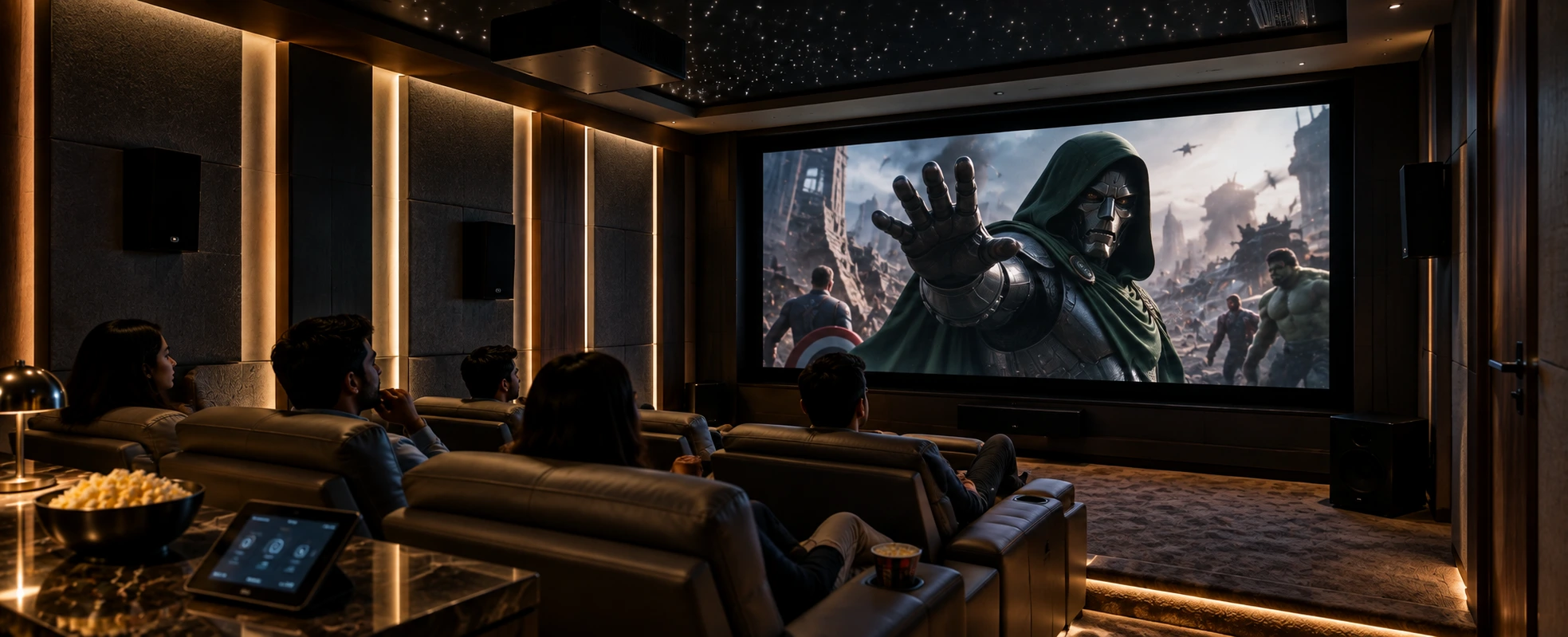
Basement home theater setup cost in India depends on room size, acoustic construction, AV equipment, and seating — so figures are indicative, not fixed. A small home theatre room cost in India starts modestly for a compact room, while a full basement build with proper acoustics runs higher because theatre construction cost in India includes soundproofing, wiring, and finishes, not just the screen and speakers. This guide covers basement home theater setup ideas, workable plans, and basement movie theater seating, so you can budget the whole room realistically rather than just the gear.
Why is a basement ideal for a home theatre?
A basement is close to a perfect home theatre location because it is naturally dark, structurally enclosed, and isolated from the rest of the house. There are few or no windows to block out; the surrounding earth and walls help contain sound, and a dedicated room downstairs keeps cinema noise away from bedrooms — three problems that upstairs theatres have to solve at extra cost.
In Indian villas, farmhouses and larger independent homes — especially across NCR and in farmhouse belts — basements are increasingly built with a home cinema in mind. The room is a blank, quiet box, which is exactly what a theatre wants. That said, basements bring their own considerations: waterproofing, ventilation, and access all matter, and they feed directly into the basement home theater setup cost. Planned well, a basement gives you a better cinema for the money than almost any other room in the house.
What drives basement home theater setup cost?
Basement home theater setup cost is driven by five things: the room construction and acoustics, the AV equipment, the seating, the lighting and automation, and the finishes. Most people budget only for the screen and speakers, then are surprised — because in a real theatre, construction and acoustics often cost as much as the gear.
Here is where the money actually goes:
| Cost area | What it covers |
|---|---|
| Construction & acoustics | Soundproofing, wall build-up, acoustic panels, false ceiling |
| AV equipment | Projector or screen, speakers, AV receiver, subwoofer |
| Seating | Recliners or tiered seating, risers |
| Lighting & automation | Scene lighting, bias light, control system |
| Finishes | Flooring, fabric walls, star ceiling, doors |
The single most under-budgeted item is acoustics. A basement contains sound well, but a bare concrete box also echoes badly — so acoustic treatment is not optional if you want the room to sound like a cinema rather than a hall. When people compare a small home theatre room cost in India against a large one, the gap is usually construction and acoustics, not the electronics.
What does theatre construction cost in India include?
Theatre construction cost in India covers everything before the AV goes in: soundproofing the walls and ceiling, building the acoustic wall layers, installing the false ceiling, running conduit and wiring, and preparing the floor for tiered seating. It is the civil and acoustic foundation of the room — and it is why a real theatre costs more than the price of a projector and speakers.
The construction stage typically includes:
Soundproofing — stopping sound leaking out to the rest of the house and unwanted noise leaking in. In a basement, this is easier than upstairs, but still needs proper treatment at the door and any service penetrations.
Acoustic build-up — the layered walls, bass traps, and panels that control reflections inside the room so dialogue is clear, and bass is even.
Structure for seating — if you want tiered rows so the back seats see over the front, the floor needs risers built at the construction stage.
Wiring and conduit — speaker cable, power, control cable, and the projector run, all laid before the walls are finished.
Doing this at the construction stage is far cheaper than retrofitting later. This is the core reason we always advise planning the theatre before the basement is finished — the basement home theater setup plans and the civil work need to happen together.
Basement home theater setup ideas for Indian homes
The best basement home theater setup ideas balance performance, comfort, and the realities of an Indian basement — heat, ventilation, and access. Rather than copying an American basement cinema, the ideas below are shaped for how these rooms are actually built and used here.
A few that consistently work well:
- A true dark room — with no windows to fight, commit to a fully controlled dark space, then add a star ceiling for atmosphere
- Tiered seating — even one raised back row transforms sightlines and makes it feel like a real cinema
- A dedicated equipment cupboard — keep the AV rack and projector electronics in a ventilated space, not in the room
- Scene lighting — bias light behind the screen, step lighting on risers, and a one-tap "Movie" scene
- Proper ventilation — a basement cinema is a sealed box full of people and electronics; cooling and fresh air are essential, not optional
- A snack/bar nook — a small counter at the back turns movie night into an occasion
The idea that matters most is treating the room as one designed experience — acoustics, seating, lighting, and cooling planned together — rather than a screen bolted onto a finished basement. Our build your first home theatre guide walks through the room as a whole, and our home theatre acoustics guide explains why the room shapes the sound.
How to approach basement home theater setup plans
Good basement home theater setup plans start with the room, not the gear. Before choosing a projector, you fix the seating position and viewing distance, the screen wall, the speaker layout, and the acoustic treatment — because these decide everything else. A plan built around the equipment first almost always ends up compromised.
A sensible planning order:
- Fix the primary seating position — this is the acoustic and visual centre of the room
- Set the screen size and wall — sized to the seating distance, not to the wall's maximum
- Lay out the speakers — front, surround and, for Atmos, height/ceiling positions
- Plan acoustics and construction — wall build-up, panels, risers, conduit
- Choose seating and lighting — once the room shell is defined
- Add finishes — flooring, fabric, star ceiling last
This order keeps the room honest. It also lets you phase the spend if needed — build the shell and acoustics properly now, and upgrade the projector or add a star ceiling later, without touching the walls again. A small home theatre room cost in India can be kept sensible this way: get the room right, and let the equipment follow the budget.
What are the best options for basement movie theater seating?
Basement movie theater seating ranges from simple sofas to dedicated cinema recliners with motorised backs, cup holders and tiered risers. The right choice depends on room size, budget, and how the room will be used — a family lounge-cinema and a dedicated audiophile screening room want different seating.
The common options:
- Sofas/lounge seating — most flexible and family-friendly, good for a room that doubles as a lounge
- Fixed cinema seats — the classic multiplex look, space-efficient for rows
- Motorised recliners — the premium choice: reclining backs, footrests and cup holders for genuine comfort across a long film
- Tiered rows on risers — the single biggest upgrade to sightlines, so the back row sees over the front
For dedicated cinemas we specify motorised recliner seating — Techvault works with Radio Motor recliners for this — arranged on built-in risers where the room allows a second row. The riser has to be planned at the construction stage, which is why seating belongs in the basement home theater setup plans from the start, not chosen at the end. Comfortable seating is also the item clients underrate most — you spend the whole film in it, so it earns its share of the budget.
Small home theatre room cost in India: keeping it sensible
A small home theatre room cost in India can be kept reasonable without cutting the parts that matter. The trick is to spend on the room and the seating — acoustics, a right-sized screen, and comfortable chairs — and to be measured about the electronics, which can always be upgraded later without rebuilding the room.
Where to spend, and where to hold back:
Spend on: acoustic treatment, a correctly sized screen for the room, comfortable seating, and proper wiring done once. These are the things that are expensive or disruptive to change later.
Hold back on: the very top of the projector and speaker range at first. A well-treated small room with mid-range gear beats a bare room with premium gear, every time. You can upgrade the projector in a few years; you cannot easily re-treat a finished room.
This is the honest way to budget a basement cinema: the room is the investment, the gear is the upgrade. For a full breakdown of how theatre budgets split across everything, see our home theatre cost guide.
FAQs
How much does a basement home theater setup cost in India?
It depends on room size, acoustic construction, AV equipment, and seating, so figures are indicative, not fixed. Construction and acoustics often cost as much as the electronics. The reliable way to budget is a designed plan and scope for your specific basement, then phasing the spend if needed.
Is a small home theatre room worth building in India?
Yes. A small, well-treated room delivers a better experience than a large, untreated one. A small home theatre room cost in India is largely acoustics, a right-sized screen, and good seating — spend there, be measured on electronics, and the room performs well above its budget.
What does theatre construction cost in India actually cover?
It covers the civil and acoustic foundation — soundproofing, layered acoustic walls, false ceiling, seating risers, and all conduit and wiring — done before the AV is installed. This stage is why a real theatre costs more than a projector and speakers, and it is far cheaper done during construction than retrofitted.
Do I need soundproofing in a basement theatre?
A basement contains sound better than an upstairs room, but you still need acoustic treatment inside the room so it doesn't echo, and sealing at the door and service openings so sound doesn't leak. Containment and internal acoustics are two different things — a good theatre needs both.
What is the best basement movie theater seating?
For a dedicated cinema, motorised recliners on tiered risers give the best comfort and sightlines. For a room that doubles as a lounge, sofa seating is more flexible. The riser must be planned at the construction stage, so seating should be decided within the basement home theater setup plans, not at the end.
Can a basement theatre be built after the basement is finished?
Partly, but it is more expensive and more constrained. Acoustics, risers, and concealed wiring are far cheaper during construction. If the basement is already finished, a surface-level setup is possible, but the best results come from planning the theatre and the basement build together.
Planning your basement home theatre
A basement is one of the best rooms in an Indian home for a cinema — dark, quiet and enclosed — but the result depends on planning the room, not just buying the gear. Spend on acoustics, the right screen and comfortable seating, plan the construction and wiring together, and let the electronics follow your budget.
We design and build home theatres end to end — from basement construction and acoustics through projection, sound, seating and finishes — as one considered room. Explore our home theatre service, or talk to us about your basement. Book a home theatre design consultation → contact us