

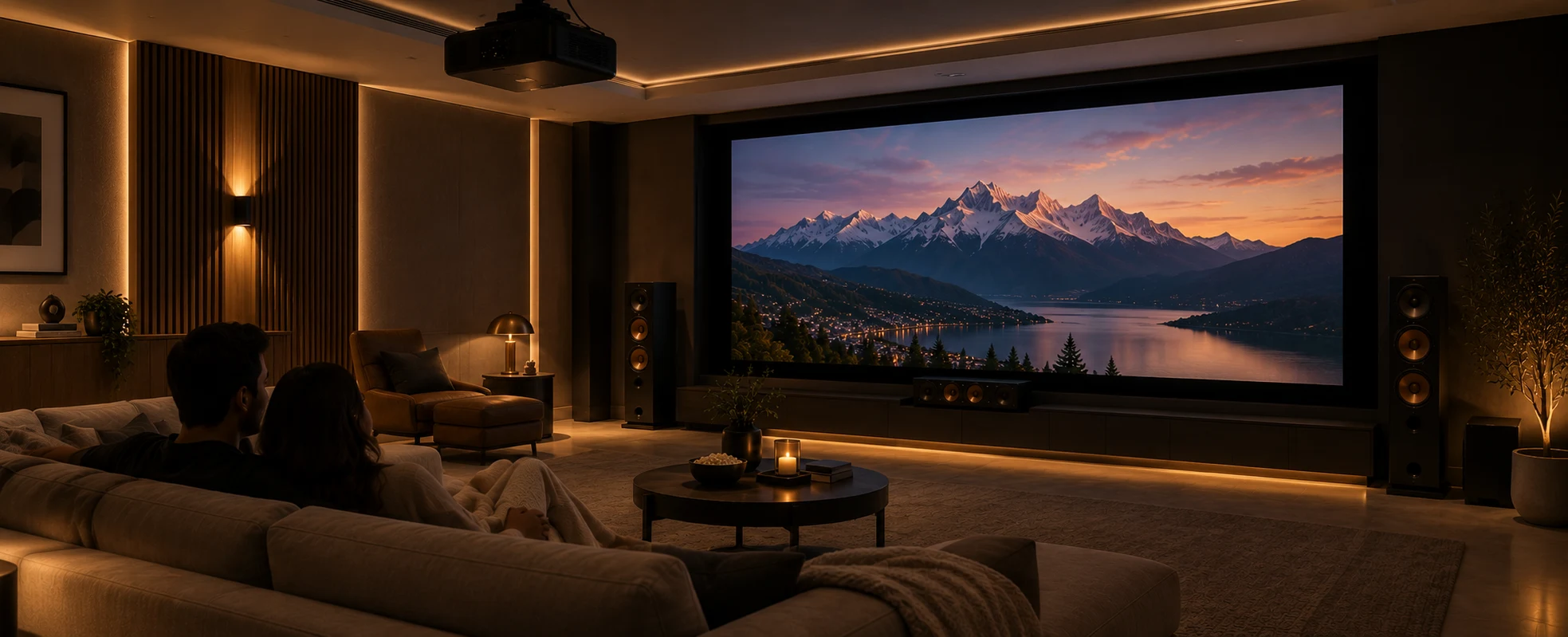
Delhi has one significant advantage over most Indian cities when it comes to home cinema: a large number of independent houses have basements, and a basement is close to the ideal room for a theatre. No windows to black out, natural sound isolation from the rest of the house, and neighbours far enough removed that volume stops being a negotiation.
If you're in an apartment, the picture is different but not worse — it just needs different decisions.
This covers what actually matters when planning a home theatre in Delhi, before anyone starts quoting equipment.
Why Delhi Basements Make Good Theatre Rooms
A dedicated theatre wants three things, and a basement delivers all three without you paying for them.
No natural light. Blackout is the single most expensive thing to achieve in an above-ground room — heavy curtains, motorised blinds, and a projector bright enough to fight what gets through. A basement starts dark.
Sound isolation. Surrounded by earth and slab rather than shared walls, a basement leaks considerably less sound than a room on an upper floor. In a city where houses sit close together, that matters.
No competing use. Basements are rarely the family's main living space, which means the room can be designed for cinema rather than compromised for daily use.
The trade-offs, honestly:
Ceiling height is usually lower than upstairs, which affects screen size and whether height speakers for Dolby Atmos are practical. Worth measuring before designing anything.
Damp is a real consideration. A basement that takes moisture in monsoon needs that resolved before acoustic panels, carpet and electronics go in — not afterwards.
Ventilation needs planning. A sealed room with people, an amplifier, and a projector heats up quickly, and there's no window to open.
If You're in an Apartment
Most Delhi apartments don't have a spare room to dedicate, which changes the approach rather than ruling it out.
A living room cinema is the usual answer. That means working with ambient light rather than eliminating it, which points toward an ultra-short-throw projector with a matched screen, or a large display. Our guide comparing projector types covers that decision.
Neighbours matter more. Shared walls and floors mean bass travels. Subwoofer placement, isolation pads and sensible level limits become part of the design rather than an afterthought.
Society permissions. Most apartment associations restrict structural work — false ceiling changes, wall channelling, anything affecting common areas. Worth checking what's permitted before designing something that isn't.
In-ceiling and in-wall speakers usually make more sense than floorstanding, both for space and because they're less visible in a room that's also a living room.
What About Air Quality?
A Delhi-specific point that doesn't come up in home theatre guides written elsewhere.
A theatre room is a sealed room. You're deliberately closing it off from light and sound, which means also closing it off from air exchange. During the months when Delhi's air is at its worst, that's arguably an advantage — a sealed, filtered room is a reasonable place to be.
But it needs planning:
Ventilation with filtration rather than an open window. If the room's air handling brings in unfiltered outside air during a bad-air week, you've built a room that pulls in exactly what you'd want to avoid.
Dust management. Delhi dust affects projector filters and lenses more than people expect. Projectors in dusty environments need their filters cleaned more often, and a neglected filter shows up as reduced brightness that's easy to blame on the lamp.
How Much Soundproofing Do You Actually Need?
Depends entirely on what's on the other side of the wall.
| Situation | Priority |
|---|---|
| Basement, independent house | Low — the structure does most of the work |
| Upper floor, independent house | Moderate — bedrooms below and beside |
| Apartment, shared walls | High — this is usually the binding constraint |
| Apartment, corner unit | Moderate |
Two things get confused constantly, and it's worth separating them:
Soundproofing stops sound leaving or entering the room. It solves neighbour problems. It's about mass and sealing — heavy doors, sealed gaps, dense construction.
Acoustic treatment improves how the room sounds inside. It solves muddy dialogue and uneven bass. It's about absorption and diffusion — panels, bass traps, carpet.
They use different materials and solve different problems. A room can have one without the other, and most disappointing home theatres have neither.
What Does It Cost in Delhi?
| Scope | Approx. Cost |
|---|---|
| Living room setup — display or UST, 5.1 audio, control | ₹3,00,000 – ₹8,00,000 |
| Dedicated room, mid-spec — projector, 7.1, basic treatment | ₹8,00,000 – ₹18,00,000 |
| Dedicated room, premium — Atmos, full acoustic build, seating | ₹18,00,000 – ₹40,00,000 |
| Basement cinema, high specification | ₹40,00,000 – ₹1,00,00,000+ |
Indicative estimates covering equipment, acoustic work, installation and calibration. Civil work, damp-proofing, and HVAC are usually separate scopes. Our home theatre cost guide has the component-level breakdown, including what the automation layer adds.
What Should You Decide Before Anyone Quotes?
The questions that determine everything downstream:
Which room, and is it dedicated? This single answer changes the entire design.
Ceiling height, measured. Particularly in a basement. It determines screen size, seating tiers, and whether Atmos height channels are practical.
How many seats, in how many rows? Drives screen size, speaker count, and room dimensions.
Damp and ventilation, resolved first. In a basement, this comes before anything else.
What's on the other side of each wall? Determines the soundproofing scope.
Is the room being built or already finished? Cabling, speaker positions, and acoustic treatment are all substantially cheaper during construction.
Which Brands Do We Work With?
For home cinema, we use Sonance and TruAudio for in-wall and in-ceiling speakers, B&W and Revel Speakers for premium front channels, DENON and Marantz for processing and amplification, Devialet where the room justifies reference-level audio, and BenQ, Epson, or Panasonic for projection. Seating typically uses Radio Motor recliners.
Selection follows the room — its size, its acoustics and its light conditions — rather than a default specification.
How Do You Choose Who Installs It?
We'd rather give you the questions than tell you the answer.
Will they see the room before quoting? A quote issued from a floor plan is a guess, and it's where "additional charges" come from later.
Is the quote itemised? Equipment, acoustic work, installation, and calibration separated, with exclusions written down. It's the only way to compare two quotes honestly.
Who does the calibration? Speakers installed but never calibrated is common, and it wastes most of what you spent on them.
Can you hear a working installation? Photographs prove a room looks good. They don't prove it sounds good.
What happens after handover? Support terms in writing, not a verbal assurance.
Our guide on common mistakes when choosing an automation company in Delhi covers the wider selection question.
FAQs
Is a basement good for a home theatre?
Generally yes, and Delhi's independent houses often have one. Basements give you natural blackout, good sound isolation and a room with no competing daily use. The things to resolve first are ceiling height, damp, and ventilation — a sealed room with people and equipment heats up quickly.
Can I have a home theatre in a Delhi apartment?
Yes, usually as a living room setup rather than a dedicated room. That means working with ambient light, being more careful about bass reaching neighbours, and checking what structural work your society permits before designing anything.
How much does a home theatre cost in Delhi?
A living room setup runs roughly ₹3,00,000 to ₹8,00,000. A mid-specification dedicated room ranges from ₹8,00,000 to ₹18,00,000. Premium dedicated rooms with full acoustic treatment run from ₹18,00,000 upward. Costs depend heavily on room condition and whether civil work is needed.
Do I need soundproofing or acoustic treatment?
They're different things. Soundproofing stops sound leaving the room and matters most in apartments with shared walls. Acoustic treatment improves how the room sounds inside and matters everywhere. Most rooms need both, and they're separate line items.
Does Delhi air quality affect a home theatre?
Indirectly. A theatre is a sealed room, so ventilation needs filtration rather than an open window. Dust also affects projector filters more than people expect — neglected filters reduce brightness in a way that's easy to misdiagnose.
Can a home theatre be added to a finished house?
Yes, though it costs more. Speaker cabling, in-ceiling positions, and acoustic treatment are all significantly easier during construction. In a finished room, the practical options narrow toward surface-mounted or freestanding equipment.
How long does installation take?
For a living room setup, a few days after the room is ready. For a dedicated room with acoustic treatment and civil work, typically four to eight weeks depending on how much building work is involved.
Planning a Home Theatre in Delhi?
The room decides most of it. Before anyone quotes equipment, the useful conversation is about which room, its dimensions, what's on the other side of the walls, and whether it's being built or already finished.
Talk to our team for a room assessment — we'd rather see the space than specify from a drawing. You can also explore our home theatre and audio-video services, or read our guide to building your first home theatre.