

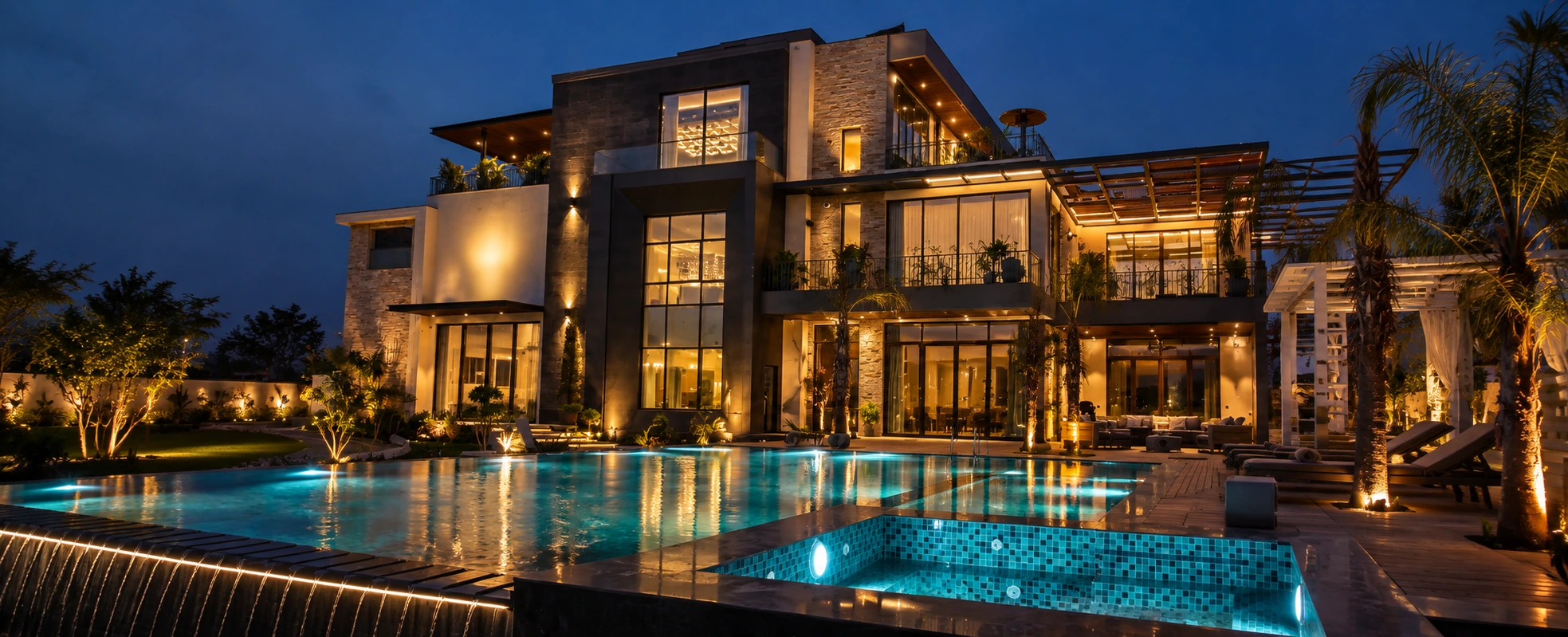
A home does not end at its walls, and neither should its lighting. Facade and outdoor landscape lighting is what makes a house look striking after dark — the architecture lit beautifully, the garden and pathways glowing, the whole property transformed from a dark shape into a designed, welcoming space. Done well, and automated so it takes care of itself, it adds beauty, safety, and security every single evening. This guide covers the types, the fixtures, the automation, and what to plan for.
Why Outdoor Lighting is Worth Getting Right
Most homes put real thought into interior lighting and then light the outside with a couple of plain wall lights and a switch someone forgets to operate. It is a missed opportunity. The exterior of a home is the first thing anyone sees, and after dark it is almost entirely defined by its lighting. The same house can look flat and unwelcoming, or elegant and impressive, depending on nothing more than how it is lit.
Good facade and outdoor landscape lighting does three things at once. It makes the home beautiful — highlighting the architecture, the textures, the trees and the grounds. It makes it safer — lit pathways, steps, and entrances that people can navigate confidently at night. And it makes it more secure — a well-lit exterior is far less inviting to an intruder than a dark one. Few investments in a home deliver on beauty, safety and security together the way exterior lighting does.
The catch is that outdoor lighting is only as good as its design and its control. Plain fixtures placed without thought, operated by a switch no one remembers, deliver none of the above. This guide covers how to do it properly — the lighting itself, and the automation that makes it effortless.
Facade Lighting: Making the Architecture the Feature
Facade lighting is the art of lighting a home's exterior walls and architecture so the building itself becomes the feature after dark. It is what turns a house into a landmark on its own street.
The main types of facade lighting, usually combined to suit the architecture, include:
- Up-lighting and down-lighting — light thrown up a wall or column, or washed down it, to give height and drama
- Wall-washing — lighting a surface evenly for a clean, elegant glow across a facade
- Grazing — light skimmed close to a textured surface like stone or brick to emphasise its texture
- Accent lighting — picking out specific features such as an entrance, a column, a nameplate or a tree against the wall
- Silhouette and backlighting — lighting behind a feature to create shape and depth
The right combination is a design decision made for your specific facade, not a formula — which is exactly how it should be approached. Our broader guide to architectural, track and facade lighting covers these techniques in more depth.
Outdoor & Landscape Lighting: Beyond the Walls
Beyond the facade is the landscape — the grounds, garden and approach — and lighting these turns a property into a complete after-dark environment rather than a lit building surrounded by darkness. This is where a home becomes somewhere you want to be in the evening.
Outdoor landscape lighting typically covers:
- Pathways and steps — gentle, guiding light for safe, confident movement around the grounds at night
- Trees and planting — up-lighting trees and lighting planting to give the garden depth and drama after dark
- Boundaries and walls — lighting the edges of the property for definition and security
- Water features and seating areas — lighting a pool, fountain or outdoor seating so these spaces come alive in the evening
- The driveway and entrance — a lit, welcoming approach to the home
Together with the facade, this creates a layered, designed exterior — the building, the grounds and the approach all considered as one picture.
Waterproof Outdoor Fixtures: Built for the Weather
An honest, practical point that matters enormously outdoors: the fixtures must be built for the conditions. Indoor lighting lives a sheltered life; outdoor lighting faces sun, rain, dust, heat and — in India — a punishing monsoon. A fixture that is not properly rated for this will fail, corrode or let in water.
So facade and landscape lighting should use weatherproof, IP-rated fixtures suited to each position — a higher ingress-protection (IP) rating means better resistance to dust and water, and the right rating depends on how exposed a fitting is, from a sheltered wall to a fully open garden spike or an in-ground uplight. Waterproof outdoor wall lights, in LED, are a staple for facades and entrances, chosen in a design that suits the home's style. The materials matter too — finishes that withstand weather and coastal or polluted air without corroding.
This is not a place to cut corners: outdoor fixtures are an investment that has to survive the elements for years, so selecting the right rating, build, and finish for each position is part of doing the job properly. A good integrator specifies this per location rather than using one fixture everywhere.
The Automation: Lighting That Takes Care of Itself
Here is what separates a smart home's exterior from an ordinary one — the lighting runs itself. The single biggest failure of outdoor lighting is human: lights left off because no one flipped the switch, or left blazing all night and all day because no one turned them off. Automation removes the switch and the forgetting, entirely.
Automated outdoor and facade lighting can:
- Switch on at dusk, off at dawn — an astronomical timer follows your local sunset and sunrise through the year, so the exterior is always lit at the right time without anyone touching a switch, and never burns through the day
- Run to scenes and schedules — a full "evening" look for when the family is home, a reduced overnight setting, and a path-and-security-only late mode, each set automatically
- Respond to motion for security — security and boundary lighting that brightens when movement is detected, a genuine deterrent; our guide to how smart security systems detect activity covers this
- Zone the exterior — facade, garden, pathway and security lighting controlled independently, so each does its job
- Save energy — lighting that runs only when needed, never all day, which matters across a large property; our blog on saving energy with a KNX smart home covers this
Protocols like DALI allow smooth, granular control of outdoor lighting within the automation — our DALI lighting guide explains how. The result is an exterior that is beautifully lit every evening, secure every night, and efficient all year — with no one ever operating a switch. This is part of our lighting automation and wider home automation design.
What to Plan For
A few honest principles if you are considering facade and outdoor lighting for your home:
- Design it with the architecture and landscape. The best results come from lighting designed around the specific building and grounds — what to highlight, from where, and how it looks from the street and from inside. It is a design exercise, not a shopping list of fixtures.
- Plan the wiring early. Outdoor wiring, conduits, and power are far cleaner to run during a build or a landscaping project than to retrofit later. If you are building or doing the grounds, plan the lighting in.
- Specify fixtures per position. The right fixture, rating, and finish differ by location and exposure. A system specified position by position outlasts and outperforms one using the same fitting everywhere.
- Automate it from the start. The value of outdoor lighting is only fully realised when it runs itself — so design the automation in alongside the fixtures, not as an afterthought.
- Budget realistically. Cost depends on the size of the property, the fixtures, the wiring and the automation, so have it estimated for your home. Remember the fixtures are only part of it — the wiring, weatherproofing and controls matter too.
We design facade, outdoor, and landscape lighting — and the automation that runs it — for homes and villas across Delhi NCR, as part of an integrated home. Our lighting and switches service covers this.
FAQs
What is facade and outdoor landscape lighting for homes?
Facade lighting illuminates the exterior walls and architecture of a home to highlight its design, while outdoor landscape lighting lights the grounds around it — pathways, trees, boundaries, water features, and seating. Together they make a home look striking after dark, improve safety and security, and extend outdoor living into the evening. In a smart home, both are automated to switch on at dusk and run to scenes and schedules without manual effort.
What are the types of facade lighting?
Common approaches include up-lighting and down-lighting to graze a wall or column, wall-washing to light a surface evenly, grazing to emphasise texture such as stone, accent lighting to pick out features, and silhouette or backlighting. Most homes use a combination, chosen to suit the architecture. The right mix is a design decision made for the specific facade rather than a fixed rule.
Should outdoor lighting be waterproof?
Yes. Outdoor and facade fixtures are exposed to rain, dust, and heat, so they must be weatherproof, IP-rated fixtures suited to the location — a higher ingress-protection rating means better resistance to dust and water, which matters for India's monsoon. A good integrator selects the appropriate rating and build for each position, from sheltered walls to fully exposed garden fittings.
How does outdoor lighting automation work?
Automated outdoor lighting switches on and off by itself — typically on an astronomical timer that follows local sunset and sunrise (dusk-to-dawn), or on schedules and scenes. It can also use sensors so areas light only when needed, and security lighting can respond to motion. This means the exterior is always lit when it should be and off when it shouldn't, without anyone operating a switch, and it saves the energy wasted by lights left on.
What does facade and landscape lighting cost?
The cost depends entirely on the size of the home and grounds, the number and type of fixtures, the wiring and the level of automation, so it should be estimated for the specific property rather than taken from a fixed figure. As a principle, the fixtures are only part of it — the wiring, weatherproofing, and controls matter too, and planning it into a build or landscaping project is more cost-effective than retrofitting later.
Can outdoor lighting be added to an existing home?
Yes, though it is cleanest when planned with a build or landscaping project, since outdoor wiring is easier to route then. An existing home can still have facade and landscape lighting added, and automation can be included using wireless options within the system where running new cabling is difficult. An integrator will advise the best approach for the property.