

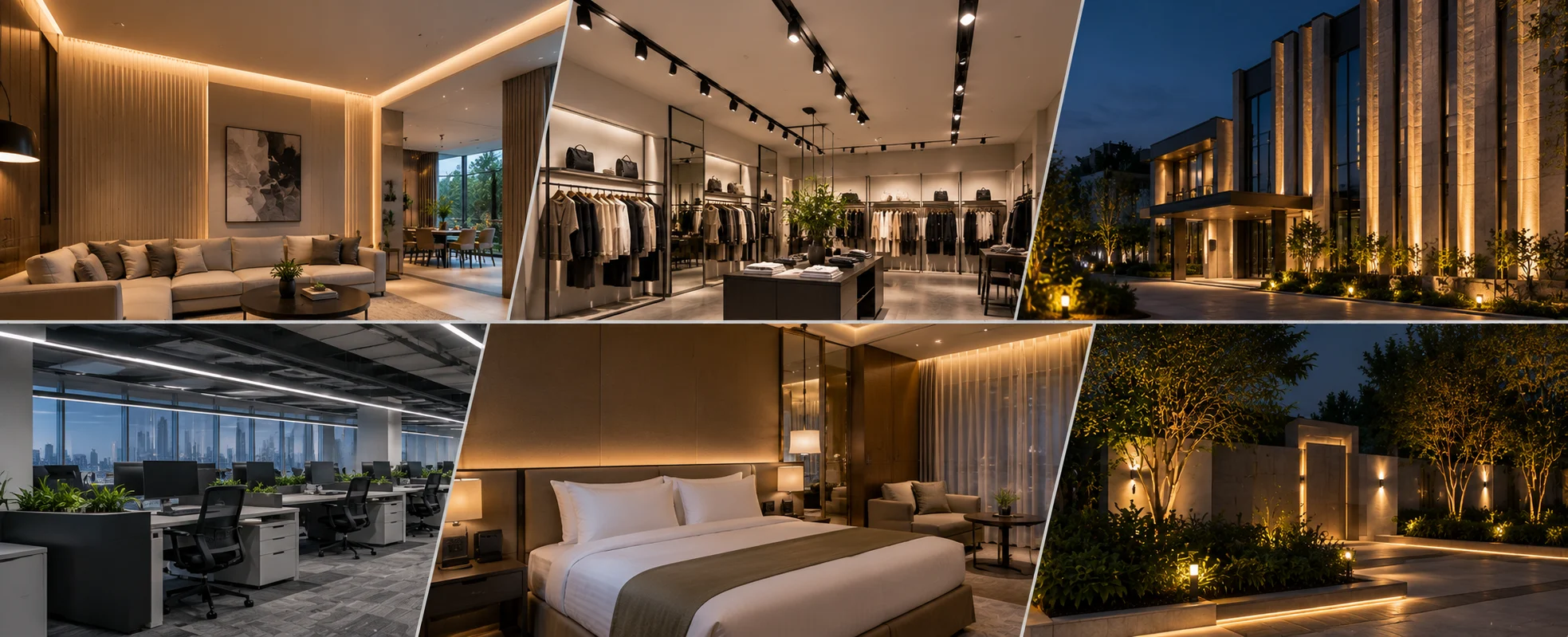
"Lighting solutions" covers a wide range of quite different work. A facade scheme for a hotel exterior and a track system for a retail floor share almost nothing in design approach, control requirements, or the problem they solve.
We deliver broad categories, and this guide covers what each one actually is, which projects it suits, and what it needs to work properly.
| Category | Primarily for | Core requirement |
|---|---|---|
| Architectural | Homes, hotels, premium interiors | Integration with the building fabric |
| Track | Retail, galleries, flexible spaces | Repositioning without an electrician |
| Facade | Hotels, commercial buildings, villas | Exterior schemes, weather-rated |
| Commercial | Retail, hospitality, mixed-use | Energy, zoning, operational control |
| Office | Workplaces | Task levels, glare control, occupancy |
| GRMS | Hotel guest rooms | Per-room scenes and energy control |
1. Architectural Lighting
What it is. Lighting built into the structure rather than added onto it — cove lighting behind a ceiling recess, profile lights tracing a wall junction, recessed linear runs, wall washing that reveals a texture. The fixture itself is largely invisible; what you see is the effect.
This is the opposite of decorative lighting. A chandelier is an object you look at. Architectural lighting is light you look by, and it shapes how a space reads.
Where it's used. Premium residential interiors, hotel public areas, showrooms, and anywhere the architecture itself is the thing worth lighting.
What it needs. Coordination with the ceiling and wall construction, because the fixtures live inside them. Cove details have to be sized correctly, profile channels have to be set into the plaster line, and all of it is decided before finishing. Retrofitting architectural lighting means rebuilding the surface it sits in.
Smooth dimming matters more here than almost anywhere else — architectural lighting is usually run at partial levels, and visible stepping or flicker at 20% undoes the effect entirely. This is where DALI-2 addressable dimming earns its cost.
Our guides on cove light versus profile light and profile lighting cover the fixture types in detail, and our residential lighting design guide covers layering.
2. Track Lighting
What it is. A powered track — increasingly a slim magnetic one — onto which light fixtures attach and can be repositioned by hand. No drilling, no rewiring, no electrician.
Where it's used. Anywhere the layout changes. Retail floors that reset displays seasonally. Galleries rehanging exhibitions. Showrooms rotating stock. Also increasingly in homes with open-plan living areas where furniture arrangements shift.
What it needs. The track has to be planned into the ceiling design and fed from a single supply point. Beyond that, it's genuinely flexible — modules can be added, removed or slid without touching the electrical installation.
Why it matters commercially. A retail space resetting displays four times a year is booking an electrician four times a year to move fixed spotlights. Magnetic track removes that entirely — staff reposition modules themselves in minutes.
Our guide to magnetic track lighting covers both residential and commercial applications.
3. Facade Lighting
What it is. Exterior illumination of a building — grazing a textured surface to reveal it, flooding a plane evenly, silhouetting a form against a lit background, or picking out architectural features.
Where it's used. Hotels, commercial buildings, institutional buildings, and villas where the elevation is worth showing after dark.
What it needs, and why it's different from every other category:
Weather rating. Fixtures are exposed to monsoon, dust, and sustained heat. Enclosure rating and material selection matter more than the light output does.
Cable routing outdoors. Runs along elevations and around a building perimeter, usually needing conduit planned during construction and junction points that can be reached for service without scaffolding.
Aiming and glare control. A facade scheme aimed carelessly lights the neighbours' windows and the sky as much as the building. Shielding and angle are the difference between an elevation that looks composed and one that just looks bright.
Maintenance access. Fixtures at height need a plan for how they get cleaned and serviced. Dust on a facade fixture reduces output noticeably within a season in most Indian cities.
Control. Facade schemes usually need scheduling — on at dusk, reduced or off late at night — and often multiple scenes for ordinary evenings versus events.
4. Commercial Lighting
What it is. Lighting for spaces that operate as businesses — retail floors, hospitality, mixed-use developments, common areas. The design priorities shift from atmosphere toward operation.
What changes compared with residential:
Energy is a recurring cost, not a preference. Lighting runs long hours across large areas, and small percentage reductions compound into real annual figures.
Zoning follows operation, not rooms. A retail floor zones by display area and trading pattern. A hotel lobby zones by daypart.
Non-technical staff operate it. A system requiring training or a manual will be left on one setting permanently.
Maintenance is planned, not reactive. Fixture replacement across a large installation needs consistency, which means specification records matter.
What it needs. Scene control tied to operating hours, occupancy sensing in low-traffic areas, and consumption monitoring so waste is visible rather than assumed. This sits naturally alongside building automation rather than as a standalone lighting installation.
5. Office Lighting
Treated separately from commercial because the requirements are specific enough to warrant it.
What it is. Lighting for workplaces — open floors, cabins, meeting rooms, breakout areas, reception.
What matters:
Task levels at the desk. Getting this wrong is why offices feel dim despite having plenty of fixtures — the light is in the ceiling rather than on the work surface.
Glare control. Screens are the dominant visual task in an office, and poorly shielded fixtures reflect into them. This is a fixture selection and positioning question, not a brightness one.
Occupancy-based control. Meeting rooms, cabins, and breakout areas sit empty for large parts of the day. B.E.G presence sensing lets those areas stand down automatically rather than running full daytime lighting into an empty room.
Meeting room integration. Lighting that changes for presentation mode alongside the display and blinds, from one control rather than three.
Our guide to smart office automation covers the wider workplace picture.
6. GRMS Lighting
What it is. Guest Room Management System lighting — per-room lighting control in hotels, integrated with occupancy, climate and door status.
What matters in a guest room:
A small number of clearly labelled scenes. Not eight unmarked switches. A guest arriving at midnight in an unfamiliar room should be able to set it comfortably without hunting.
Occupancy-linked control. Rooms stand down when unoccupied and prepare when the guest returns. Given the proportion of hours a hotel room sits empty, this is where the operational case sits.
Welcome scene on entry. A room that lights appropriately when the door opens rather than requiring the guest to find switches in the dark.
Housekeeping and service integration. Room status visible to staff, do-not-disturb respected by the system.
Consistency across rooms. Every room behaving identically matters more in a hotel than any individual feature — a guest who learns one room has learned all of them.
More on this in our guest room automation service, and our guide to hotel lighting retrofits covers upgrading existing properties.
How These Combine on a Real Project
Most projects use more than one category, and the value comes from running them on a single control layer rather than separate systems.
A hotel typically needs all six in some form — architectural in public areas, facade on the exterior, track in retail spaces, commercial lighting across common areas, office lighting in back-of-house, and GRMS in every guest room. On KNX, all of it sits on one system with one management interface.
A luxury villa uses architectural lighting internally, facade lighting on the elevation, and often track lighting in a gallery or open living area.
A commercial building combines office lighting on the floors, commercial lighting in common areas, and facade lighting on the exterior.
The reason this matters: separate systems mean separate interfaces, separate maintenance, and no shared scheduling. One system means a single dusk trigger runs the facade, the common areas, and the exterior signage together.
Our guide to how KNX works covers the control layer that makes this possible, and DALI covers the fixture-level addressing.
What Do These Cost?
| Category | Approx. Cost |
|---|---|
| Architectural lighting, residential (per room) | ₹40,000 – ₹2,50,000 |
| Track lighting (4–5m run with modules) | ₹60,000 – ₹2,00,000 |
| Facade lighting (villa elevation) | ₹2,00,000 – ₹12,00,000 |
| Facade lighting (commercial building) | ₹10,00,000 – ₹75,00,000+ |
| Office lighting control (per floor) | ₹3,00,000 – ₹15,00,000 |
| GRMS lighting (per guest room) | ₹25,000 – ₹80,000 |
Indicative estimates covering fixtures, control, and installation. Actual figures depend heavily on area, fixture specification, and control depth. Our lighting automation cost guide has the component-level breakdown.
FAQs
What is architectural lighting?
Lighting built into the structure rather than added onto it — cove lighting, profile lights, recessed linear runs and wall washing. The fixture stays largely invisible, and what you see is the effect on the surface. It has to be planned before finishing, because the fixtures live inside the ceiling and wall construction.
How is track lighting different from fixed spotlights?
Track lighting fixtures attach to a powered rail and can be repositioned by hand, without tools or an electrician. Fixed spotlights are wired in place, and moving one is an electrical job. Track lighting suits any space where the layout changes — retail displays, galleries, or open-plan living areas.
What does facade lighting require that interior lighting doesn't?
Weather-rated enclosures, outdoor cable routing planned during construction, careful aiming to avoid glare into neighbouring buildings, and a maintenance access plan. Dust reduces facade fixture output noticeably within a season in most Indian cities, so cleaning access matters at design stage.
Is office lighting different from general commercial lighting?
Yes, enough to be treated separately. Offices need specific task light levels at desks, glare control because screens are the dominant visual task, and occupancy-based control for meeting rooms and cabins that sit empty for much of the day.
What is GRMS lighting?
Guest Room Management System lighting — per-room control in hotels, integrated with occupancy, climate, and door status. The priorities are a small number of clearly labelled scenes, automatic standby when the room is unoccupied, and consistent behaviour across every room in the property.
Can different lighting categories run on one system?
Yes, and on a multi-category project that's the main advantage. On KNX, facade, architectural, commercial and guest room lighting all sit on one control layer with shared scheduling — a single dusk trigger can run the facade, common areas and signage together rather than three separate systems.
Which category does a luxury villa need?
Usually architectural lighting internally and facade lighting on the elevation, with track lighting where there's a gallery wall or a frequently rearranged living area. The exterior scope — facade, garden and boundary — is what most distinguishes a villa from an apartment project.
Planning a Lighting Solutions Project?
Which category applies depends on the building and what it needs to do. Most projects use more than one, and the useful conversation is about which ones, and how they run together.
If you're planning a residential, commercial, or hospitality project in Noida, Delhi NCR, Gurgaon, or Jaipur, talk to our team. You can also explore our lighting automation, premium switches and lighting, office automation, and hotel automation services.