

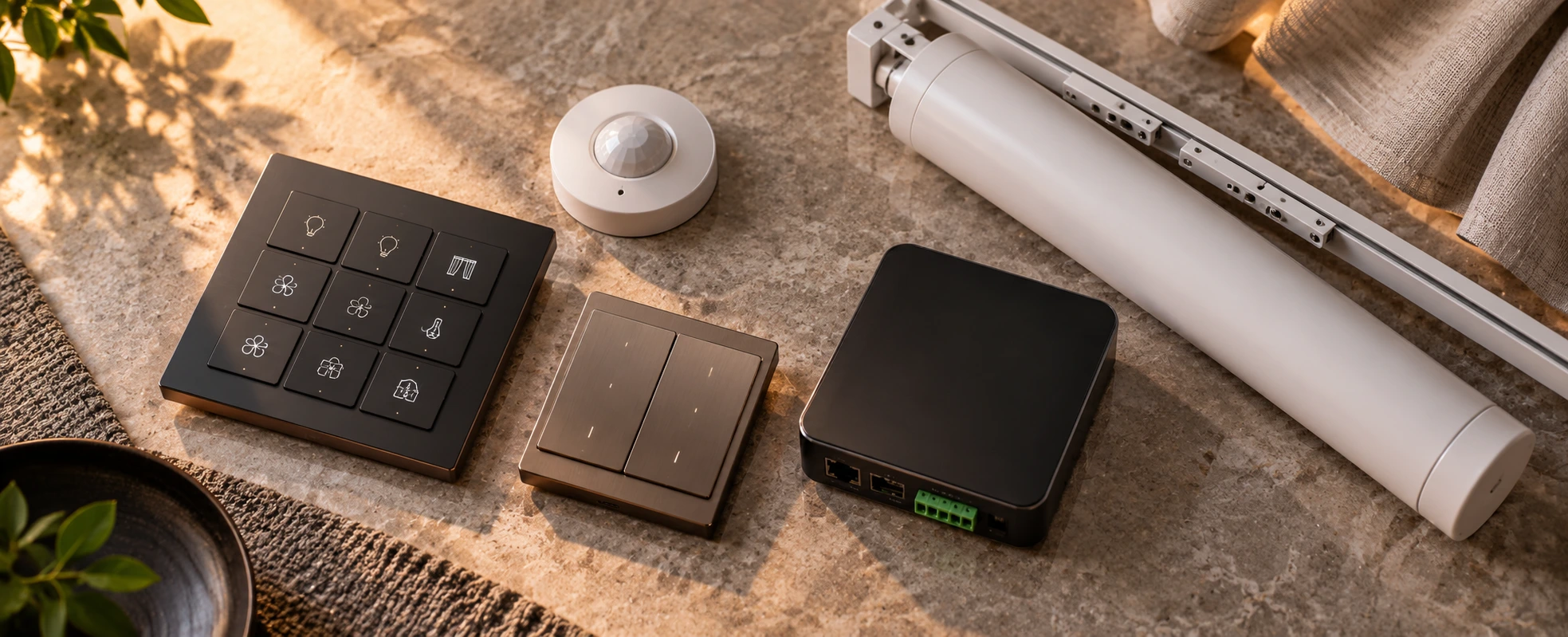
A home automation kit is the simplest way to describe everything your home needs to become smart — the switches, lighting, curtains, sensors, and controls that turn an ordinary house into one you run from a keypad, an app, or your voice. But "kit" can mean very different things: a basic set for one room, or a professionally designed package that makes your whole home work as one. This page explains what a home automation kit includes, the wired and wireless options, what suits a 2BHK, 3BHK, or villa, what affects the price, and how to choose the right one for your home.
What Is a Home Automation Kit?
A home automation kit is a package of connected devices and controls that let you automate your home — so lights, fans, curtains, climate, and more respond to a touch, a schedule, a scene, or your voice, instead of being operated one switch at a time.
The key word is connected. A true kit is not a drawer of separate gadgets, each with its own app; it is a set of parts designed to work together as one system. That is what turns "some smart devices" into a genuine smart home — one control, scenes that move several things at once, and a home that responds as a whole. Our complete guide to home automation covers the fundamentals of how this works.
A kit can be as small as a single room or as complete as a whole villa. What stays the same is the principle: the parts should work together, and the system should be able to grow.
What Does a Home Automation Kit Include?
A home automation kit is built from a few core building blocks. A typical kit includes:
- Smart switches and keypads — replacing ordinary switches to control lights, fans and scenes; our guide to smart switches explains the options
- Lighting control — dimming, warmth and scene control, so rooms can be set by mood rather than one switch per light
- Motorised curtains and blinds — opening, closing and scheduling your curtains at a touch or automatically
- Sensors — motion and occupancy sensors that let the home respond on its own, such as lighting a passage at night
- A hub or controller — the brain that connects everything, with app and often voice control
Larger kits extend into climate control, security and audio-video — so the same system that runs your lighting also manages your AC, cameras and entertainment. The best kits are designed so every part works as one, controlled from one place, rather than several disconnected products. Explore our premium switches and lighting range for the heart of most kits.
Wired vs Wireless Home Automation Kits
One of the first choices is whether your kit is wired or wireless — and the right answer depends mainly on your home.
A wireless kit connects devices over WiFi or similar wireless protocols. It is easy to add to a finished home without new cabling, which makes it a good fit for apartments and smaller or starter setups. A wired kit, built on an open standard like KNX, runs on dedicated control cabling — more reliable and scalable across a whole home, and best planned during construction or a renovation.
In short: for a small home or a few rooms, a wireless kit may be all you need; for a large home or villa where reliability matters, a wired kit is more dependable. Our detailed wired vs wireless smart home guide compares the two in full, so you can decide what fits your home.
Home Automation Kit for 2BHK, 3BHK and Villas
The right kit scales with the home, so it helps to think in terms of the space:
- 2BHK apartment — a starter kit covering smart switches and lighting control in the living room and bedrooms, a couple of motorised curtains, and app and voice control is a popular, high-impact start, and can be expanded later
- 3BHK apartment / independent floor — the same across more rooms, often adding climate control and a few scenes, and sometimes security such as a video door phone
- Villa or large home — a whole-home, wired kit (typically KNX) covering lighting, climate, curtains, security and audio-video across the property, designed as one integrated system for reliability and scale
The point is that a kit is not one fixed box — it is scaled and shaped to your home. A 2BHK and a villa need very different kits, and the right one is matched to your rooms, your priorities, and whether the home is new or finished.
Home Automation Kit Price in India - Factors Affecting Cost
There is no single price for a home automation kit, because the cost depends entirely on what you are automating. Rather than a fixed figure, it helps to understand what drives the price:
- How much of the home — one room, a few rooms, or the whole house
- Wired or wireless — and the scale of cabling and controls involved
- The devices and finishes — the quality and brand of switches, keypads and fittings (designer keypads cost more than basic ones)
- The systems included — lighting alone, or lighting plus climate, curtains, security and audio-video
- New build vs retrofit — building it in during construction is usually cleaner and more cost-effective than retrofitting later
A basic single-room wireless kit is affordable; a whole-home or villa system is a considered investment that pays back in comfort, convenience and efficiency over years. Because it depends so much on your home, the right approach is a specification and estimate for your specific space — our guide to home automation cost in India explains the cost factors in more depth.
How to Choose the Right Kit
A few honest principles for choosing well:
- Start with what matters most to you. Usually lighting and switches — and choose a kit that can grow, not a closed box you cannot add to.
- Match wired or wireless to your home. New build or large home → lean wired (KNX). Finished apartment or starter setup → wireless can be enough.
- Favour open standards. A kit built on an open standard like KNX keeps your options open and avoids being locked to one brand.
- Insist that the parts work together. The value of a kit is integration — one control, one system — not a collection of apps.
- For anything beyond one room, get it designed. A professionally designed kit, matched to your home, will outperform a generic off-the-shelf one — and for a whole home, that design is what makes it reliable.
That last point is the honest one: a boxed DIY kit can be fine for a single room, but a whole smart home is best designed, not just bought. That is what we do — design the right kit for your home and make it work as one.
FAQs
What is a home automation kit?
A home automation kit is a package of devices and controls that lets you automate your home — typically smart switches or keypads, lighting control, motorised curtains, sensors, and app or voice control, all connected so they work together. A kit can be a basic set for a single room, or a professionally designed package covering the whole home. The right kit depends on how much of the home you want to automate and how well you want it to work together.
What does a home automation kit include?
A typical kit includes smart switches or keypads to control lights and fans, lighting control for dimming and scenes, motorised curtain or blind control, sensors such as motion or occupancy, and a hub or controller with an app and often voice control. Larger kits add climate control, security, and audio-video. The best kits are designed so every part works as one system, not as separate gadgets with separate apps.
What is the difference between a wired and a wireless home automation kit?
A wireless kit connects devices over WiFi or similar and is easy to add to a finished home, suiting apartments and smaller setups. A wired kit, built on a standard like KNX, runs on dedicated cabling and is more reliable and scalable for a whole home or villa — best planned during construction or renovation. For a small home, a wireless kit may be enough; for a large one, wired is more dependable.
What does a home automation kit cost in India?
It varies widely depending on how much of the home you automate, whether it is wired or wireless, and the quality of the devices. A basic single-room wireless kit is affordable, while a whole-home or villa system is a larger investment. Because the cost depends entirely on your home and what you want it to do, it is best to get a specification and estimate for your specific home rather than relying on a fixed price.
Which home automation kit is best for a 2BHK or 3BHK?
For a 2BHK or 3BHK apartment, a kit covering smart switches and lighting control in the main rooms, a few motorised curtains, and app plus voice control is a popular starting point and can be expanded over time. Whether wired or wireless suits you depends on whether the home is being built or is already finished. The right kit is best matched to your rooms and how you live, rather than bought as a fixed box.
How do I choose the right home automation kit?
Start with what matters most to you — often lighting and switches — and choose a kit that can grow rather than a closed box. Decide wired or wireless based on whether your home is new or finished and how large it is, favour open standards like KNX so you are not locked in, and make sure the parts work together as one system. For anything beyond a single room, a professionally designed kit matched to your home will outperform a generic off-the-shelf one.