

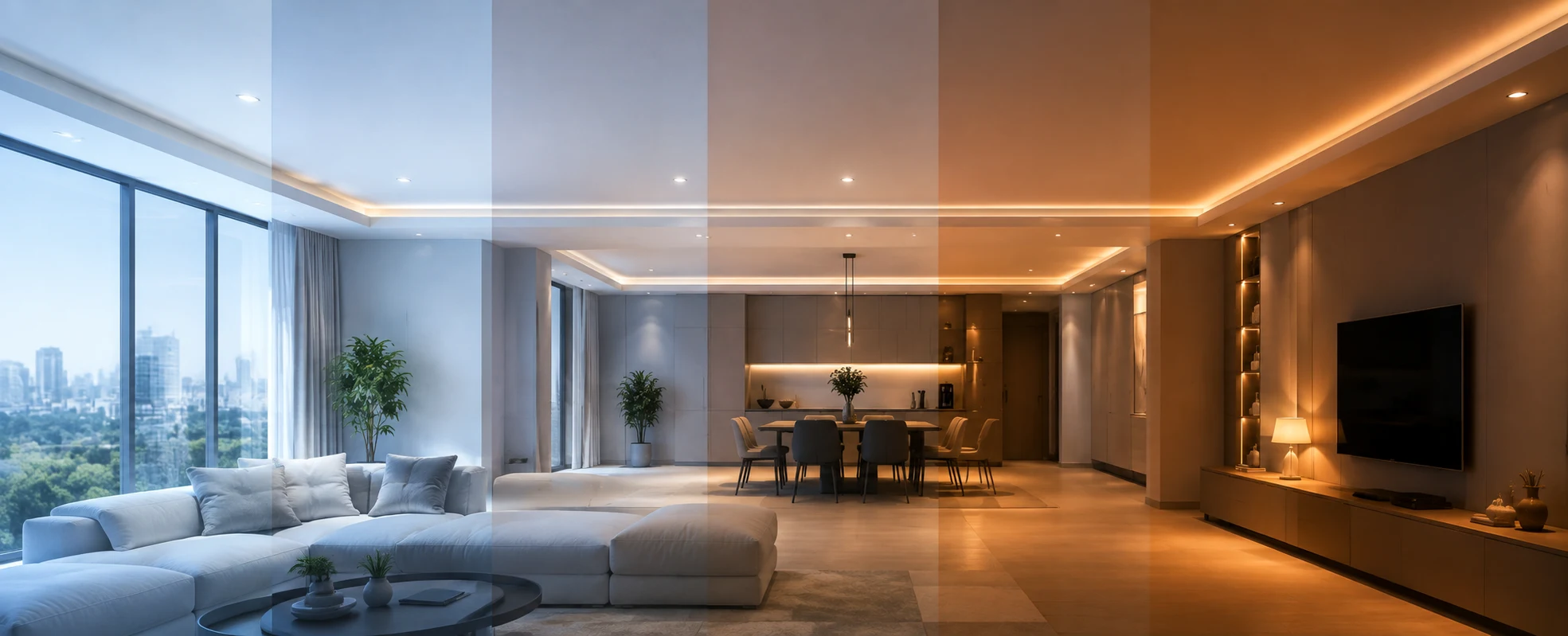
Human-centric lighting, often shortened to HCL, is lighting designed to change through the day rather than stay fixed - cooler and brighter in the middle of the day, warmer and dimmer towards evening, roughly following the pattern of natural daylight. The idea is that indoor light should behave more like outdoor light, instead of being the same colour at 9 in the morning and 11 at night.
It's one of the more genuinely interesting things you can do with a modern lighting system. It's also one of the most over-marketed features, so this guide covers what it is, what it needs, and what's reasonable to expect.
Why Does Changing Light Through the Day Matter?
The underlying idea comes from established science rather than lighting marketing: the human body runs on an internal daily cycle, and light is the strongest signal that keeps that cycle aligned. This is well-documented biology; the mechanisms behind circadian rhythms were the subject of the 2017 Nobel Prize in Physiology or Medicine.
Outdoors, the light you receive changes continuously. Cool and bright around midday. Warmer and lower as the sun drops. Very little after dark.
Indoors, most homes deliver the same light at every hour. A 4000K ceiling light at 11 pm is, from your body's point of view, a fairly confusing signal.
Human-centric lighting tries to close that gap, not to replace daylight, which it can't, but to stop indoor lighting from working against the pattern daylight sets.
Where this matters more in India: homes are increasingly sealed and air-conditioned, curtains stay drawn against heat and glare for much of the day, and a lot of people spend the daylight hours indoors. The result is less exposure to bright light when it would be useful, and more exposure to bright cool light in the evening when it isn't.
What Actually Changes in an HCL System?
Two things, and they change together.
Colour temperature — measured in Kelvin. Warm light around 2700K looks amber and settled. Neutral around 4000K reads as ordinary white. Cool light above 5000K is closer to overcast daylight.
Intensity — how much light is actually delivered. A warm colour at high brightness isn't the same as a warm colour at low brightness, and the evening needs both to come down.
A typical residential pattern:
Time of day | Colour temperature | Intensity | Character |
|---|---|---|---|
| Early morning | 2700–3000K rising | Low, rising gradually | Gentle wake |
| Mid-morning to afternoon | 4000–5000K | High | Alert, task-oriented |
| Late afternoon | 3500–4000K | Moderate | Transitional |
| Evening | 2700–3000K | Low to moderate | Settled, social |
| Night | 2700K or lower | Very low | Minimal |
These are design choices rather than prescribed values. Different households want different things, and the schedule should suit the people living there — not a chart.
What Does an HCL System Need?
This is where the marketing and the reality separate. HCL isn't a product you buy; it's a capability the lighting system either has or doesn't.
Tunable white fixtures and drivers. Ordinary LED fixtures produce one fixed colour temperature. Tunable white fixtures contain two LED types — warm and cool — and mix them. Without these, no amount of control software delivers HCL.
DALI-2 control. The DALI-2 standard supports colour temperature control alongside dimming, addressed per fixture. This is what makes smooth, coordinated shifts possible rather than crude stepping. Our guide to the DALI lighting control system covers the protocol.
A scheduling layer. Something has to decide what the light should be doing at 4 pm. On a KNX system, this is scene and time logic, optionally tied to actual sunrise and sunset times rather than fixed clock hours.
Circuits planned for it. Tunable white drivers need to be specified at the design stage. Retrofitting means replacing drivers, and in a false-ceilinged home that means opening the ceiling.
That last point is the practical one. HCL is inexpensive to include when a home is being wired and expensive to add afterwards.
Which Rooms Are Worth Doing?
Not all of them, and that's a useful thing to know before quoting the whole house.
| Room | Worth it? | Why |
|---|---|---|
| Bedroom | Yes | Wake and wind-down are where the shift is most noticeable |
| Living room | Yes | Long occupancy across very different times of day |
| Home office/study | Yes | Cooler light during work hours, warm in the evening |
| Kitchen | Partly | Task lighting stays neutral; ambient layer can shift |
| Bathroom | Partly | Useful at the vanity, less so elsewhere |
| Corridors, utility | Rarely | Occupancy is brief. Fixed warm light is fine |
| Home theatre | No | Wants controlled darkness, not daylight simulation |
Concentrating tunable white in the three or four rooms where people actually spend hours is usually better value than spreading it thinly everywhere.
What Can You Reasonably Expect?
Here's where we'd rather be straight than enthusiastic.
What's well established: light influences the body's daily cycle, and the timing, intensity and colour of light all play a part. That much is settled science.
What's less settled: how much difference a specific residential installation makes to a specific person. Home lighting is only one of the light sources in your day, and usually not the strongest — daylight through a window generally delivers far more than any indoor fixture. Screens, sleep habits, work schedules, and caffeine all sit in the same picture.
So the honest position: HCL is a sensible thing to do, and an unreasonable thing to promise outcomes from. Anyone quoting a percentage improvement in sleep or productivity from a lighting installation is going beyond what the evidence supports for a home.
What clients do consistently report is that the house feels appropriate to the hour — bright when they need to get things done, settled in the evening without anyone adjusting anything. That's a real and worthwhile result on its own.
One caveat worth stating: if you have a diagnosed sleep disorder or a medical condition affected by light, that's a conversation for a doctor, not a lighting integrator. HCL is a design approach, not a treatment.
How is It Different From Ordinary Dimming?
A reasonable question, since dimming already makes a room feel warmer in the evening.
Dimming only | Human-centric lighting | |
|---|---|---|
| What changes | Brightness | Brightness and colour temperature |
| Evening effect | Dimmer, same colour | Dimmer and warmer |
| Fixtures needed | Standard dimmable | Tunable white |
| Control | Standard dimmer or KNX | DALI-2 with colour control |
| Automation | Usually manual or scene-based | Scheduled across the day |
Some LED fixtures do warm slightly as they dim, imitating an incandescent bulb. That's a pleasant effect, but it isn't HCL — the colour range is narrow, and it only moves in one direction, so there's no cool, bright midday setting to move away from.
Should It Be Automatic or Manual?
Automatic, with the ability to override.
The point of HCL is that it happens without anyone thinking about it. A system that requires someone to change the colour temperature at the right time will simply not be used after the first fortnight.
Schedule it against sunrise and sunset rather than fixed clock times, so the pattern shifts with the season instead of running the same at every time of year.
Keep a manual override on the keypad. Someone working late will want the cooler setting at 10 pm, and the system shouldn't argue.
Don't over-engineer it. Three or four transitions across the day is enough. Continuous minute-by-minute adjustment is imperceptible and adds nothing.
What Does It Cost?
Tunable white is a premium on standard lighting automation, mainly in the drivers.
| Component | Approx. Cost |
|---|---|
| Tunable white DALI-2 driver (per fixture) | ₹3,500 – ₹8,000 |
| Standard DALI-2 driver (per fixture), for comparison | ₹1,200 – ₹4,500 |
| Additional programming and scheduling setup | ₹20,000 – ₹50,000 |
For a 3BHK doing tunable white in the bedroom, living room and study — roughly 25 to 30 fixtures — the premium over standard dimmable lighting typically runs ₹1,00,000 to ₹2,50,000.
Indicative estimates. Actual figures depend on fixture count, driver quality, and how much of the home is included. Our lighting automation cost guide has the wider breakdown.
Is It Worth Including?
Our view, for what it's worth as integrators rather than salespeople:
Include it if you're building or renovating, you're already specifying DALI-2 lighting, and you spend a lot of your day indoors. The incremental cost at that point is modest, and the capability is permanent.
Skip it if the budget is tight and something else is competing for it. Getting the lighting design itself right — proper layering, task lighting where it's needed, good dimming — matters considerably more than colour temperature shifting. A well-designed fixed-colour scheme beats a poorly-designed tunable one every time.
Don't retrofit it alone. Replacing drivers across a finished home is rarely worth the disruption unless the ceiling is coming down anyway.
Our residential lighting design guide covers the fundamentals that come first.
FAQs
What is human-centric lighting?
Lighting designed to change colour temperature and intensity through the day, roughly following natural daylight — cooler and brighter around midday, warmer and dimmer in the evening. It requires tunable white fixtures and a control system that schedules the shift automatically.
Does human-centric lighting improve sleep?
Light influences the body's daily cycle, and that much is established science. But how much a specific home installation contributes for a specific person isn't something anyone can responsibly quantify — daylight, screens, and habits all matter too. If you have a diagnosed sleep condition, that's a medical conversation rather than a lighting one.
Can I add HCL to my existing lighting?
Only by replacing the drivers and usually the fixtures, since ordinary LEDs produce one fixed colour temperature. In a false-ceilinged home, that means opening the ceiling, so it's much simpler to specify at the design stage than to add later.
What's the difference between HCL and dimming?
Dimming changes brightness only. HCL changes brightness and colour temperature together, on a schedule. Some LEDs warm slightly as they dim, which is pleasant but isn't the same thing — the range is narrow, and there's no cool daytime setting.
Do I need DALI for human-centric lighting?
Some form of colour-capable control is needed, and DALI-2 is the most common approach in professional installations because it addresses each fixture individually and handles colour temperature alongside dimming. Simpler consumer systems exist but generally offer less precision.
Which rooms should have it?
Bedrooms, living rooms and studies are where it's most noticeable, because people spend hours in them at very different times of day. Corridors and utility areas rarely justify it, and home theatres want controlled darkness rather than daylight simulation.
Does it use more electricity?
Not meaningfully. Tunable white fixtures draw broadly similar power to equivalent fixed-colour LEDs, and because HCL usually means lower intensity in the evening, consumption often ends up slightly lower rather than higher.
Planning Your Lighting at Home?
If tunable white is something you want, the decision belongs at the design stage — when drivers are being specified and circuits planned. Adding it later is disproportionately expensive.
If you're building or renovating in Noida, Delhi NCR, Gurgaon, or Jaipur, talk to our team, and we can tell you honestly whether it's worth it for your home. You can also explore our premium switches and lighting, and home automation services.