

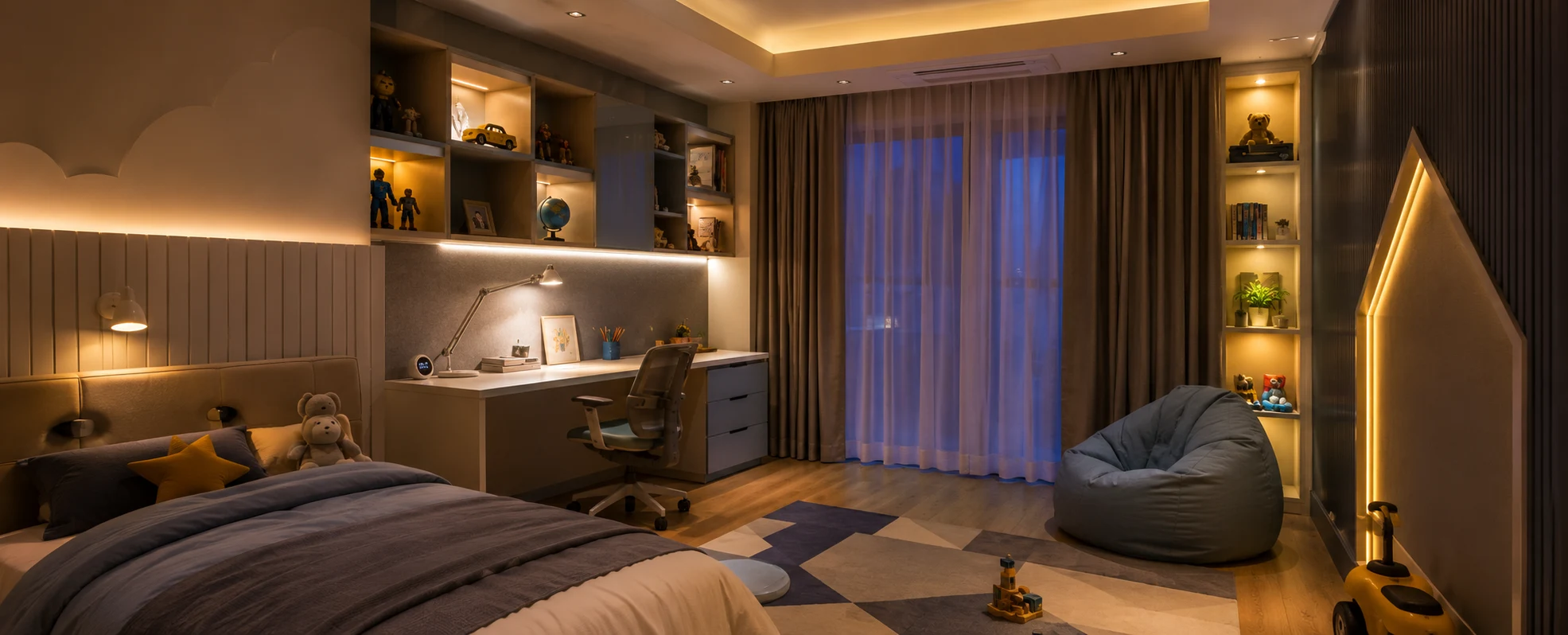
A child's room has to do more jobs than any other room in the house. It's a study, a bedroom, a play area, and for a few years it's where a small person is learning to fall asleep on their own.
Most of those jobs need different lighting, and most homes handle all of them with one ceiling light and a table lamp.
This is what we'd actually plan in a kids' room, what changes as the child gets older, and the couple of things we'd advise against.
What Makes a Kids' Room Different From Any Other Bedroom?
Three things, and they all pull in different directions.
It's a workspace. Indian children study a great deal, and often for long stretches at a desk. That needs proper task lighting — brighter and cooler than anything else in a bedroom.
It's a bedroom for someone still learning to sleep well. Which means the same room needs to become dim, warm, and calm within an hour of being a study.
The requirements change every few years. What a four-year-old needs and what a fifteen-year-old needs share almost nothing. A room set up rigidly for one age is wrong within three years.
Good automation here isn't about features. It's about a room that can be four different things at four different times, and one that doesn't need rewiring when the child outgrows it.
How Should a Study Desk Be Lit?
This is the part most rooms get wrong, and it's the one with real consequences.
Task lighting at the desk, not just overhead. A ceiling light behind a seated child puts their own shadow on the book in front of them. The desk needs its own light source — a wall-mounted or desk lamp positioned so the light falls on the work, not on the back of their head.
Around 300 to 500 lux at the desk surface for sustained reading and writing, which is noticeably brighter than the rest of the room needs to be. Our residential lighting design guide has the room-by-room lux figures.
Cooler light for study, warmer for everything else. Around 4000K neutral white supports alertness at a desk. The same room at 2700K in the evening feels calm. On a tunable-white system, this is one scene change rather than two different fixtures.
Ambient light on alongside task light. A bright pool of desk light in an otherwise dark room is tiring on the eyes. Keep general room lighting at a moderate level while the desk lamp is on — a "Study" scene should raise both, not just one.
What Does a Good Sleep Routine Look Like?
The useful idea here is that the room helps with the routine instead of the routine being a nightly negotiation.
Wind-down. Lights drop to a warm, low level around forty-five minutes before bedtime. Not switched off — lowered. Children read the room, and a room that's clearly settling down does some of the work for you.
Sleep. Everything fades to zero over ten to fifteen minutes rather than clicking off. Curtains close. AC moves to a sleeping temperature.
Night light. A very low warm light — five per cent or less — either left on or triggered by motion near the bed if the child gets up. Low enough not to disturb sleep, enough to see by.
Morning. Lights rising gradually over twenty minutes before the alarm, and curtains opening at the end of it. For school-age children this works considerably better than a sudden alarm in a dark room.
Parents tell us the wind-down and the night light are the two they'd keep if they could only have two. Our bedroom automation guide covers the same logic for adult bedrooms.
What Should the Child Be Able to Control?
More than most parents initially plan for.
A child who can't operate their own room lighting will use the one switch they can reach, which defeats the point of the scenes. From roughly age five or six, they should be able to run their own room.
A keypad at child height near the door and beside the bed, with two or three clearly distinct buttons. Not eight. Not an app.
Buttons that mean something. Bright, Study, Night. A young child will learn three named buttons quickly and use them for years.
One thing kept out of reach. Curtain control and AC setpoints are usually better on the parent side, at least for younger children.
Physical buttons matter more here than anywhere else in the house. A phone-based system means either the child has a phone or they can't control their own room.
What About Safety?
A few genuinely useful things, and one thing worth knowing.
Motorised curtains remove the cord. Looped blind and curtain cords are a recognised strangulation hazard in children's rooms, and motorised operation eliminates them. If there's one safety argument for automation in a kids' room, this is it.
Door and window sensors. Useful in a young child's room — knowing a window has been opened, or that a toddler has left their room at 2 am, without anyone having to check.
Temperature monitoring. Indian summers get severe, and a small child can't reliably tell you the room is too hot. A sensor that alerts if the room goes above or below a set range is simple and worth having.
Motion-activated floor lighting. Low-level lighting that comes on if the child gets out of bed at night — enough to see the doorway, not enough to wake them properly.
Sockets, furniture anchoring, and window restrictors are the other half of child safety, and they aren't automation — but they matter more than anything on this list.
Should There Be a Camera in the Room?
Worth addressing directly, because we're asked and the honest answer depends entirely on age.
For a baby or toddler, a monitor is normal, and most families use one. It's a supervision tool for a child who can't call out.
As children get older, this changes. A camera in the bedroom of an eight-year-old, and certainly a teenager, is a privacy question rather than a safety one — and most families we work with move away from it well before that point. Older children know when they're being watched, and it affects how they feel about their own room.
Our general advice: monitors for the years when they're genuinely a supervision tool, and door or window sensors rather than cameras after that. Sensors tell you what you actually need to know without watching a child in their own room.
How Does the Room Grow With the Child?
This is where a properly designed system earns its cost, because the alternative is redoing the room every few years.
| Age | What the Room Needs |
|---|---|
| 0–3 | Night light, gradual dimming, temperature monitoring, monitor |
| 4–7 | Simple keypad they can reach and understand, night light, wind-down routine |
| 8–12 | Proper study lighting, more independent control, wake-up scene |
| 13+ | Full control of their own room, study scene, longer and later usage patterns |
On a KNX system, none of these transitions need new wiring. The scenes are reprogrammed, the button meanings change, and the room follows the child. The fixtures and the cabling stay exactly as they were.
That's the practical argument for doing it properly at construction: one set of cabling covers all four stages.
What About Shared Rooms?
Common in Indian homes, and it needs slightly different planning.
Independent bedside lighting. Two separately switched reading lights so one child can read while the other sleeps. This single decision prevents most of the arguments.
A shared ambient layer with individual task lighting at each desk or bed.
Different bedtimes handled by zone, not by room. If siblings sleep at different times, the room needs two lighting states rather than one — a "Sleep" scene that dims the room but leaves one bedside light available.
What Does It Cost?
For a single kids' room, as part of a wider home automation project:
| Scope | Approx. Cost |
|---|---|
| Lighting automation with scenes | ₹40,000 – ₹1,20,000 |
| Adding motorised curtains | ₹25,000 – ₹80,000 per window |
| Adding climate control | ₹15,000 – ₹50,000 |
| Sensors — door, window, temperature | ₹8,000 – ₹30,000 |
Indicative estimates covering automation hardware and programming, not fixtures or furniture. Costs come down significantly when the room is part of a whole-home KNX project rather than a standalone installation, because the infrastructure is shared.
Our lighting automation cost guide has a fuller breakdown.
What Would We Not Bother With?
Being honest about this is more useful than a longer feature list.
Colour-changing lights. They're the first thing everyone asks about and the first thing that stops being used. Fun for a fortnight. If you want them, a single strip is enough — don't build the room around it.
Voice control as the primary interface. Fine as an addition, unreliable as the main way a child controls their room. Buttons work every time.
Complicated scenes. Three buttons that get used beat eight that don't. This is true everywhere in a house and doubly true here.
Automating the study routine itself. Lights that switch to study mode at a fixed time don't make homework happen. That's a parenting problem and automation isn't the answer to it.
FAQs
What is the best lighting for a child's study desk?
Task lighting positioned so light falls on the work rather than from behind the child, at roughly 300 to 500 lux at the desk surface, with cooler light around 4000K. Keep general room lighting on at a moderate level too — a bright desk in a dark room is tiring on the eyes.
At what age can a child use smart lighting controls?
Most children manage a simple keypad with two or three clearly named buttons from around five or six. The key is physical buttons at a height they can reach, not an app — and few enough options that they learn them quickly.
Are motorised curtains safer for a kids' room?
Yes, in one specific and meaningful way: they remove looped cords, which are a recognised strangulation hazard in children's rooms. It's the clearest safety argument for automation in a child's bedroom.
Should I put a camera in my child's room?
For a baby or toddler, a monitor is a normal supervision tool. As children get older, it becomes a privacy question, and most families move away from it. Door and window sensors usually tell you what you need to know without watching a child in their own room.
Will the setup still suit my child in five years?
On a KNX system, yes — scenes are reprogrammed and button meanings change without new wiring. That's the main reason to run proper cabling during construction even if the initial setup is simple.
Do siblings sharing a room need anything different?
Independent bedside lighting is the important one, so one child can read while the other sleeps. Beyond that, a shared ambient layer with individual task lighting at each desk works well.
Is it worth automating just one room?
It can be, though the cost per room drops considerably when it's part of a whole-home system, because the infrastructure is shared. If you're building or renovating, it's worth wiring the whole house even if you only commission one or two rooms initially.
Planning a Kids' Room Automation?
The decisions worth getting right are the boring ones — a keypad at the right height, task lighting at the desk, cabling that lets the room change as the child does.
If you're building or renovating in Noida, Delhi NCR, Gurgaon, or Jaipur, talk to our team. You can also explore our home automation, premium switches and lighting, and curtain and gate motors services.