

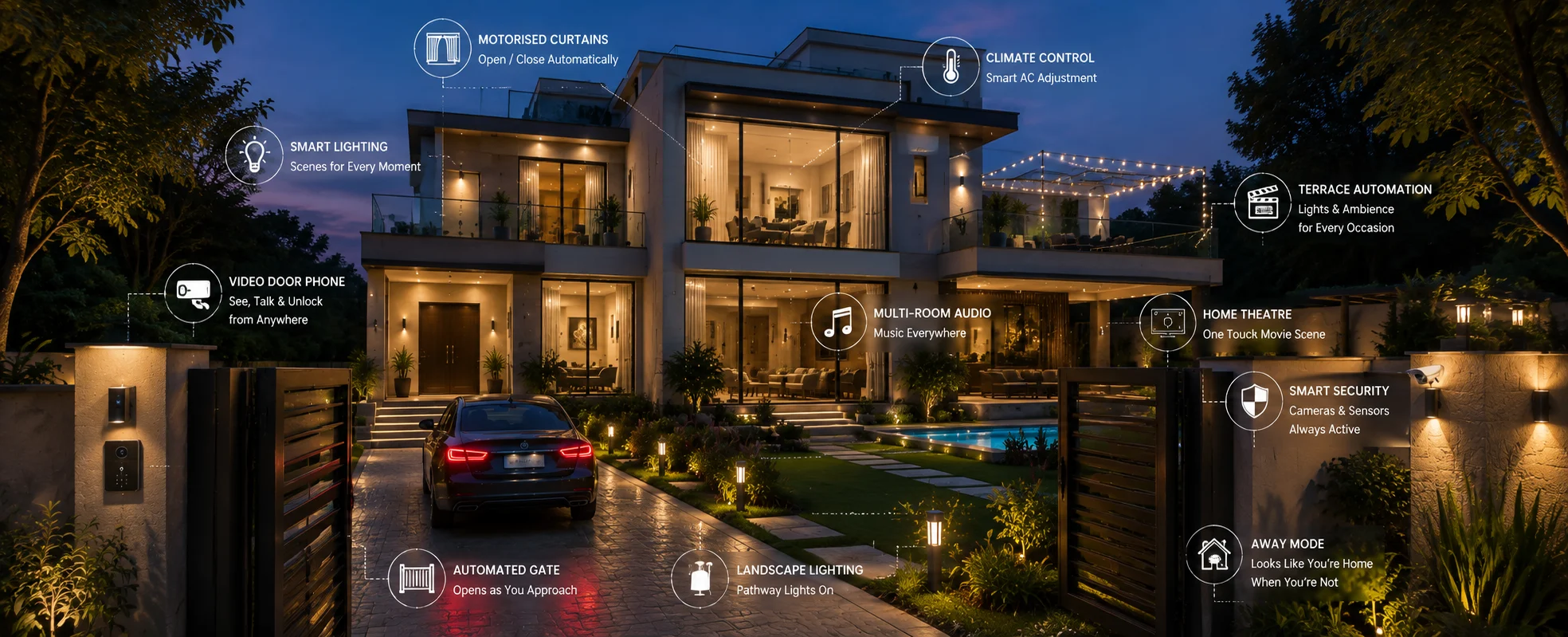
Most automation ideas you'll read were written for apartments. They stop at the front door.
A villa doesn't. The gate is a hundred feet from the porch. There's a driveway, a boundary wall, a garden that looks like nothing after dark, a terrace nobody uses in May, and usually a guest wing or a floor for parents that runs on a completely different rhythm from the rest of the house.
That's where the interesting ideas are. These are the ones we're asked for most, and the ones people actually use.
Arrival and Outdoors
1. The Arrival Sequence
The idea most villa owners keep once they've lived with it.
You turn in from the road. The gate opens as you approach. Driveway lighting comes up ahead of the car, the porch light is already on, and by the time you're at the door, the entrance hall is lit, and the living areas are at a comfortable temperature.
Nothing was pressed. Nothing was unlocked in the rain. On a large plot where the gate is a long way from the house, this is the difference between arriving and arriving.
2. Boundary Lighting That Behaves Differently After Midnight
Perimeter and garden lighting on a fixed on/off schedule is wasteful and, oddly, less secure - a boundary lit all night identically tells you nothing.
Better: full levels through the evening, dimmed to around 30% after midnight, and any motion at the boundary brings that section straight back to full. A dark stretch of wall suddenly lighting up is a far stronger signal than a wall that was already lit.
On a project in Sector 50, Noida, we ran the garden pathway on exactly this logic: sunset activation, 30% after midnight, motion-triggered back to full.
3. A Garden That's Worth Looking At in the Evening
Most villa gardens are designed for daylight and disappear after seven.
Uplighting on the trees, low-level path lighting, and a wash on the boundary wall change how the house looks from inside. The living room window stops being a black rectangle in the evening and becomes a view again.
Worth putting on its own scene so it can run for guests and stay off on ordinary nights.
4. Driveway and Gate Access Without Getting Up
A video intercom at the gate that connects to your phone, and a gate you can open from anywhere.
For deliveries, staff arriving before you're up, or a relative reaching at eleven at night, this removes the entire routine of someone walking down to check. BasIP intercom at the gate, with Yale or Dorset locks on the doors themselves.
Our video door phone guide covers the options in detail.
Inside the House
5. Scenes Named for What You're Doing, Not What They Do
The single biggest usability idea, and it costs nothing extra.
Not "Living Room 40%, Cove On, Accent 60%". Just Evening. Or Dinner. Or Movie. Six named scenes on a keypad at the entrance, and nobody in the house needs to understand zones or dimming levels.
On the Sector 50 villa, fourteen separately controlled zones sit behind six buttons. The owner has never needed to know there are fourteen.
6. A Guest Wing That Runs Independently
Villas usually have a guest room or wing, and guests shouldn't be able to affect the rest of the house — or be affected by it.
Independent scenes and schedules per wing, with the ability to switch the whole area to a standby state when it's empty so it isn't being lit and cooled for nobody. When guests arrive, one press brings it back.
7. A Parents' Floor With Its Own Rhythm
Multi-generational villas are common, and a single whole-home schedule rarely suits everyone. Older family members often wake earlier, sleep earlier, and prefer warmer light in the evening.
Running that floor as its own zone set — with its own morning and night timing — works far better than compromising on a shared schedule.
One practical detail: keep a physical keypad as the primary control there. App-first control tends not to stick with everyone, and a consistent button in a consistent place is more reliable than a phone.
8. Corridor and Staircase Lighting That Handles the Night
Villas have long corridors, and at least one staircase, and both are a nuisance at 3 am — either you turn on full lighting and wake up properly, or you navigate in the dark.
Low-level motion-activated lighting solves it: step lights or corridor lighting at five to ten per cent, triggered by movement, off again after a minute. Bright enough to be safe, dim enough that you go straight back to sleep.
9. A Master Bedroom That Wakes You Properly
Lights that rise gradually over twenty to thirty minutes before your alarm, curtains that open at the end of it, and the AC adjusting to a comfortable waking temperature.
The reverse at night — everything fading down over twenty minutes rather than switching off.
Clients mention this more than anything in the living room. Our bedroom automation guide goes into the detail.
10. Curtains That Handle the Afternoon Sun on Their Own
Large villa glazing is wonderful in January and punishing in May.
Curtains that draw when a west-facing room starts heating, and open again in winter mornings for free warmth, do a meaningful amount of the temperature work before the AC has to. Somfy and NICE motors, Renson or Hunter Douglas where external shading suits the elevation.
11. A Puja Room With Its Own Lighting Scene
Often overlooked, and easy to do well.
A warm, dedicated lighting scene for the space, set to come on at aarti times and stay at a low level otherwise. Small, specific, and something families notice every day.
12. Music That Follows You Through the House
Multi-room audio across the living areas, terrace, and master bedroom, all controlled from the same keypads as the lighting.
For villas where the interior design won't tolerate visible grilles, in-plaster invisible speakers from Sonance or TruAudio disappear completely — see our guide to hidden speakers for luxury homes.
Terrace, Pool and Entertaining
13. A Terrace That Becomes Usable in the Evening
Most Indian villa terraces sit unused for eight months because nobody thought about them after dark.
Layered lighting — a wash on the parapet, a few accent points, and weather-rated outdoor speakers — turns it into a space people actually go up to. Put it on an Entertaining scene alongside the garden lighting, and it's one press.
14. One Scene for When People Are Coming Over
Guests arriving is a predictable event that involves about eight separate actions.
Garden and boundary lighting up, terrace lit, music on at a background level in the living areas, AC brought forward in the rooms being used, gate on a mode that opens easily.
One button, twenty minutes before people arrive.
15. A Home Theatre That Doesn't Need Explaining
Villas have the space for a dedicated room, and the point of automating it is that anyone can start a film.
One press: lights fade to five per cent, screen down, projector on and switched to the right input, curtains closed, AC adjusted. Pause brings the lights to thirty per cent so you can walk out.
We built exactly this into a 7.1.4 Dolby Atmos room at a farmhouse in Ozone City, Aligarh. Our speaker placement guide covers the audio side.
The Ideas Nobody Sees
16. An Away Mode That Actually Looks Like Someone's Home
Villas are frequently empty for weeks at a time.
Lighting that runs at believable hours with some variation rather than the same minute every day, curtains that open and close, and the boundary lighting behaving normally. From the road, the house is lived in.
17. Generator Load Management
Every villa runs a generator, and every villa has the same moment when supply switches over and something trips.
Automation can shed non-essential loads automatically the instant the house moves to generator supply — the theatre, spare-room ACs, garden lighting — and restore them when mains returns. Nobody runs to the panel.
18. Knowing Where the Electricity Actually Goes
On a large villa, the bill is a single large number, and nobody knows which part of the house is responsible.
Consumption monitoring by floor or zone turns that into something you can act on. It's the least glamorous idea on this list and frequently the one that pays for itself.
What Do These Ideas Cost?
Roughly, for a 4BHK villa:
Scope | Approx. Cost |
|---|---|
| Lighting automation with scenes | ₹7,00,000 – ₹15,00,000 |
| Adding climate and curtains | ₹15,00,000 – ₹30,00,000 |
| Complete villa — all systems above | ₹25,00,000 – ₹60,00,000 |
| Large villa or farmhouse, full scope | ₹60,00,000 – ₹1,50,00,000+ |
Indicative estimates covering automation hardware, cabling, installation, and programming. Fixtures, false ceiling work, AC units, and civil work are quoted separately.
One thing specific to villas: cost scales with the plot more than the house. Boundary length, gate distance, and garden coverage drive the outdoor cabling, and two villas with identical built-up area can differ substantially on that alone.
Our lighting automation cost guide has a component-level breakdown.
Which Ideas Should You Do First?
If you're building, the honest answer is: run cable for all of them, install a few.
Conduit and cable are the only parts that become genuinely hard to add later - particularly the long runs to the gate, boundary and garden, which are easy to forget and expensive to add once the driveway is laid. Devices can follow over several years.
If you're choosing where to start, we'd suggest the arrival sequence, living room and master bedroom scenes, and the outdoor lighting. Those four get used daily. The rest can wait.
FAQs
What makes villa automation different from apartment automation?
Everything outside the building. Gate, driveway, boundary, garden, and terrace all need cabling and control that apartments simply don't have, and these outdoor runs are usually the largest cost difference between two villas of similar built-up area.
Can different floors run on completely separate schedules?
Yes, and on multi-generational villas it's usually the better arrangement. Each floor runs its own scenes and timing, with shared areas, outdoor lighting, and security on common control.
Do these ideas work if the internet goes down?
On a KNX system, yes. Scenes, schedules, and lighting logic run locally on the wired bus. Remote app access needs connectivity, but the house keeps working.
Can I add these ideas to a villa that's already built?
Some retrofit easily — gate automation, digital locks, video intercom, motorised curtains where a power point exists. Full scene control across the house usually needs cabling, which is much simpler during construction or a renovation.
What's the one thing people regret not doing?
Cable to the gate, boundary, and garden. It gets left out of the initial scope more often than anything else, and adding it after the driveway and landscaping are finished is disproportionately expensive.
How long does a full villa installation take?
Cabling runs alongside electrical work through construction. After the building is ready, installation and commissioning for a full-scope villa typically takes three to six weeks depending on zone count and how many systems are included.
Planning a Villa Automation?
The ideas worth having are mostly decided before anything is visible — where the cable goes, which zones exist, what the outdoor scope covers. Getting that right early costs very little.
If you're building or renovating a villa in Noida, Delhi NCR, Gurgaon or Jaipur, talk to our team — we're happy to look at drawings and flag what needs deciding before construction moves past it.
You can also explore our home automation, premium switches and lighting, curtain and gate motors, and security and surveillance services.