

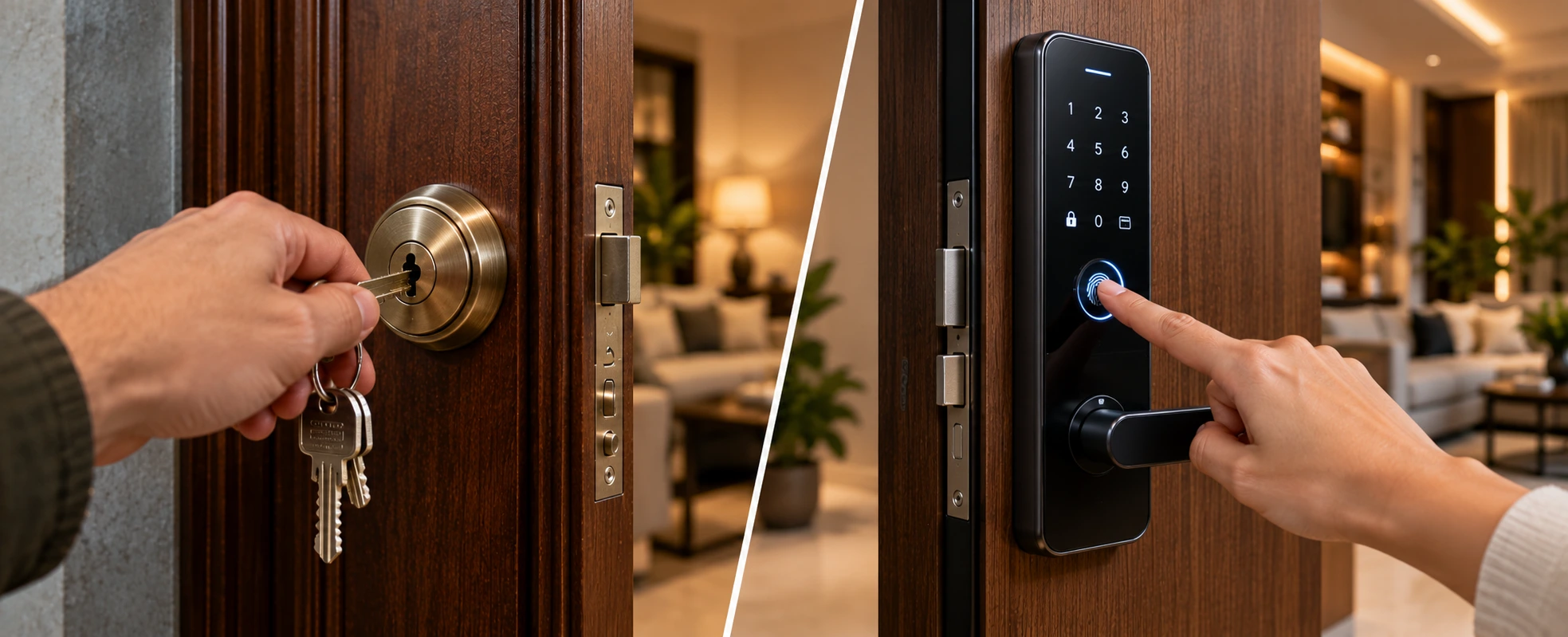
Smart locks are everywhere now, and the pitch is seductive: no keys, fingerprint entry, codes for your maid, alerts on your phone. But they cost more than a good old lock-and-key; they run on batteries, and "what if it gets hacked?" is a fair question. So is a smart lock actually worth it, or is a traditional lock still the sensible choice? This is an honest comparison — cost, security, convenience, and the real downsides of each — so you can decide what is right for your home, rather than what the ad wants you to buy.
What each one is actually good at
Before comparing them head-to-head, it helps to be clear about what each lock is genuinely good at — because they are good at different things, and the "better" lock depends on which of those you value.
A traditional lock is good at being simple and dependable. There are no batteries, no electronics, no app — just a mechanism and a key. It is the cheapest option; there is nothing to update or maintain, and nothing to fail electronically. For a lot of people, that simplicity is exactly the point.
A smart lock is good at convenience, control, and awareness. You enter by fingerprint, PIN, card, or phone instead of a key; you give your maid or a guest a code that you can revoke; you get a record of who came and went; and it can auto-lock and alert you. It turns the front door from a thing you unlock into a thing you manage.
Neither is simply "better." The question is whether the convenience and control of a smart lock are worth its cost and upkeep, for how you actually live. Our guide to the top benefits of a digital door lock covers the smart-lock upsides in depth; here we weigh both sides.
Convenience: the biggest real difference
This is where the smart lock earns most of its keep, and it is a genuine, everyday difference. A key is fine until it is not — until you are juggling groceries at the door, until a family member is locked out, until you need to let the maid in while you are at work, until you are not sure whether the kids got home.
A smart lock answers all of these:
- No keys to carry, lose or copy — enter by fingerprint, PIN, card or phone
- Access for others, on your terms — a code for domestic staff, a temporary one for a guest or a delivery, revoked when you want
- Know who came and went — a record of entries, so you know the kids are home
- It locks itself — auto-lock means the door is never accidentally left unlocked
For a busy household — especially an Indian home with staff, deliveries and family coming and going — this convenience is the real reason to switch. A traditional lock simply cannot do any of it.
Security: the honest picture
"Is a smart lock safe?" is the question everyone asks, and it deserves an honest answer rather than either marketing hype or scare stories.
In everyday terms, a good smart lock is often more secure than a key, not less: a key can be lost, copied, or left behind, while a fingerprint or code cannot; the lock auto-locks so the door is never left open; it can alert you to tampering; and it keeps a record. These are real security gains over a traditional lock.
The honest caveats:
- Quality matters. A smart lock is only as secure as its build — both its physical lock and its electronics. A cheap, no-name lock is a false economy; a reputable brand is worth it.
- Connected features need sensible setup. Any device with an app or cloud connection should be set up carefully with a strong account and kept updated. The core entry methods (fingerprint, PIN) work offline, which limits exposure.
- Physical security still counts. The strength of the lock and the door it sits in matters as much as the smart features — a lock is one layer of a home's security, alongside a video door phone and cameras.
The balanced verdict: a quality smart lock, set up sensibly, is secure and usually an upgrade on a key — but "cheapest smart lock" is not the way to buy security.
The real downsides of a smart lock
A fair comparison has to be honest about where smart locks fall short — because they do, and knowing this upfront avoids disappointment.
- They cost more. A smart lock is a bigger upfront spend than a traditional lock, and better ones cost more.
- They run on batteries. Batteries need replacing — though they last a long time and warn you weeks in advance. Ignore the warnings entirely, and you risk a flat lock (which is why there is a backup).
- Entry can occasionally fail. A fingerprint can misread with wet or worn fingers, or a PIN can be forgotten — so a backup (a mechanical key, card or alternate code) matters.
- There is more to set up and learn. Codes, fingerprints, and app settings take a little setting up, versus a key that just works.
None of these are dealbreakers for most homes — a good smart lock includes a mechanical key or backup override, gives ample battery warning, and is simple to live with once set up. But they are real, and a traditional lock has none of them.
Smart lock vs traditional lock: side by side
Here is the honest head-to-head on what actually matters:
| What matters | Traditional Lock | Smart Lock |
|---|---|---|
| Upfront cost | Lowest | Higher |
| Convenience | A key, always | Keyless; codes for others; no keys to lose |
| Access control | None — a key is a key | Temporary & revocable access, per person |
| Record of entry | None | Log of who came and went |
| Maintenance | None | Battery changes; occasional setup |
| Fails if… | Lost/copied key, worn mechanism | Flat battery ignored; occasional misread (backup covers it) |
| Power cut | Unaffected | Unaffected (own battery, offline entry) |
| Smart home integration | No | Yes — scenes, alerts, video door phone |
| Best for | Simple homes, lowest cost, rentals | Busy households, staff/guests, control & awareness |
The pattern is clear: a traditional lock wins on simplicity and cost; a smart lock wins on convenience, control and awareness. Which column matters more to you is the answer.
So, is it worth it? Our honest take
For most modern households, yes — a smart lock is worth it. If your home has the daily churn of family, domestic staff, deliveries, and travel, the convenience and control genuinely improve daily life, and the record and auto-lock add real peace of mind. For these homes, going back to a key feels like a step backward.
But not for everyone. If you want the lowest cost and nothing to maintain, if a key works perfectly well for your home, if it is a rental where you cannot or should not modify the door, or if it is a secondary door where keyless access adds little — a good traditional lock is still the sensible choice. There is no shame in a lock and key that does its job.
And it is not all-or-nothing: most smart locks keep a mechanical key as a backup, so you can have the new convenience and the old reliability together. If you do go smart, buy a quality lock, set it up sensibly, and choose the features you will actually use — our guide to the best digital locks for your main door and to digital lock installation and integration can help.
We supply, install, and integrate smart locks as part of complete home security across Delhi NCR — and we will tell you honestly if a simpler option suits your home. Explore our digital locks service.
FAQs
Is a smart lock worth it over a traditional lock?
For most modern households — busy families, homes with domestic staff, deliveries and travel — a smart lock is worth it for the convenience, controlled access and the record of who came and went. For a simple home where a key works fine and you value the lowest cost and nothing to maintain, a good traditional lock is still perfectly sensible. It comes down to whether the convenience and control are worth the extra cost and the small upkeep, for how you actually live.
Are smart locks safe and secure?
A good smart lock from a reputable brand is secure, and in everyday terms often more secure than a key — it auto-locks, can't be copied like a key, alerts you to tampering, and keeps a record of entries. Like any connected device, app or cloud features should be set up carefully, and it is wise to choose a quality lock rather than the cheapest option. The physical security of the lock itself matters as much as the smart features.
What are the disadvantages of a smart lock?
Honestly, there are a few: they cost more than a traditional lock, they run on batteries that need replacing (with low-battery warnings), fingerprint or PIN entry can occasionally fail and needs a backup, and app or cloud features need sensible setup. None of these are dealbreakers for most homes — a good lock has a mechanical key or backup override, and gives weeks of battery warning — but they are real and worth knowing before you buy.
What happens to a smart lock in a power cut or if the battery dies?
Smart locks run on their own batteries, not mains power, so a power cut does not affect them, and fingerprint and PIN entry work offline. Batteries last a long time and give low-battery warnings well in advance, and most locks have a mechanical key override or an emergency power option as a backup if the battery is ignored. So being locked out is avoidable with basic attention to the warnings.
When is a traditional lock the better choice?
A traditional lock is the better choice when you want the lowest cost and nothing to maintain, for a simple home or a door where keyless access adds little, for a rental where you cannot modify the door or need landlord consent, or as a trusted backup on a secondary door. Its strengths are simplicity, low cost, and no electronics to fail — real advantages for the right situation.
Can I have both a smart lock and a key?
Yes — most smart locks include a mechanical key override alongside fingerprint, PIN, card, or app access, so you get the convenience of keyless entry with a physical key as a backup. This is one reason the smart-vs-traditional choice is not all-or-nothing: a good smart lock gives you the new ways in and keeps the old one as a fallback.