

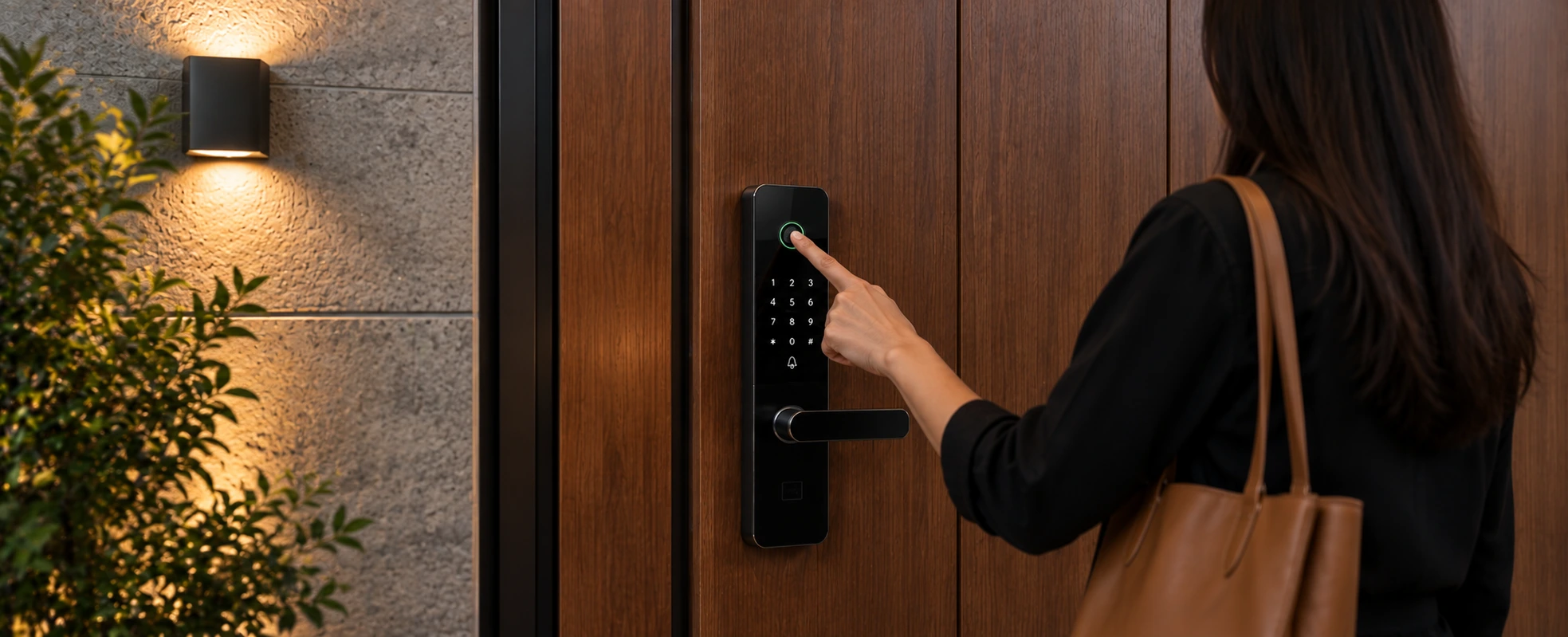
Installing a digital lock is not just screwing a device onto a door. The lock must match your door's material, thickness, and handing; you may need a mortise cutout; and if it is joining a smart home, it must be wired or paired into the wider system so the door talks to lights, cameras, and scenes. We handle door compatibility, installation, and KNX integration as one job - so the lock works on day one and keeps working with everything else.
What does digital lock installation actually involve?
Digital lock installation involves four stages: checking the door is compatible, preparing the door (often a mortise cutout), mounting and wiring the lock body and reader, and then configuring access - fingerprints, PINs, and app users. On a smart home project, a fifth stage is added: integrating the lock into the automation system so it reports status and responds to scenes.
Most homeowners assume a smart lock is a simple swap for the old one. Sometimes it is. Often it is not - because the door was never built for it. This is what determines whether the lock feels premium or frustrating, and it is worth understanding before you buy.
Will a digital lock fit my existing door?
Not every door accepts every lock. Compatibility depends on the door material, its thickness, the way it swings, and whether the lock is mortise or rim type. A quick check before buying prevents the most common installation problem - a lock that physically cannot be fitted to the door you have.
Here is what determines fit:
| Factor | What to check | Why it matters |
|---|---|---|
| Door material | Wood, steel, PVC, composite | Cutting and mounting differ for each |
| Door thickness | Measure the leaf | Mortise locks have a supported thickness range |
| Handing / swing | Left or right, in or out | Reader and handle orientation must match |
| Lock type | Mortise vs rim | Mortise replaces the internal lock body; rim mounts on the surface |
| Existing cutout | Size of current mortise pocket | A larger pocket may need filling or re-cutting |
Mortise locks sit inside the door and are the more secure, more integrated option - but they need an accurate pocket cut into the door. Rim locks mount on the surface and are far easier to retrofit, which makes them useful when the door cannot be modified. On a new build, we specify the door and lock together so this is never an issue. On a retrofit, we survey the door first.
What happens during a professional installation?
A professional installation follows a fixed sequence: survey, template and cutting, mounting, wiring or pairing, and configuration. Skipping the survey is where most DIY installs go wrong - the lock is bought, the door does not accept it, and the project stalls.
The stages we follow:
Survey. We measure the door, confirm handing, and check the existing lock pocket. If a video door phone or KNX integration is planned, we confirm cable routes at this stage too.
Template and cut. A mortise lock needs a precise pocket. This is done with a template, not by eye. A poor cutout weakens the door and misaligns the bolt.
Mount and wire. The lock body, external reader, and internal unit are fitted and aligned so the bolt throws cleanly. Wired integrations get their cabling run now; battery locks are seated and tested.
Configure. Fingerprints, PINs, and app users are enrolled. Auto-lock timing, tamper alarm, and low-battery alerts are set. We test every access method before handover.
The bolt alignment is the detail that separates a good install from a bad one. A lock that has to be forced or lifted to lock will fail early and annoy the household daily.
How does a digital lock integrate with a KNX smart home?
In a KNX smart home, the digital lock stops being a standalone device and becomes part of the system. Its locked or unlocked status can appear on the same app as your lights and cameras, and it can respond to whole-home scenes - so a single "Leave Home" action can confirm the door is locked while switching everything off.
There are a few ways a lock joins the system, and the right one depends on the lock and the project:
Status and control via the automation platform. The lock's state is exposed to the smart home so you can see, from one app, whether the main door is locked — alongside lights, climate and CCTV. A "Leave Home" or "Good Night" scene can include a door-lock check.
Electric strike or motorised release on KNX. For gated entrances and lobbies, the release mechanism can be driven by a KNX output - so the door can be triggered from a keypad, an app, or automatically after a video door phone call is answered.
Video door phone as the front layer. This is the combination we install most often. The video door phone provides visual verification of who is at the door; once you have seen and spoken to them, you can release the door remotely. For deliveries and unexpected visitors, this closes the gap that a lock alone leaves open.
We covered the visual side of this in our video door phone buyer's guide, and door security is one layer of a wider setup - our villa security systems guide shows how locks, cameras, and alarms work together.
Do digital locks work during power cuts and without internet?
Yes. Fingerprint and PIN authentication work entirely offline - no internet is needed to unlock the door. Digital locks run on batteries with low-battery alerts well in advance, and quality locks include a mechanical key override for emergencies. Only remote app access depends on connectivity.
This matters in Indian homes specifically, and it is worth being precise about what depends on what:
- Fingerprint / PIN - work offline, always. No Wi-Fi, no problem.
- Battery - locks run on batteries; a low-battery warning appears weeks ahead, and most locks accept emergency USB power if the battery is fully drained.
- Mechanical override - a physical key backup means you are never locked out if electronics fail.
- App / remote access - this is the only function that needs the internet. If broadband drops, you lose remote unlocking but keep every on-door method.
When a lock is integrated into a wired KNX system, the local automation continues to function during an internet outage - because KNX does not depend on the cloud to run its scenes. We explained this reliability difference in our wired vs wireless smart home guide.
What should you check before buying a digital lock?
Before buying, confirm five things: your door is compatible, the lock has a mechanical override, it carries proper certification, the brand has genuine India service support, and - if it is for a smart home - that it can integrate with your automation system. Getting these right before purchase prevents almost every common regret.
A short honest note here: not every home needs an app-connected lock. If you only want to stop carrying keys and give temporary access to staff, a good fingerprint-plus-PIN lock with a mechanical override does the job at a lower cost. The app and integration features are worth it when the lock is part of a wider smart home, or when you genuinely need remote access - for a second home, or when you travel often. Buy the capability you will use, not the longest spec sheet.
We work with locks from Yale and Dorset, and BasIP for video-door-phone-integrated entry, chosen to match the door and the wider system rather than sold as a one-size product.
A real integration example
On a 3BHK apartment in Sector 137, Noida, the main door was part of a wider automation scope covering lighting, climate, and curtains. The digital lock was integrated so its status sat on the same interface as the four time-based scenes, and a Basalte keypad at the entrance let the family arm the home and confirm the door on the way out - one action, checked and logged, rather than wondering from the lift whether the door had locked.
This is the difference an integrator makes: the lock was not an afterthought bolted on later, but designed into the entrance experience from the start.
FAQs
Can any digital lock be fitted to any door?
No. Fit depends on the door's material, thickness, handing, and whether the lock is mortise or rim type. A mortise lock needs an accurate pocket cut into the door. Always have the door surveyed before buying, especially for a retrofit — this prevents the most common installation problem.
Do I need a professional to install a digital lock?
For a simple rim lock on a compatible door, a competent person can manage it. For a mortise lock, a lock joining a smart home, or any door needing cutting, professional installation is strongly advised — bolt misalignment and poor cutouts cause early failure and daily frustration.
Can a digital lock be added to an existing smart home?
Yes. Depending on the lock and system, it can be integrated so its status shows on your smart home app and responds to scenes, or a KNX-controlled electric strike can be used for gated entrances. The integration path depends on your existing setup, which is why a survey comes first.
What happens if the battery dies completely?
Quality digital locks warn you weeks before the battery is exhausted. If it does fully drain, most locks accept emergency USB power to open them, and all reputable locks include a mechanical key override as a final backup. You are not locked out.
Is a video door phone necessary with a digital lock?
Not necessary, but a strong pairing. A lock controls access; a video door phone lets you see and verify who is asking for it before you grant access remotely. Together they close the gap a lock alone leaves for deliveries and unexpected visitors.
Does an integrated lock still work if the internet is down?
Yes. On-door methods - fingerprint, PIN, mechanical key - work regardless of the internet. In a wired KNX home, local scenes continue too. Only remote app unlocking needs connectivity. Local authentication never depends on the internet.
Planning a digital door that fits your home
A digital lock is only as good as its installation and how well it joins the rest of your home. The lock on the shelf and the lock working reliably on your door are two different things - and the gap between them is compatibility, installation quality, and integration.
We survey the door, match the right lock, install it properly, and integrate it into your smart home so the front door becomes part of how the whole home works. Explore our digital locks service, or talk to us about your project.