

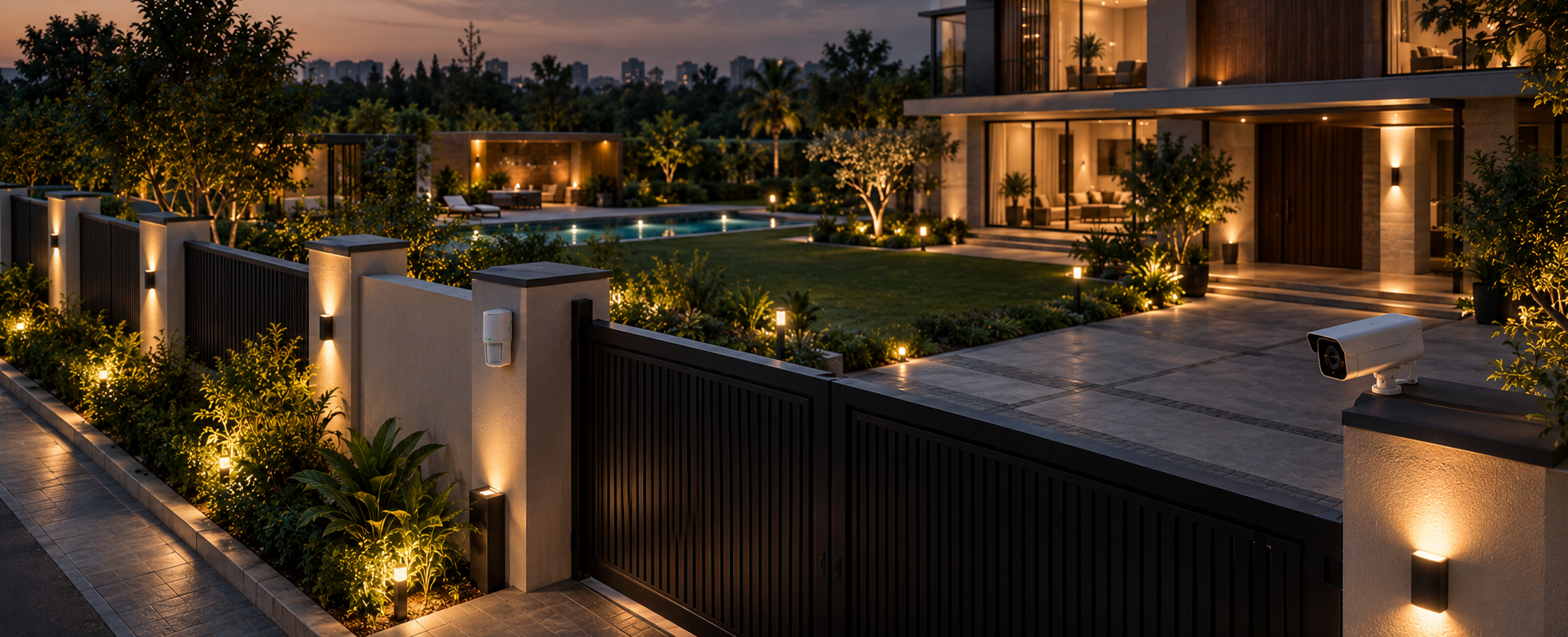
No single system suits every villa, and any answer that starts with a product answers the wrong question. Villa security is a perimeter-and-layering problem first, a detection-technology problem second, and a panel-selection problem last.
The failure mode is consistent: a system specified as though the villa were a large apartment. Contacts on the doors, PIRs in the rooms, a panel in the utility area - and a boundary, a gate, a garden, and two outbuildings entirely unaddressed.
This is written for installers and specifiers rather than homeowners.
Why Villas Are a Different Design Problem
Three structural differences drive everything else.
The protected area extends well beyond the building. Boundary wall, gate, driveway, garden, sometimes a pool house or servant's quarters. In an apartment, the front door is the perimeter. In a villa, it is one of several lines.
Detection outdoors behaves nothing like detection indoors. Interior PIR is a solved problem. Outdoor detection has to contend with animals, foliage movement, vehicle headlights, rainfall, and thermal conditions that indoor devices never encounter.
Distances are substantial. Cable runs to a gate a hundred feet away, power at remote points, and network coverage across a plot rather than a floor plate.
Get those three right and the panel choice becomes straightforward. Get them wrong, and no panel compensates.
Layer the Detection
The standard model is three lines, and villas are one of the few residential cases where all three are justified.
| Layer | Purpose | Typical detection |
|---|---|---|
| Perimeter | Detect at the boundary, before the building | Outdoor PIR or dual-technology detectors, beam detectors along walls, gate contacts |
| Building line | Detect entry attempts at the shell | Door and window contacts, glass-break detection, curtain detectors at vulnerable openings |
| Interior | Detect movement inside | PIR, dual-technology, pressure or vibration on specific assets |
Design intent per layer differs. The perimeter layer is usually configured for notification and deterrence - lighting response, camera trigger, alert - rather than full alarm, because outdoor false activations are inevitable, and a system that sirens at every stray dog gets disarmed permanently by the client.
The building line is the one that should trigger a confirmed alarm. It is the most reliable layer and the one with the clearest intent behind an activation.
The interior layer is the fallback and matters most for occupied-mode partitioning, which is covered further down.
Outdoor Detection - Where Most Villa Systems Fail
This deserves its own section because it accounts for the majority of villa security complaints post-handover.
What causes outdoor false activations:
Animals — stray dogs, cats, cattle in peri-urban plots. The single most common cause in Indian installations.
Foliage movement in wind, particularly where planting has grown since commissioning.
Vehicle headlights sweeping across a detection field from an adjacent road or driveway.
Thermal conditions — a sun-heated wall or paving cooling in the evening can present a moving thermal signature to a basic PIR.
Rain and insects on the lens.
What reduces them:
Dual-technology detection, requiring two sensing methods to agree before activation, rather than single-technology PIR.
Detectors with pet or small-animal discrimination, mounted at a height and angle that keeps ground-level movement out of the primary detection field.
Beam detectors along boundary runs where the geometry suits them, since a beam crossing at a set height is inherently less susceptible to ground-level animal movement than a volumetric field.
Careful aiming away from roads, driveways, and planting. This is a site decision, not a datasheet decision.
Camera-based verification, so an activation can be assessed rather than acted on blindly.
OPTEX manufactures outdoor detection specifically, and their range is worth specifying where perimeter detection is a genuine requirement rather than an afterthought.
The commissioning implication: planting grows. A detector aimed correctly at handover may be looking into a shrub eighteen months later. Worth setting client expectations and covering it in the maintenance scope.
Cameras - Placement Before Specification
Resolution matters less than position, and villa camera schemes are frequently over-specified and under-positioned.
Positions that earn their place:
Gate and entry, capturing faces and vehicle registrations at a usable angle — which usually means a dedicated camera at approach height rather than a wide-angle overview.
Each building approach, not just the front door.
Boundary corners where the wall geometry creates blind spots.
Driveway and parking.
Any secondary access - service gate, rear entry, terrace access.
Practical points:
Mount high enough to be out of reach, low enough to capture identifiable faces. An overhead camera capturing the top of a head is effectively useless.
Consider what the camera looks into at different times of day. West-facing cameras become useless for an hour in the evening if nothing accounts for it.
IR illumination range and the actual scene depth need to match. A camera whose IR reaches fifteen metres pointed down a forty-metre driveway records nothing beyond the first stretch.
Dust and monsoon exposure on outdoor housings - factor cleaning into the maintenance scope, because a dirty dome degrades quietly rather than failing visibly.
We specify HIKvision for surveillance across residential and commercial projects.
Access Control on a Villa
More points than an apartment, with a genuine day-to-day operational requirement rather than a purely security one.
Typical controlled points:
Main gate — vehicle and pedestrian, usually with intercom.
Main door and any secondary entrances.
Servant's quarters or outbuilding, often with a different access schedule.
Terrace access, where the client wants it restricted.
The requirement that actually drives design is domestic staff access. Indian villas routinely have cooks, housekeepers, and drivers arriving on different schedules, and the household is often out. Time-bound codes with an entry log solve this properly, where physical keys in circulation do not.
BasIP for video intercom at the gate, Yale and Dorset for digital locks. Our video door phone guide covers intercom selection.
Partitioning - The Part Clients Actually Judge You On
A villa security system that can only be fully armed or fully disarmed will be used for about a fortnight.
The arming modes a villa realistically needs:
| Mode | What's active | When |
|---|---|---|
| Away | Perimeter, building line, interior | Property empty |
| Night | Perimeter, building line, ground floor interior | Household asleep upstairs |
| Home | Perimeter only, low-level notification | Occupied, people moving around |
| Partial | Selected zones — e.g. unoccupied wing or upper floor | Guests absent, family travelling |
Night mode is the one that determines whether the system gets used. If arming at bedtime means nobody can go downstairs for water, the client stops arming it.
That requires zone planning at design stage — interior detection grouped by floor and wing, not lumped into one area. It is a design decision, not a panel feature.
Cabling and Power on a Large Plot
The practical work, and where villa jobs differ most from apartment jobs.
Cable runs. Gate, boundary, and outbuilding runs are long, cross open ground, and typically need trenching or conduit laid during landscaping. Once a driveway is laid and a garden planted, adding a run is disproportionately expensive. This is the single most common omission from initial scope.
Power at remote points. Gate motors, intercom, boundary cameras and outdoor detectors all need supply. Deciding this late means either surface conduit across finished ground or a compromise on device placement.
Junction and enclosure siting. Outdoor junctions need appropriately rated enclosures, and they need to be reachable for service without a ladder and a hedge trimmer.
Panel location. Not in the garage, not in an unventilated cupboard, and not somewhere an intruder reaches before the entry delay expires. Tamper protection on the enclosure, and a sensible entry route relative to where the panel sits.
Backup power. Villas run inverters and generators. The panel, network, and any device expected to work during an outage need to be on backup — and worth confirming rather than assuming, because a security system that dies with the mains is not a security system.
Our guide to KNX cable covers the control-side infrastructure that runs alongside.
Integrating With the Automation System
Where a KNX villa differs from a standalone alarm installation.
What integration usefully enables:
Perimeter activation triggering lighting response — the boundary section brightening, which is both deterrent and useful for camera capture.
Arming Away as part of a whole-house scene alongside lighting, climate and blinds, so the client presses one button rather than remembering the alarm separately.
Occupancy simulation on Away, running lighting and blinds to believable patterns rather than the same schedule daily.
Alarm state informing other systems — lighting to full on confirmed activation, for instance.
What to keep separate: the alarm's own detection and signalling path should not depend on the automation system being operational. Integration should add behaviour, not create a dependency. If the KNX system is down for service, the alarm should still alarm.
That distinction is worth being explicit about with clients who assume "integrated" means "merged."
Our guide on how KNX works covers the bus architecture.
Panel and Detection Brands
For alarm panels and detection, we work with Texecom and Honeywell for outdoor and perimeter detection, and HIKvision for surveillance. Hochiki covers fire detection, which is a separate discipline with its own regulatory requirements and should not be folded into a security scope.
Selection follows the site — perimeter length, detection layers required, integration depth and the client's tolerance for false activations — rather than a standard specification applied across projects.
Commissioning
Walk test every detector, in the conditions it will operate in. An outdoor detector walk-tested at 11 am in still air tells you very little about its behaviour at dusk with wind in the planting.
Verify camera coverage against the actual scene, at day and at night. IR performance in situ is frequently different from the datasheet.
Test every arming mode, particularly Night mode, with someone actually walking the route the client will walk.
Confirm entry and exit timing against the real route from gate to panel, not an assumed one.
Test on backup power. Pull the mains and confirm the system behaves as specified.
Document zone naming clearly. "Zone 14" means nothing to a client at 2 am. "Rear garden — east" does.
Handover
Train whoever actually uses it, which is often not the person who commissioned the project. Include domestic staff where they'll be arming or disarming.
Set realistic expectations on outdoor false activations. They will happen. A client who has been told this in advance reports them as a tuning item; one who hasn't reports them as a fault.
Document the maintenance scope — detector cleaning, lens cleaning, battery replacement, and re-aiming as planting grows.
Provide zone documentation and the as-built layout. Whoever services this in five years will need it.
FAQs
What is the biggest difference between villa and apartment security design?
The protected area extends well beyond the building — boundary, gate, driveway, garden and outbuildings. Outdoor detection behaves nothing like indoor detection, and cable runs are long enough that they must be planned during landscaping rather than added afterwards.
How do you reduce false alarms on outdoor detectors?
Dual-technology detection rather than single-technology PIR, careful mounting height and aiming away from roads and planting, beam detectors along boundary runs where geometry suits, and camera-based verification so activations can be assessed. Planting growth should be covered in the maintenance scope.
Should perimeter detection trigger a full alarm?
Usually not. Outdoor false activations are inevitable, and a system that sirens at every stray animal gets permanently disarmed. Perimeter detection is generally better configured for notification, lighting response, and camera trigger, with confirmed alarm reserved for the building line.
How many arming modes does a villa need?
At minimum, Away, Night, and Home, with partial arming for unoccupied wings. Night mode is the one that determines whether the system gets used — if arming at bedtime prevents normal movement inside the house, the client stops arming it.
Where should the alarm panel be located?
Somewhere ventilated, tamper-protected, on backup power, and not reachable by an intruder before the entry delay expires. Garages and unventilated cupboards are both common and both poor choices.
Should security be integrated with the automation system?
Integration adds useful behaviour — lighting response to perimeter activation, arming as part of a whole-house scene, occupancy simulation. But the alarm's own detection and signalling should not depend on the automation system being operational. Integration should add capability, not create a dependency.
What is most often missing from initial villa security scope?
Cable runs to the gate, boundary and outbuildings. They are long, cross open ground, and once the driveway is laid and the garden planted, adding them is disproportionately expensive.
Working on a Villa Project?
The decisions that determine whether a villa security system works are made at the survey and cabling stage, not at panel selection. Perimeter layering, detection technology per zone, cable routes across the plot, and arming mode design all come before any product is chosen.
If you're specifying or installing on a villa project in Noida, Delhi NCR, Gurgaon, or Jaipur, talk to our team. You can also explore our security and surveillance and security and access control services, or read our home security guide written for homeowners.