

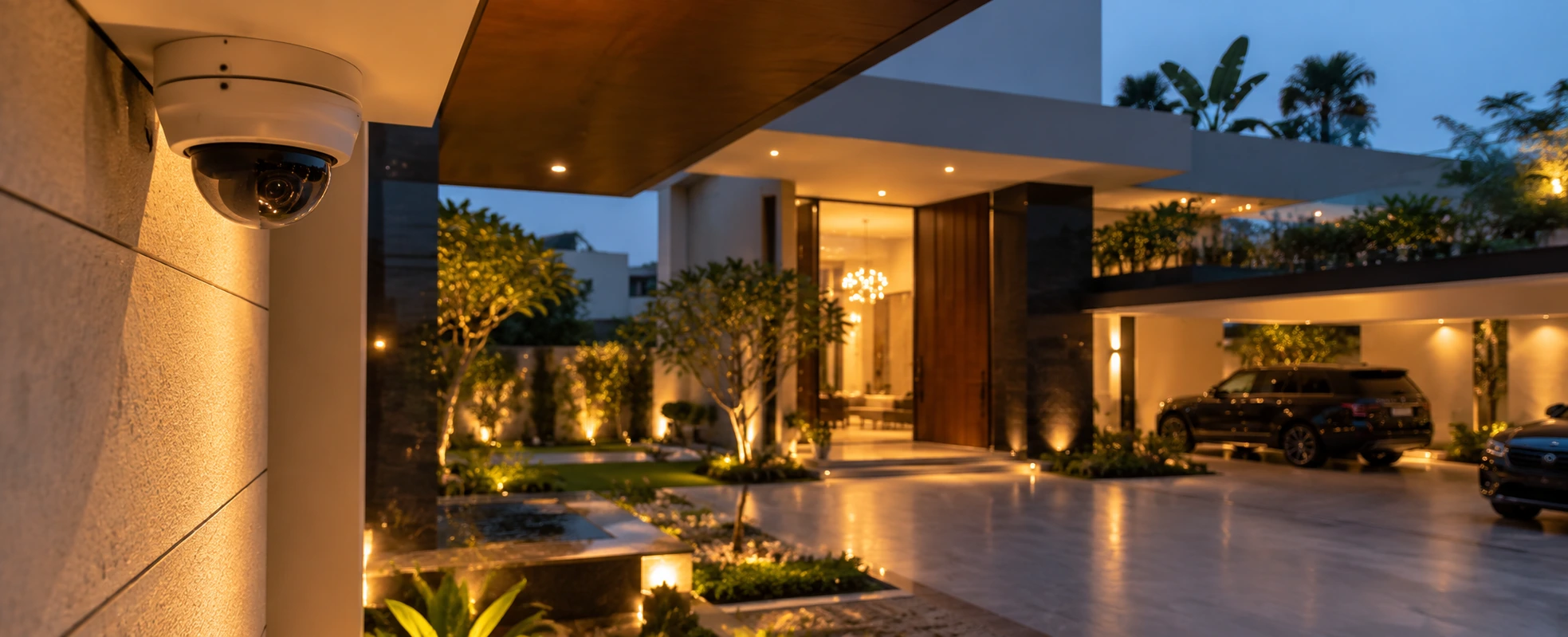
CCTV camera security for a luxury home is a designed surveillance system solution- the right camera types placed for full coverage, reliable night vision, secure recording and storage, remote viewing from anywhere, and discreet integration that fits the architecture rather than fighting it. For a large or high-value property, it is not about buying more cameras; it is about designing coverage with no blind spots, keeping footage secure and accessible, and integrating the whole system into home automation so you can monitor and control security from one place. This guide covers how to plan it.
Why a luxury home needs a designed system, not just cameras
A luxury home is a harder surveillance problem than an apartment, and buying a box of cameras does not solve it. The property is larger, with a perimeter, gardens, gates, driveways, and multiple entrances. It has areas of very different lighting - bright open lawns, shadowed side returns, dark boundaries. And crucially, the owner cares as much about how the system looks and how private the footage is as about the cameras themselves.
That is why the difference between a good luxury-home CCTV system and a poor one is design, not hardware. A designed system gives complete coverage with no blind spots, handles the property's real lighting conditions, keeps footage secure and easy to access, and disappears into the architecture. A poorly planned one leaves gaps, floods the owner with useless alerts, and looks like an afterthought bolted onto a beautiful home.
This guide walks through the elements that matter for a luxury property: coverage design, camera types, night performance, recording and storage, remote access, integration with the home's automation, and privacy - the concern that matters most to high-value clients. For the wider security picture beyond cameras, our villa security systems guide covers alarms and perimeter detection alongside cameras.
Coverage design: eliminating blind spots
The single most important decision in a luxury-home CCTV system is where the cameras go - and that is a design exercise done on the property's plans, not a guess made on site. Coverage design means mapping the whole property and ensuring every approach, entrance, and vulnerable area is seen, with cameras overlapping so there are no gaps a person could move through unseen.
Good coverage design for a luxury home considers:
- The perimeter and approaches — boundaries, gates, driveways and the routes onto the property, seen before anyone reaches the house
- Entrances and access points — every door, and ground-floor windows and other ways in
- Overlap, not just placement — cameras positioned so their views overlap and cover each other's blind spots
- The property's blind spots — the shadowed side returns, rear gardens and corners that casual placement misses
For a large plot, this is where most systems fail - the front looks well covered while the sides and rear are left open. Designing coverage on the plans first is what prevents that.
Camera types: matching the camera to the job
Different parts of a property need different cameras, and matching the type to the job is part of good design. A camera watching a wide lawn has a different task from one reading faces at the front door or one covering a long boundary wall.
The main camera types used in a luxury home include:
- Fixed cameras for defined areas — an entrance, a driveway, a specific approach - giving a consistent, reliable view
- Wide-coverage cameras for open areas like lawns and courtyards where a broad field of view matters
- Cameras suited to identification at key points like the main entrance and gate, where seeing a face or a number plate clearly matters more than a wide view
- Cameras built for the location — weather-rated for outdoors, and discreet forms for interiors and refined exteriors
The point is not to choose one camera and repeat it, but to place the right type where its strength is needed. A good integrator specifies the mix based on what each position has to achieve.
Night vision and difficult lighting
Most security incidents happen after dark, so night performance is not a nice-to-have - it is the core of the system. A camera that gives a crisp daytime image and a useless grainy one at night is not protecting the property when it matters most.
A luxury property also has genuinely difficult lighting: bright pathway and facade lighting next to deep shadow, headlights sweeping across the drive, and dark boundaries far from any light. Cameras have to handle this range, not just simple darkness. Good night performance and the ability to cope with strong contrast between bright and dark areas are things to specify carefully for each position - and they work best when the property's own lighting design is considered alongside the cameras, since well-placed architectural lighting improves what the cameras can see.
We keep the specifics of night performance to what each position genuinely needs rather than a blanket claim, because a boundary camera and a porch camera face very different conditions.
Recording, storage, and keeping footage secure
Cameras are only half the system - the footage has to be recorded reliably, kept long enough to be useful, and protected. For a luxury home, secure recording matters as much as good cameras, because footage is only valuable if it is there when needed and cannot be tampered with.
A luxury-home recording setup should address:
- Reliable local recording — a properly specified recorder (NVR) sized for the number of cameras and the retention the owner wants
- Retention that suits the home — footage kept long enough to be useful after an incident, decided with the owner rather than left to a default
- Secure storage — recordings protected against tampering and unauthorised access, and ideally the recorder itself kept in a secure location
- Resilience — the system designed to keep recording through the interruptions a real home sees, such as power cuts, which matter in the Indian context
The right retention and storage design depends on the number of cameras and how the owner wants to use the footage, and should be sized for the specific property.
Remote viewing and smart alerts
A luxury homeowner is often travelling, and the value of a modern system is that the home is visible from anywhere - securely - with alerts that mean something rather than a constant stream of notifications.
A well-designed system offers:
- Secure remote viewing — live and recorded footage on a phone or tablet from anywhere, over a secure connection
- Meaningful alerts — notifications for events that matter, rather than every moving shadow, so the owner pays attention when it counts
- Smart detection — modern systems can distinguish types of activity to cut false alarms; our guide to how smart security systems detect suspicious activity explains this
- One place to look — footage and alerts alongside the rest of the home's controls, rather than a separate app the owner forgets
The goal is a homeowner who can glance at their property from another city and trust that they will be told if something genuinely needs attention.
Integration: security as part of the smart home
For a luxury home that is already automated, CCTV should not be an island. Its real value comes when it is part of the whole system - seen and controlled alongside lighting, access, and the rest of the home, and able to work with them. This is why we design it as part of our home automation offering rather than a bolt-on.
Integrated CCTV in a smart home can:
- Live in one interface — cameras viewed from the same panels and app as the home's other controls, not a separate system
- Work with access and entry — cameras tied in with the video door phone and access control so entry and surveillance work together, as part of a single security and access control approach
- Trigger and respond — security events able to prompt responses like lighting, as part of the home's automation
- Present cleanly — one coherent system the owner actually uses, rather than several that compete
This integration is what turns a set of cameras into home security, and it is best designed alongside the home's automation rather than added later.
Privacy and discretion: the luxury client's real concern
For a high-value homeowner, two concerns sit above the rest: that the system is private, and that it does not spoil the home. Both deserve real attention.
Footage privacy. The owner's footage is sensitive, and who can access it - and how securely - is a genuine concern. A luxury system should keep recordings secure and access controlled, and the owner should understand where footage is stored and who can reach it. This is a conversation to have openly with the integrator, not an afterthought.
Discreet design. A beautiful home should not look like it is under guard. Cameras can be chosen and placed to be discreet and to fit the architecture - present and effective without dominating the facade or the interiors. Getting this right is part of designing for a luxury property, and it is where a considered installation shows.
We treat both as core to a luxury-home system, not extras - the whole point is security that protects the home without compromising how it feels to live in. Our security and surveillance service covers how we approach this.
What should a luxury homeowner plan for?
An honest note. A CCTV system delivers on its promise when it is designed for the specific property, and disappoints when it is bought as a package and fitted uniformly.
Design on the plans, ideally early. Coverage, cabling, and power for cameras are far cleaner to plan into a build or renovation than to retrofit. If the home is being built or renovated, plan the CCTV alongside it.
Specify for each position, not the whole house. The right camera, night performance, and view differ by location. A system specified position by position outperforms one where the same camera is repeated everywhere.
Decide recording and retention with intent. How long footage is kept and how securely it is stored should be a decision, sized to the property and the owner's needs.
Plan for integration and privacy from the start. If the home is automated, design CCTV as part of it, and settle how footage is kept private early rather than later.
We design CCTV and integrated home security for luxury properties across Delhi NCR as part of the wider automated home. Camera and detection brands are specified to suit the property - we work with established, reliable equipment, including Hikvision for cameras.
FAQs
What makes CCTV for a luxury home different from a normal home?
Scale and priorities. A luxury home has a larger property with a perimeter, gardens, gates and multiple entrances, varied lighting conditions, and an owner who cares about footage privacy and how the system looks. It needs designed coverage with no blind spots, cameras matched to each position, secure recording, and discreet integration — not simply more cameras.
How many CCTV cameras does a luxury home need?
There is no fixed number — it depends on the property's size, layout, perimeter, and the areas that need covering. The right count comes from a coverage design done on the property's plans, ensuring every approach and entrance is seen with overlapping views and no blind spots. An integrator determines this from the specific property, not a package.
Can I view my home's CCTV while travelling?
Yes. A well-designed system gives secure live and recorded viewing from a phone or tablet anywhere, with meaningful alerts for events that matter rather than constant notifications. For a frequently travelling owner, this is one of the main benefits - the home stays visible and trustworthy from another city.
How long is CCTV footage kept?
That is a decision, not a default. Footage should be kept long enough to be useful after an incident, and the retention is sized to the number of cameras and how the owner wants to use the footage, along with the recorder's storage. It should be decided with the owner rather than left as whatever the equipment does out of the box.
Can CCTV be discreet in a luxury home?
Yes, and it should be. Cameras can be chosen and placed to be effective while fitting the architecture, so the home is well protected without looking like it is under guard. Discreet design is part of specifying a system for a luxury property, and it is where a considered installation shows.
Can CCTV work with my home automation system?
Yes — and this is where it delivers most. Integrated CCTV is viewed from the same panels and app as the home's other controls, works with the video door phone and access control, and can be part of the home's automated responses. Designing it alongside the automation, rather than adding it later, gives one coherent system the owner actually uses.
Security that protects the home without changing how it feels
For a luxury home, CCTV is not about the cameras - it is about the design behind them: complete coverage with no blind spots, cameras matched to each position, footage that is secure and accessible, and a system that integrates with the home and stays discreet. Done well, it protects the property completely while leaving the home feeling like a home, not a fortress.
The one thing that decides whether it delivers is whether it is designed for the specific property. We design CCTV and integrated home security for luxury properties across Delhi NCR, as part of the wider automated home.