

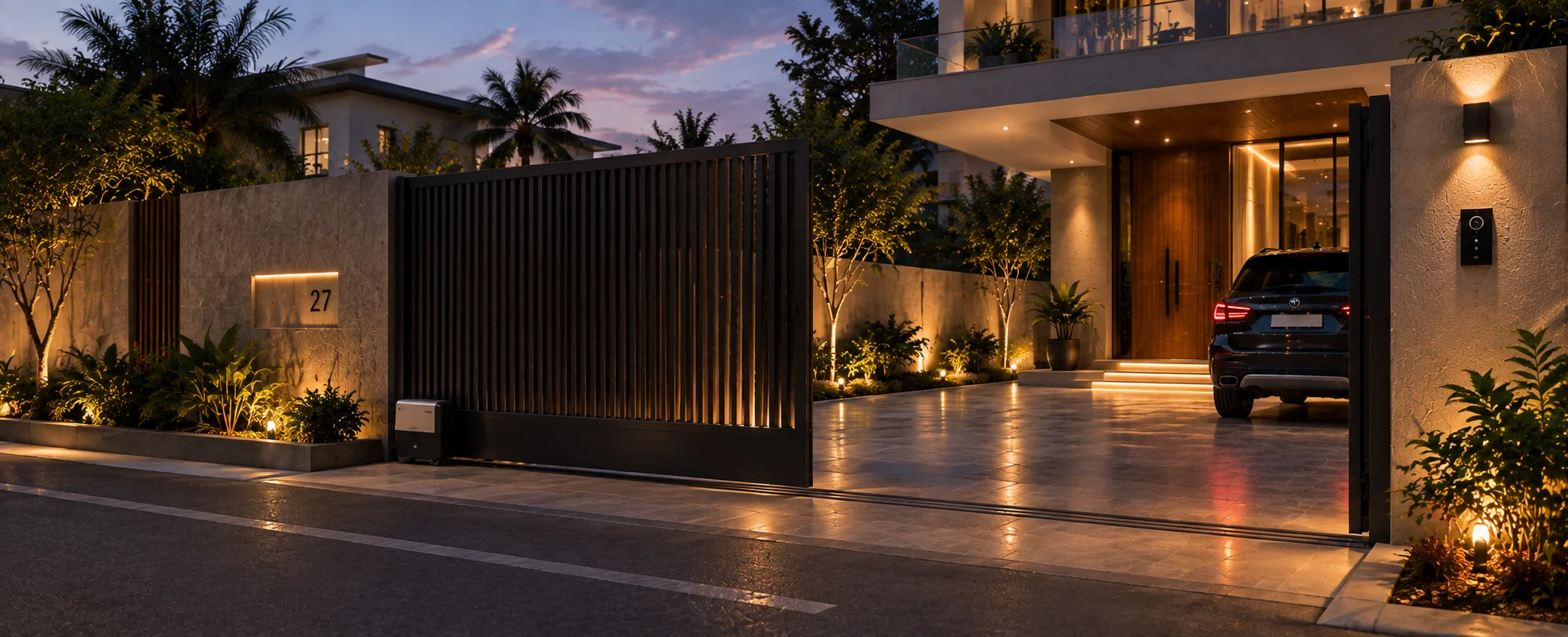
Gate automation replaces the guard, the chain, and the getting-out-of-the-car with a motor, a control board, and some way of triggering it. Which motor you need is decided almost entirely by the gate you already have - swing gates need one type, sliding gates another, and a boom barrier is a different product altogether.
The decisions that matter are less about the motor than about the site: gate weight, the slope of the driveway, where the power comes from, and what happens when the electricity goes off.
Which Type of Gate Do You Have?
This is the first question, and it settles most of the rest.
| Gate type | How it moves | Motor type | Suits |
|---|---|---|---|
| Swing | Hinged, opens inward or outward like a door | Articulated arm or underground | Homes with space for the gate to swing clear |
| Sliding | Runs sideways along a track or cantilevered | Rack-and-pinion sliding motor | Narrow driveways, sloped approaches |
| Boom barrier | A horizontal arm lifts and lowers | Barrier unit | Commercial entries, societies, parking |
| Telescopic sliding | Multiple panels slide over each other | Specialised sliding motor | Wide openings with limited side space |
Swing gates are the most common on Indian independent houses. They need clear space for the leaf to travel through its arc, which rules them out where the driveway slopes upward or where a parked vehicle would foul the swing.
Sliding gates work where swing doesn't. They need side run - space alongside the opening for the gate to retract into- either on a floor track or cantilevered above ground.
Boom barriers are for vehicle control rather than security. They stop cars, not people, and they're chosen where throughput matters - society entrances, commercial parking, office gates.
What Actually Decides the Motor?
Four site conditions, and getting these wrong is why gate motors fail early.
Gate weight. The single most important figure. Motors are rated for a maximum weight, and a motor running near its limit every cycle wears quickly. A heavy MS gate with solid infill weighs considerably more than an open grille gate of the same size, and the difference matters.
Cycle frequency. A family home might open the gate eight times a day. A society entrance might do it four hundred. Domestic-duty motors aren't built for that, and specifying one at a commercial gate is a guaranteed failure within months. Duty rating should match actual use, not gate type.
Driveway slope. An upward slope at the gate rules out most swing configurations, because the leaf fouls the ground as it travels. This is one of the more common reasons a swing gate gets converted to sliding.
Power availability at the gate. The gate is often a long way from the house. Power has to reach it, which means either a cable run planned during construction or trenching afterwards. This is the item most often missing from an initial scope.
What Goes Into a Gate Automation System?
| Component | What it does |
|---|---|
| Motor | The drive unit, matched to gate type and weight |
| Control board | Logic, timing, limits, force settings |
| Safety devices | Photocells and safety edges - stop or reverse on obstruction |
| Manual release | Allows the gate to be opened by hand when power is out |
| Access trigger | Remote, keypad, intercom, or app |
| Backup power | Battery backup on the motor, so it operates during an outage |
| Warning light | Indicates gate movement |
The two that get omitted and shouldn't be:
Photocells. A beam across the opening that stops the gate if something is in the way. A powered gate closing on a vehicle or a person is a serious safety failure, and photocells are the cheapest thing preventing it.
Manual release. Every motor should have a way to disengage and move the gate by hand. If the power is out and there's no battery, this is how you get your car out. It should be demonstrated at handover, not discovered during an emergency.
How Do You Open It?
The trigger is a separate decision from the motor, and it's what the client actually interacts with.
Remote handset. Simple, reliable, and the one most people use daily. Lost handsets are the main downside - worth confirming the system supports deleting a lost remote.
Keypad at the gate. Useful for staff and visitors without a handset, and codes can be changed.
Video intercom. The gate answers to the house. Someone rings, you see them from your phone or a wall panel, and you release the gate. BasIP handles this side, and our video door phone guide covers the options.
App and automation. Where the gate is on the wider system, it can be part of an arrival sequence rather than a separate action.
Vehicle detection. A loop or sensor that opens the gate as a vehicle approaches from inside. Common on commercial installations, occasionally useful at home for exit.
Gate Automation on a KNX System
The practical difference is that the gate stops being a standalone product.
On a villa running KNX, the gate can be part of an arrival sequence - the gate opens as you turn in, driveway lighting comes up ahead of the car, the porch light is on, and the entrance hall is lit by the time you reach the door. One trigger, not four separate actions.
It also means gate status is visible in the same place as everything else. A gate left open is something the system can notice and report, rather than something someone discovers in the morning.
Somfy and NICE motors are what we typically specify, and both integrate into a KNX installation through the control layer. Our guide to luxury villa automation covers the arrival sequence in more detail.
What Happens During a Power Cut?
The question every Indian client asks, and rightly so.
Battery backup on the motor keeps it operating for some cycles without mains. This is worth specifying rather than treating as an option - a gate that can't open during an outage is a gate you have to push.
Manual release is the fallback when the battery is also flat. Every installation should have it, and the client should have been shown how to use it.
Solar is occasionally used at gates where running mains is genuinely impractical - a farmhouse entrance far from the building, for instance. It works for low cycle counts but needs careful sizing.
Our guide on home automation during power cuts covers backup planning across the whole system.
Boom Barriers - What's Different
Worth treating separately because the requirements are commercial rather than residential.
Throughput is the design driver. How many vehicles per hour, and how fast the arm needs to raise. A three-second barrier and a six-second barrier feel very different at a busy society gate at 9 am.
Duty rating is critical. Boom barriers at active entrances run continuously through peak hours. This is where domestic-grade equipment fails fastest.
Integration with access control. RFID tags, number plate recognition, or a guard-operated control - the barrier is usually one part of a wider vehicle access system rather than a standalone device.
Safety. Loop detection so the arm doesn't drop on a vehicle, and clear visual indication of barrier state.
Boom barriers control vehicles, not access. Anyone can walk around one. Where genuine access control is needed, the barrier works alongside pedestrian gates and other measures rather than replacing them.
What Does Gate Automation Cost in India?
| Scope | Approx. Cost |
|---|---|
| Swing gate motor, residential (pair) | ₹35,000 – ₹1,20,000 |
| Sliding gate motor, residential | ₹40,000 – ₹1,50,000 |
| Underground swing motor | ₹80,000 – ₹2,50,000 |
| Boom barrier, commercial | ₹70,000 – ₹3,00,000 |
| Photocells and safety devices | ₹8,000 – ₹25,000 |
| Battery backup | ₹10,000 – ₹35,000 |
| Video intercom at gate | ₹25,000 – ₹1,50,000 |
| Cable run and civil work | Varies with distance |
Indicative estimates covering supply and installation. Heavy or oversized gates, long cable runs, and trenching can move these figures considerably — a site assessment is what produces a real number.
The variable most people underestimate is the cable run. A gate eighty feet from the house needs power and control cable trenched across the driveway. Done during construction, it costs very little. Done after the driveway is laid, it costs a great deal more.
Can an Existing Gate Be Automated?
Usually yes, subject to the gate itself being suitable.
What gets checked first:
Is the gate structurally sound and does it move freely by hand? A motor won't fix a gate that binds, drags, or has worn hinges - it'll just fail trying.
Are the hinges and posts capable of taking powered operation? Powered cycles are harder on hardware than manual use.
Is there power available at the gate, or a practical route to run it?
For swing gates, is there clear travel through the full arc?
The honest answer is that a poorly built gate is often better replaced than automated. A motor fitted to a gate that doesn't move properly will be a recurring service call.
FAQs
Which gate motor is best - swing or sliding?
Neither. It depends on the gate you have and the space available. Swing gates need clear space for the leaf to travel through its arc and don't suit upward-sloping driveways. Sliding gates need side run alongside the opening. The site decides.
What does gate automation cost in India?
Residential swing motors run roughly ₹35,000 to ₹1,20,000 for a pair, sliding motors ₹40,000 to ₹1,50,000, and commercial boom barriers ₹70,000 to ₹3,00,000. Photocells, battery backup, and cable runs are additional and often underestimated.
Will the gate open during a power cut?
With battery backup, yes, for some cycles. Without it, no - and you'd use the manual release to open the gate by hand. Battery backup is worth specifying rather than treating as optional.
Can I automate my existing gate?
Usually, if the gate is structurally sound and moves freely by hand. A motor won't fix a gate that binds or drags. Hinges, posts, and clearance all get checked, and a poorly built gate is often better replaced than automated.
Are photocells necessary?
Yes. They stop the gate if something is in the way, and a powered gate closing on a vehicle or person is a serious safety failure. They are inexpensive and should never be omitted from a specification.
How does a boom barrier differ from a gate?
A boom barrier controls vehicles, not access - anyone can walk around one. It is chosen where vehicle throughput matters, such as society entrances and commercial parking, and usually works alongside pedestrian access control rather than replacing it.
Can the gate be controlled from my phone?
Yes, where it's connected to a home automation or intercom system. On a KNX installation, the gate can also be part of an arrival sequence - opening as you approach, with driveway and entrance lighting following.
What is most often left out of a gate automation quote?
The cable run. A gate a long way from the house needs power and control cable trenched to it, and doing that after the driveway and landscaping are finished costs considerably more than during construction.
Planning a Gate Automation?
The useful conversation is about the gate and the site - its weight, how it moves, the slope at the opening, and how power reaches it. The motor follows from that.
Talk to our team for a site assessment, or explore our curtain and gate motors and security and access control services.