

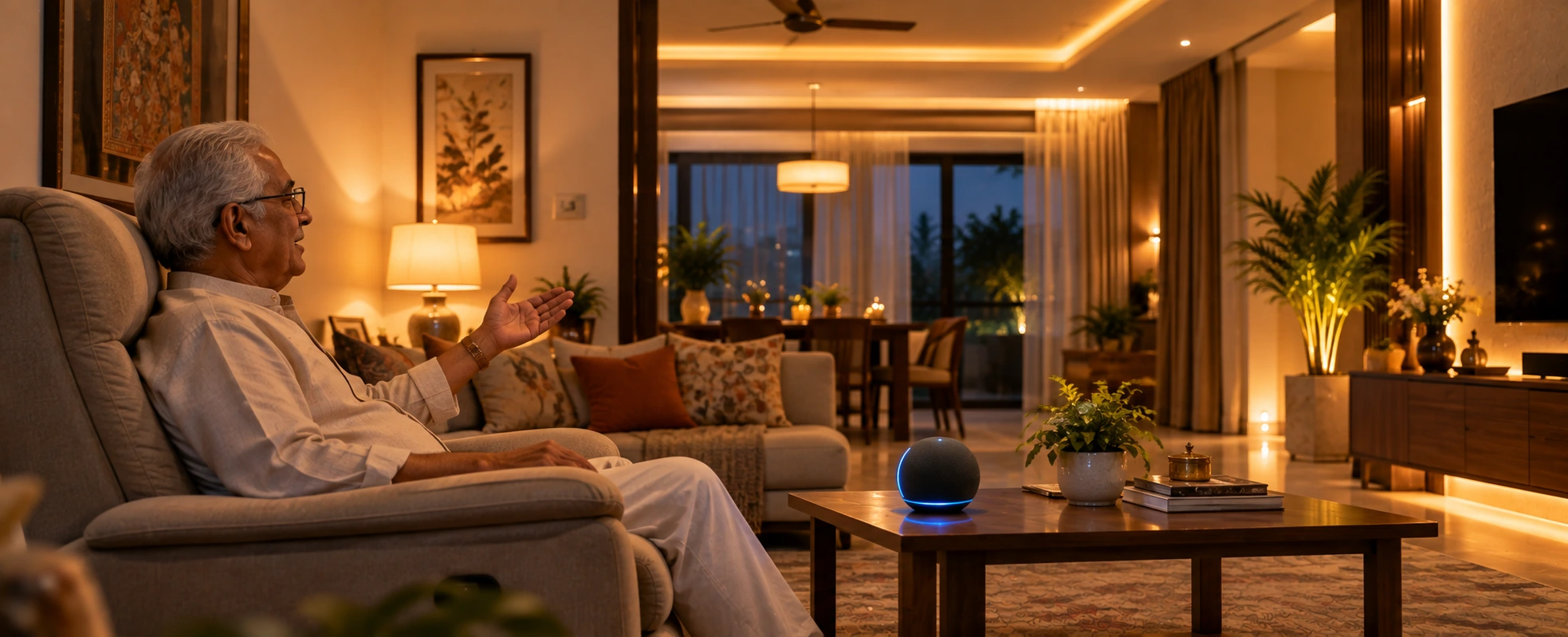
Home automation for the elderly means using smart controls to make a home easier, safer, and more comfortable for an ageing parent to live in — and to give family peace of mind. Voice and simple one-touch controls remove the struggle of fiddly switches; automatic, well-lit pathways make moving around at night safer; climate and curtains that manage themselves keep the home comfortable without effort; and family, including those living abroad, can stay connected and check in. Used well, it supports independence and dignity — helping an elderly person live comfortably in their own home for longer. It supports care; it does not replace it.
Why this matters, especially in India
For many Indian families, caring for ageing parents is deeply important — and increasingly complicated. Parents want to stay in their own home, with their independence and dignity intact. Adult children often live in another city, or abroad, and worry about how their parents are managing day-to-day. And the home itself, designed for a younger family, can quietly become harder to live in with age — switches that are a reach, stairs that are dark at night, fiddly controls.
Home automation speaks to exactly this. It cannot replace human care or company, and it should never be presented as doing so. But it can remove many of the small daily difficulties that make a home harder to live in with age, reduce some everyday risks, and help families stay connected across distance. For an elderly parent, that can mean living comfortably and independently in their own home for longer. For their children, it can mean real peace of mind.
This guide covers how automation helps — honestly, including what it can and cannot do — so families can decide what is right for their parents.
Easier control: no more fumbling with switches
One of the first things that becomes harder with age is simply operating the home — reaching switches, managing multiple remotes, getting up to adjust something across the room. Automation makes control effortless, which is both a comfort and a safety benefit.
- Voice control — being able to say "turn on the lights" or "set the fan" without getting up or finding a switch is one of automation's most genuinely valuable uses for an elderly person; our guide to voice-controlled home automation covers how it works
- Simple one-touch controls — a single clearly labelled keypad or a simple app replaces a confusing array of switches and remotes; our guide to centralised, one-app control explains this
- Bedside convenience — controlling lights, fan and curtains from the bedside without getting up, which matters most at night; our smart bedroom automation guide covers this
- Remove the reach and the fiddle — the aim is a home an older person operates easily, comfortably and confidently
The point is dignity as much as convenience: a home that responds easily lets an elderly person stay in control of their own space without having to ask for help with small things.
Lighting and safe movement around the home
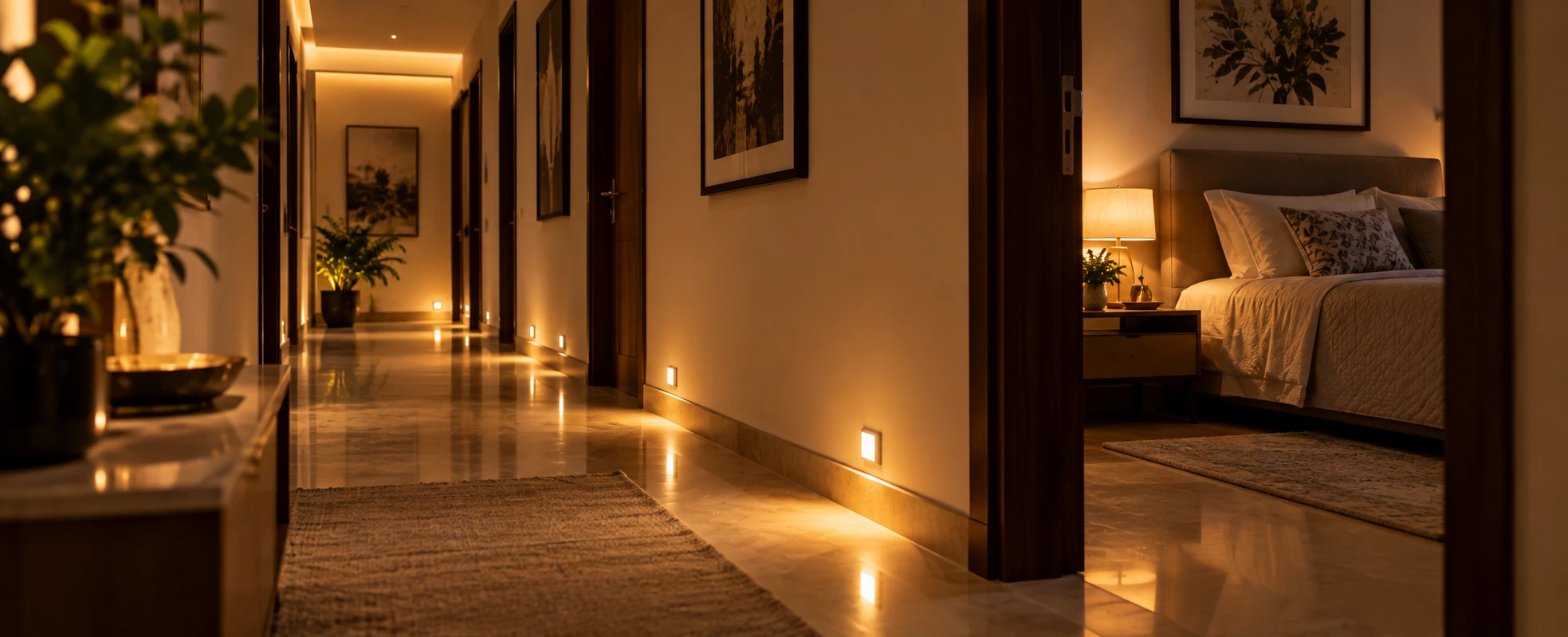
Moving around the home — especially at night — is where thoughtful automation can genuinely reduce everyday risk. Getting up in the dark, fumbling for a switch, navigating a passage or stairs: these are exactly the moments where good lighting helps.
Automation can help by:
- Lighting the path automatically — motion or occupancy sensors can bring on gentle lighting as someone moves through a passage, to the bathroom at night, or down a hallway, so no one moves through the dark or hunts for a switch; our guide to smart motion sensors explains this
- Gentle night lighting — soft, low-level lighting that guides without the harsh glare of a full light switched on at night
- Consistent, easy lighting — well-lit rooms set at a touch, rather than a struggle with multiple switches
- No dark corners at the wrong moment — lighting that is simply there when needed
To be clear and honest: this reduces some everyday risk and makes the home easier and safer to move around — it is a help, not a guarantee against falls, and it works alongside sensible home safety (grab rails, even flooring, good design) that a professional should advise on, not as a substitute for it.
Comfort without effort
Comfort becomes both more important and harder to manage with age. Adjusting the AC, opening or closing curtains, managing the geyser for a bath — each is a small task that automation can simply take care of.
- Climate that manages itself — rooms kept comfortable by schedule and scene, without an elderly person needing to adjust a remote or reach a thermostat
- Motorised curtains — opening for morning light and closing for privacy or rest at a touch or on schedule, instead of a physical struggle with heavy curtains; our guide to curtain automation covers this
- Hot water, ready — the geyser scheduled so warm water is ready at bath time, without managing a switch
- Everything on an easy routine — a "good morning" and "goodnight" that set the whole home comfortably with one word or touch
These remove the small daily efforts that add up, letting an older person enjoy a comfortable home without the constant management it used to need.
Security, entry, and staying connected
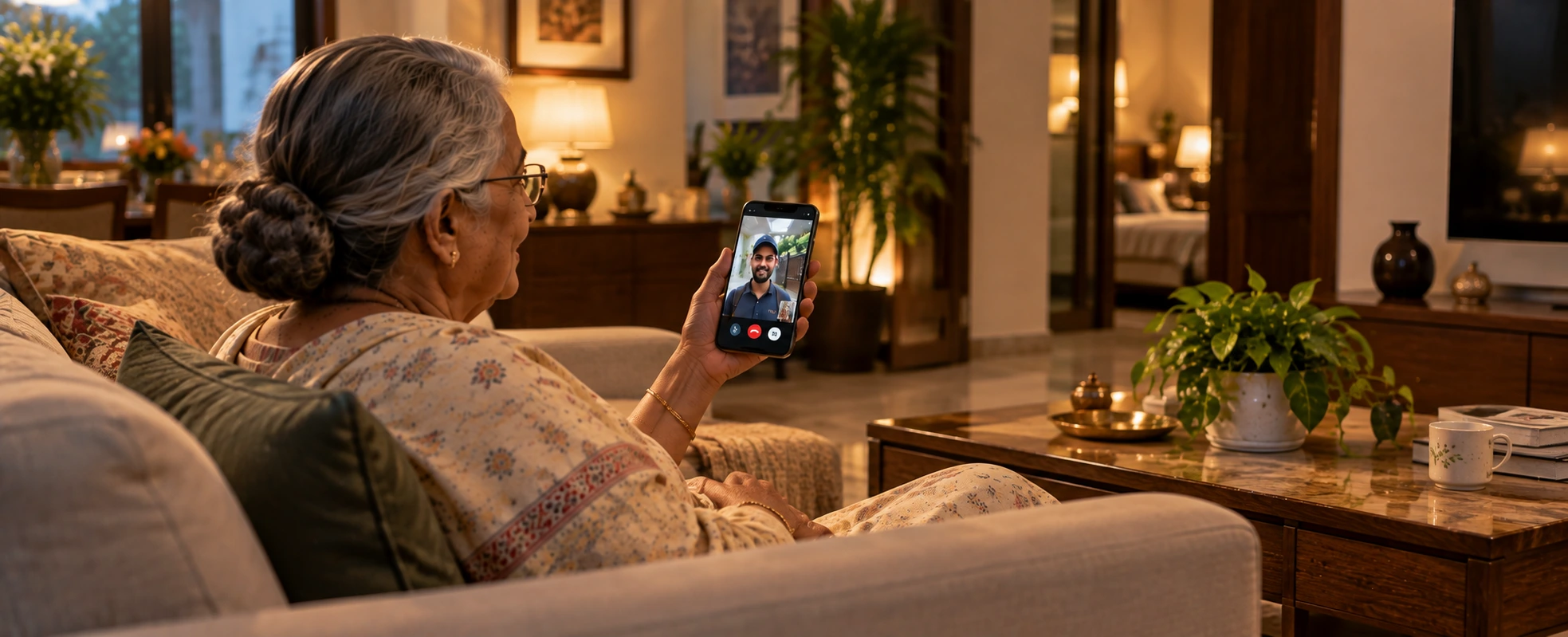
Automation gives families—especially those at a distance—real reassurance while helping the elderly person feel safe and in control.
- See who is at the door — a video door phone lets an elderly person see and speak to whoever is at the gate from where they are, without rushing to the door or opening it to a stranger; our video door phone guide covers this
- Easy, secure entry — managing the door and letting in trusted help or family easily, including remotely
- Family connection across distance — for children living in another city or abroad, being able to stay connected to their parents' home and help manage it remotely is a genuine comfort; our guide to controlling a home from anywhere covers remote access
- A home that feels safe — security that is simple for the elderly person to live with, and reassuring for the family
An honest note on emergencies: home automation can make a home safer and keep families connected, but it is not a medical alert or emergency-response system. For medical emergencies, a dedicated medical alert service and proper care arrangements are what families should rely on — automation complements these; it does not replace them.
What automation can and cannot do — honestly
Because this is about someone's parents, it deserves an honest framing rather than overselling.
What it genuinely does: makes the home easier and more comfortable to operate, reduces some everyday difficulties and risks (like moving through a dark house), helps an elderly person stay independent and in control of their space, and keeps families connected and reassured across distance. These are real, meaningful benefits.
What it does not do: it does not replace human care, company or supervision; it is not a medical device or an emergency-response system; and it does not, on its own, make a home safe for someone with significant mobility or health needs — that requires proper advice on home safety and care from qualified professionals. Automation is one helpful layer alongside good care, sensible home design, and the involvement of family and professionals.
Used with that understanding, automation is a genuinely valuable support for ageing at home — which is exactly how we approach it.
Designing a home for ageing parents
A few practical principles if you are considering this for your parents:
- Keep it simple for them. The best setup for an elderly person is one they find easy and intuitive — clear voice commands, simple controls, reliable routines — not a complex system. Simplicity is the priority.
- Focus on the daily difficulties. Start with what is actually hard for them day to day — the switches they struggle with, the dark passage at night, the curtains, the door — and solve those first.
- Involve them. A home automated around how your parent actually lives, with their input, is one they will use and value; one imposed on them may just confuse. Dignity matters.
- Build it reliably. For an elderly person, the home must just work — a reliable system on a solid backbone matters more here than anywhere; our guide to what home automation is covers the fundamentals.
We design home automation for families across Delhi NCR, including homes set up to help ageing parents live comfortably and independently — thoughtfully, simply, and matched to their real needs. Our home automation service is where it comes together.
FAQs
How does home automation help elderly people?
It makes the home easier, safer, and more comfortable to live in. Voice and simple one-touch controls remove the struggle with switches and remotes; sensor-based lighting lights pathways automatically so moving around at night is safer; climate and curtains manage themselves; and a video door phone lets them see visitors safely. It helps an elderly person stay independent and in control of their own home, and keeps family reassured.
Is home automation a replacement for elderly care?
No, and it should never be presented as one. Automation removes many daily difficulties and reduces some everyday risks, but it does not replace human care, company or supervision, and it is not a medical or emergency-response system. It is one helpful layer alongside proper care, sensible home safety advice, and the involvement of family and professionals.
Can automation help prevent falls for elderly people?
It can reduce some of the everyday risk — for example, sensor-based lighting means an elderly person does not move through a dark house or fumble for a switch at night. But it is a help, not a guarantee against falls, and it works alongside proper home safety measures like grab rails, even flooring and good design, which a professional should advise on. It supports safety; it does not ensure it.
I live abroad — can automation help me look after my parents' home in India?
Yes, this is one of its most valued uses for families at a distance. You can stay connected to your parents' home and help manage things remotely — and features like a video door phone help your parents handle visitors safely. It is a genuine comfort for NRIs and those in other cities, though it complements regular contact and local care arrangements rather than replacing them.
What is the most useful automation feature for an elderly person?
Often voice control and automatic lighting. Voice control lets them operate the home without getting up or finding a switch, which is both a comfort and a safety benefit; automatic, sensor-based lighting makes moving around — especially at night — safer and effortless. The best choice depends on the individual's needs, so it is worth focusing on their specific daily difficulties.
How do we set up a home automation system for ageing parents?
Keep it simple and focused on their real daily difficulties — the switches they struggle with, the dark passage, the curtains, the door — and involve them so it fits how they actually live. Build it on a reliable system so it simply works, and treat it as one layer alongside good care and sensible home safety. An integrator can design it thoughtfully around their needs.