

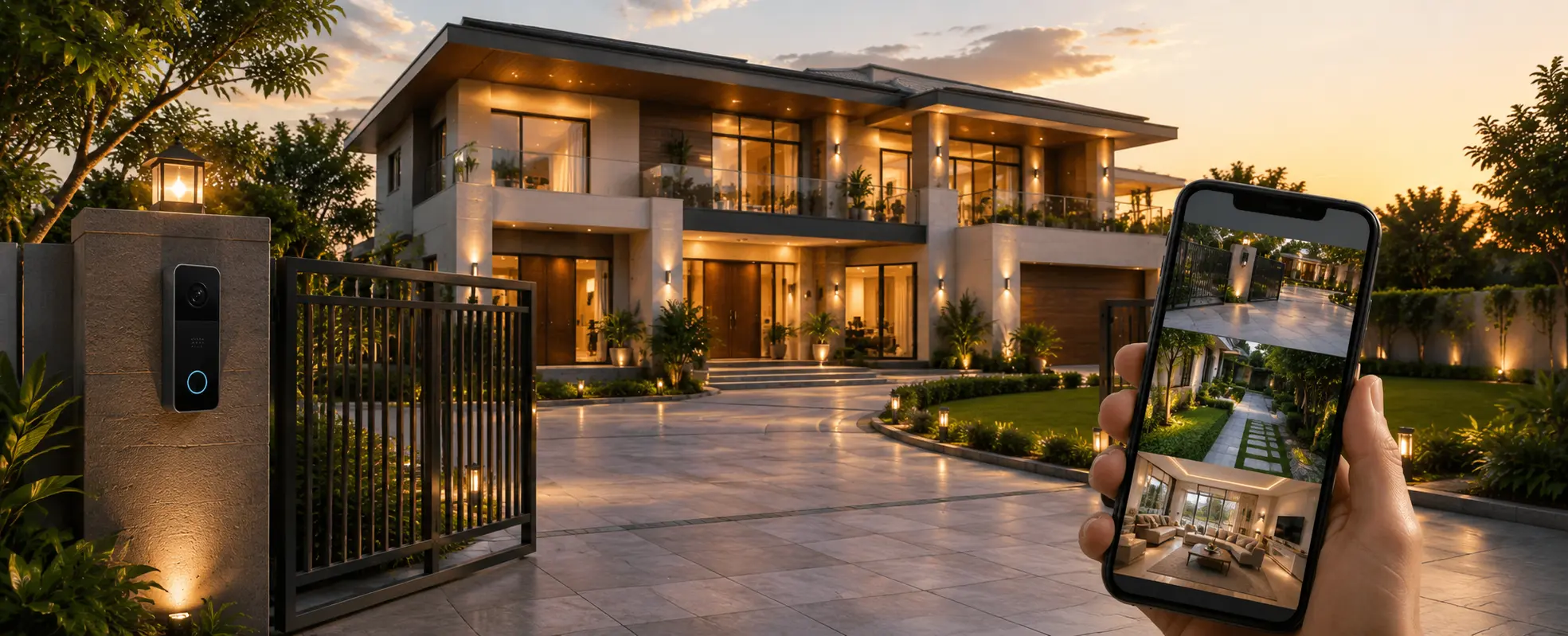
Automating a luxury villa in Lucknow involves a few decisions that don't come up in Mumbai or Bengaluru. The city runs genuinely hot in summer and genuinely cold in winter, so climate control has to work in both directions rather than just cooling. Winter air quality across the Indo-Gangetic plain makes ventilation and filtration part of the conversation. Dust affects every piece of outdoor equipment. And on large plotted villas, the boundary, gate, and garden matter as much as the interior.
This guide covers what a complete automation system looks like for a Lucknow villa, which decisions are specific to the city, and what it costs.
Why Does Lucknow Need a Different Approach?
Most automation content written for Indian homes quietly assumes a Mumbai or Bengaluru climate — cooling year-round, no real winter, moderate dust. Lucknow doesn't work that way, and four local realities change the system design.
Both Seasons Are Extreme
Lucknow summers are severe, and its winters are genuinely cold — not Himalayan cold, but cold enough that heating matters in a way it doesn't across much of India.
For automation, this means climate logic runs in two directions. A "Morning" scene in June should have cooling active before anyone wakes. The same scene in January should not. Systems set up for cooling alone end up being manually overridden for four months of the year, which defeats the point.
On KNX, this is handled with season-aware scene logic rather than two separate systems — the same button behaves correctly in both.
Winter Air Quality
Lucknow sits in the Indo-Gangetic plain, and air quality deteriorates markedly during winter months across the region.
That has practical consequences for a villa. Windows stay shut for longer stretches, which makes mechanical ventilation and filtration more relevant than in a coastal city. Automation's role here is coordination — running purification when outdoor conditions are poor, keeping fresh-air intake managed rather than constant, and tying it into occupancy so it isn't running through empty rooms.
Dust is Constant
Dust affects the parts of a system that live outside — camera housings, gate motors, garden lighting fixtures, outdoor sensors.
The practical response is specification rather than clever programming: appropriately rated enclosures for outdoor equipment, sensible placement away from the worst exposure, and a maintenance schedule that accounts for it. It's an unglamorous point that saves a lot of service calls.
Power Supply Cannot Be Assumed
Supply reliability varies across the city, and most Lucknow villas run an inverter, a generator, or both.
This is where system architecture matters more than features. A KNX system operates on its own wired bus rather than depending on Wi-Fi and cloud servers, so lighting scenes, schedules, and locks continue working locally through an outage. Anything Wi-Fi-dependent needs the router on backup, or it simply stops.
Load management also becomes useful — the system can be programmed so that when the house switches to generator supply, non-essential loads drop out automatically rather than someone running to the panel.
Our comparison of wired vs wireless smart homes covers this trade-off in detail.
What Does a Complete Villa System Include?
For a large plotted villa, a full system usually covers:
| System | What It Handles |
|---|---|
| Lighting | Scene control across all floors, cove and accent circuits, garden and facade lighting |
| Climate | Zone-wise cooling and heating, season-aware logic, occupancy-based setback |
| Curtains and blinds | Motorised operation on large glazing, scheduled and scene-linked |
| Security | Perimeter cameras, boundary sensors, alarm panel |
| Access | Main gate automation, digital locks, video door phone |
| Networking | Structured cabling and access points across a large footprint |
| Audio and AV | Multi-room audio, home theatre where planned |
| Energy | Consumption monitoring, generator load management |
The distinguishing feature of a villa compared with an apartment isn't the interior — it's everything outside it. Boundary length, gate distance from the house, garden lighting runs, and outdoor camera coverage are what make a villa project structurally different.
Which Areas of Lucknow Do These Projects Come From?
Luxury villa automation in Lucknow tends to concentrate in a few areas — the planned sectors of Gomti Nagar and Gomti Nagar Extension, Sushant Golf City, and the plotted and farmhouse developments along the Sitapur Road and Faizabad Road corridors. Older properties in and around Hazratganj and the Mahanagar area come up too, though those are usually renovation projects rather than new builds.
The distinction that matters more than the locality is whether the villa is under construction or already finished, because that determines what's practical.
What Should You Decide Before Construction?
The same rule applies in Lucknow as anywhere — cabling is the only part that becomes genuinely difficult to add later.
Before plastering and false ceilings:
- KNX bus cable and conduit to every switch point and device position, including outdoor and boundary runs
- Neutral wire at every switch point
- Network cabling backbone across the footprint, including outbuildings and gate
- Power at curtain pelmets
- Cable routes to gate, boundary cameras and garden lighting positions
- Actuator panel space with access and ventilation
Villa projects have one extra consideration that apartments don't: cable runs to the gate and boundary. These are long, they cross open ground, and they're the ones most often forgotten until the driveway is already laid.
Our guide to KNX cable covers what runs through those conduits, and our networking guide covers the backbone.
How Is a Multi-Generational Villa Handled?
Worth addressing, because large Lucknow villas frequently house more than one generation.
The practical implication is that a single whole-home scene rarely suits everyone. What works better is floor-level or wing-level independence — each portion running its own scenes and schedules, with shared areas and outdoor systems on common control.
Access is the other half of it. Elderly family members generally do better with a physical keypad than an app, and it's worth keeping at least one simple, consistent control point per area rather than assuming everyone will use a phone.
What Does It Cost?
Indicative ranges for a luxury villa in Lucknow:
| Scope | Approx. Cost |
|---|---|
| Lighting automation only (4BHK villa) | ₹7,00,000 – ₹15,00,000 |
| Lighting + climate + curtains | ₹15,00,000 – ₹30,00,000 |
| Complete villa system (all systems above) | ₹25,00,000 – ₹60,00,000 |
| Large villa/farmhouse, full scope | ₹60,00,000 – ₹1,50,00,000+ |
These cover automation hardware, cabling, installation, and programming. Light fixtures, false ceiling work, AC units, and civil work are quoted separately. Figures are indicative estimates — an accurate number requires a site assessment and confirmed scope.
Boundary length and plot size affect villa costs more than built-up area does, because outdoor cabling runs, gate distance, and perimeter coverage scale with the plot rather than the house.
Our lighting automation cost guide has a fuller component-level breakdown.
What Usually Goes Wrong?
Three things, in roughly this order of frequency:
Automation gets introduced after the ceiling drawings are final. By then, positions are compromised and some scope quietly disappears.
Outdoor scope is underestimated. Gate, boundary, garden, and driveway cabling gets costed late, and it's substantial on a large plot.
Climate logic is set up for summer only. It works beautifully for eight months and gets manually overridden for the other four.
All three are planning problems rather than technical ones, which is why the timing of the first conversation matters more than the equipment list.
Planning a Luxury Villa Automation in Lucknow?
The decisions that matter most — cabling routes, outdoor scope, climate logic — all get made before anything is visible. Getting them right early costs very little; getting them wrong is expensive to undo.
Talk to our team about your project, and we can review the drawings and flag what needs to be decided before construction moves past it. You can also explore our home automation, premium switches and lighting, security and surveillance, and curtain and gate motors services.
FAQs
Does home automation work during power cuts in Lucknow?
A KNX system runs on its own wired bus, so lighting scenes, schedules, and locks keep working locally through an outage. Remote app access requires the router to be on inverter backup. Wi-Fi-dependent systems stop entirely unless the network is backed up.
Is automation practical for a villa that's already built?
Partly. Digital locks, video door phones, and gate automation retrofit reasonably well. Full wired automation usually only makes sense alongside a renovation where ceilings or walls are already being opened — otherwise a wireless system is the more sensible option.
How does winter affect automation in Lucknow?
Mainly through climate logic. Because Lucknow has a real winter, scenes need heating behaviour as well as cooling, and systems configured for cooling alone tend to get manually overridden for several months. Winter air quality also makes ventilation and filtration control more relevant.
What's different about automating a villa versus an apartment?
Everything outside the building. Boundary length, gate distance, garden lighting runs, and outdoor camera coverage scale with the plot, and these are usually the largest cost variable between two villas of similar built-up area.
Can different floors run independently?
Yes, and on multi-generational villas it's usually the better arrangement. Each floor or wing runs its own scenes and schedules, with shared areas, outdoor lighting and security on common control.
When should the automation discussion start?
While electrical drawings are being finalised and before conduit is laid. On a villa, that's also the point to decide gate and boundary cable routes, which are easy to miss and expensive to add once the driveway is finished.