

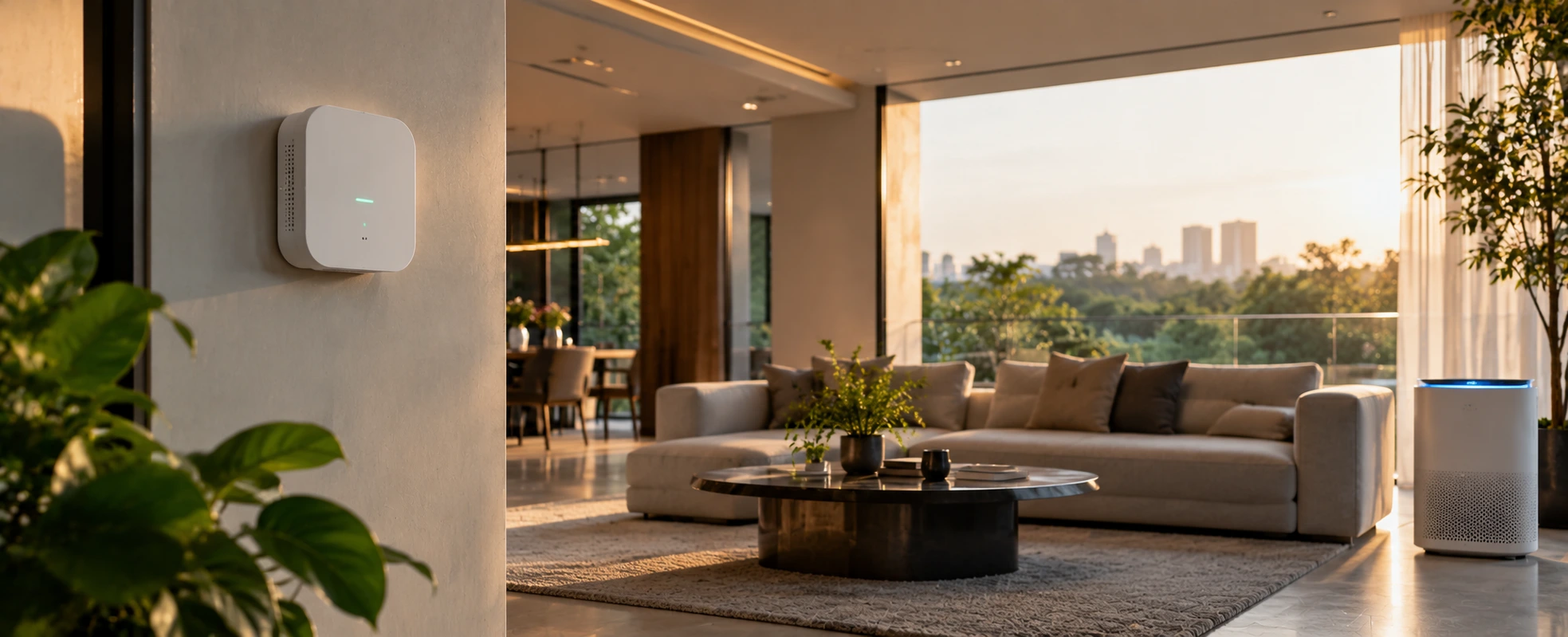
Indoor air quality (IAQ) monitoring continuously measures the air inside your home - fine dust (PM2.5/PM10), carbon dioxide (CO2), volatile organic compounds (VOCs), humidity, and temperature - and shows it on an app or display. In a modern, airtight home, it is genuinely worthwhile, because pollutants build up with less natural air exchange. The real value comes when monitoring is integrated into home automation, so rising readings automatically trigger purifiers, fresh air, or ventilation - turning numbers into a healthier home.
We spend most of our lives indoors, yet the air inside a home can be more polluted than the air outside. As homes get more sealed and energy-efficient, that matters more, not less. This guide explains what indoor air quality monitoring is, what a modern home should track, how it works, and - most importantly - how monitoring can actually improve your air rather than just report on it.
What Is Indoor Air Quality (IAQ) Monitoring?
Indoor air quality monitoring is the continuous measurement of the air inside your home using sensors, with the readings shown somewhere you can act on them - an app, a wall display, or your smart-home dashboard.
Instead of guessing, you can see how clean the air actually is, how it changes through the day, and what affects it - cooking, cleaning, the windows being open during high outdoor pollution, or a room full of people. On its own, a monitor is a source of awareness; integrated into automation, it becomes a trigger for action. For how sensing fits into a smart home generally, see our complete guide to home automation.
What a Modern Home Should Monitor
Not all "air quality" is one number. The readings worth tracking are:
- PM2.5 and PM10 — fine and coarse particulate matter from outdoor pollution, cooking, dust, and smoke. The finest particles are the most concerning for health.
- CO2 (carbon dioxide) — builds up in closed, occupied rooms and causes stuffiness, drowsiness and poor concentration; a good proxy for whether a space needs fresh air.
- VOCs (volatile organic compounds) — gases released by paints, adhesives, furnishings, cleaning products and more, especially in newer interiors.
- Humidity and temperature — central to comfort, and to the risk of mould and dust mites when humidity is too high (or discomfort when too low).
Together, these give a genuine picture of indoor air — far more than a single "good/bad" light.
How Indoor Air Quality Monitoring Works
The principle is simple: sensors placed in key areas measure the air continuously and report the readings to a hub, app, or display. Good systems show live values and trends over time, and raise an alert when something crosses a sensible threshold - so you know, for example, that CO2 is climbing in a closed bedroom, or that PM2.5 spiked while cooking.
Where this gets powerful is when the monitoring is not a standalone gadget but part of the home's automation, sharing the same app and logic as everything else - which brings us to the part that actually changes your air.
From Monitoring to Action: Automating a Healthier Home
A monitor that only shows numbers leaves the work to you. The real benefit of integrating air quality into a smart home is that the home can respond on its own:
- Particulate rises → air purifiers switch on (or speed up) automatically.
- CO2 climbs → fresh-air ventilation or an energy-recovery unit brings in outside air; or you're prompted to ventilate.
- After cooking → kitchen exhaust runs for a set period to clear the air.
- Humidity drifts → the system coordinates with AC or dehumidification to bring it back into a comfortable, healthy range, much as we describe in your curtains and AC should be talking to each other.
On an open platform like KNX, these responses are designed as part of one system and managed from a single app. Monitoring stops being a readout and becomes an automatic path to cleaner air.
Why Monitoring Matters More in Modern Homes
There is a reason this has become more relevant, not less. Modern homes are built to be airtight and energy-efficient - excellent for comfort and running costs, but it also means less natural air exchange, so pollutants from cooking, furnishings, and outdoors can accumulate indoors. Layer on the high outdoor pollution many Indian cities see for parts of the year, and monitoring indoor air becomes genuinely worthwhile.
For a city-specific view of this - particularly the outdoor-pollution side in the capital region - see our guide to air quality sensors for Delhi NCR smart homes, which goes deeper on the local context.
Designing Air Quality Monitoring into a Smart Home
Getting real value depends on a few design decisions: placing sensors where they reflect how rooms are actually used (bedrooms, living areas, kitchen), choosing what to monitor for each space, setting sensible thresholds that trigger action without nuisance, and - crucially - connecting the monitoring to the devices that can respond (purifiers, ventilation, exhaust, climate). Done as part of the home's automation on our automation platform, it becomes a seamless, mostly invisible system rather than another app to check.
How We Approach Indoor Air Quality
TechVault designs air quality monitoring as part of a home's automation, not as a standalone gadget. That means selecting the right sensors for each space, integrating them on an open standard like KNX so readings live in the same app as the rest of the home, and - most importantly - linking monitoring to a response, so purifiers, ventilation, and climate act automatically to keep the air healthy. The result is a home that looks after its own air quietly, in the background.
If you want a home that not only tells you about its air but actively improves it, that starts with designing monitoring and response together. Book a consultation to plan indoor air quality monitoring for your home.
FAQs
What is indoor air quality monitoring?
Indoor air quality (IAQ) monitoring is the continuous measurement of the air inside your home using sensors that track things like fine dust (PM2.5 and PM10), carbon dioxide (CO2), volatile organic compounds (VOCs), humidity, and temperature. The readings are shown on an app or display and can trigger alerts - and, in a smart home, can automatically act to improve the air.
What should a modern home monitor in its air?
The most useful things to monitor are PM2.5 and PM10 (fine particulate matter from outdoor pollution, cooking and dust), CO2 (which builds up in closed rooms and causes stuffiness and drowsiness), VOCs (gases released by paints, furnishings, cleaning products and more), and humidity and temperature (which affect comfort and the risk of mould). Together, these give a clear picture of how healthy your indoor air actually is.
How does air quality monitoring improve the air, not just measure it?
On its own, a monitor only tells you the numbers. The real value comes when monitoring is integrated into home automation so it can act: switching on air purifiers when particulate levels rise, bringing in fresh air or ventilation when CO2 climbs, running exhaust after cooking, or adjusting the AC and humidity. Monitoring becomes a trigger for a healthier home rather than just a readout.
Why does indoor air quality matter more in modern homes?
Modern homes are built to be more airtight and energy-efficient, which is great for comfort and energy use but means less natural air exchange - so pollutants from cooking, furnishings, and the outdoors can build up indoors. Add high outdoor pollution in many Indian cities, and monitoring indoor air becomes genuinely worthwhile for a modern, sealed home.
Can air quality monitoring be part of a smart home system?
Yes. On an open platform like KNX, air quality sensors become part of the home's automation, so readings can be seen in the same app as everything else and can trigger purifiers, ventilation, exhaust, or climate control automatically. This integrated approach is far more useful than a standalone monitor that only displays numbers.
Is indoor air quality monitoring worth it for health?
Air quality affects comfort, sleep, and wellbeing, and poor indoor air is linked to a range of health effects, so being able to see and improve it is valuable - especially for children, the elderly, or anyone with respiratory sensitivity. Monitoring is not a medical device and does not replace professional advice, but it gives you awareness and, when automated, the means to act on it.