

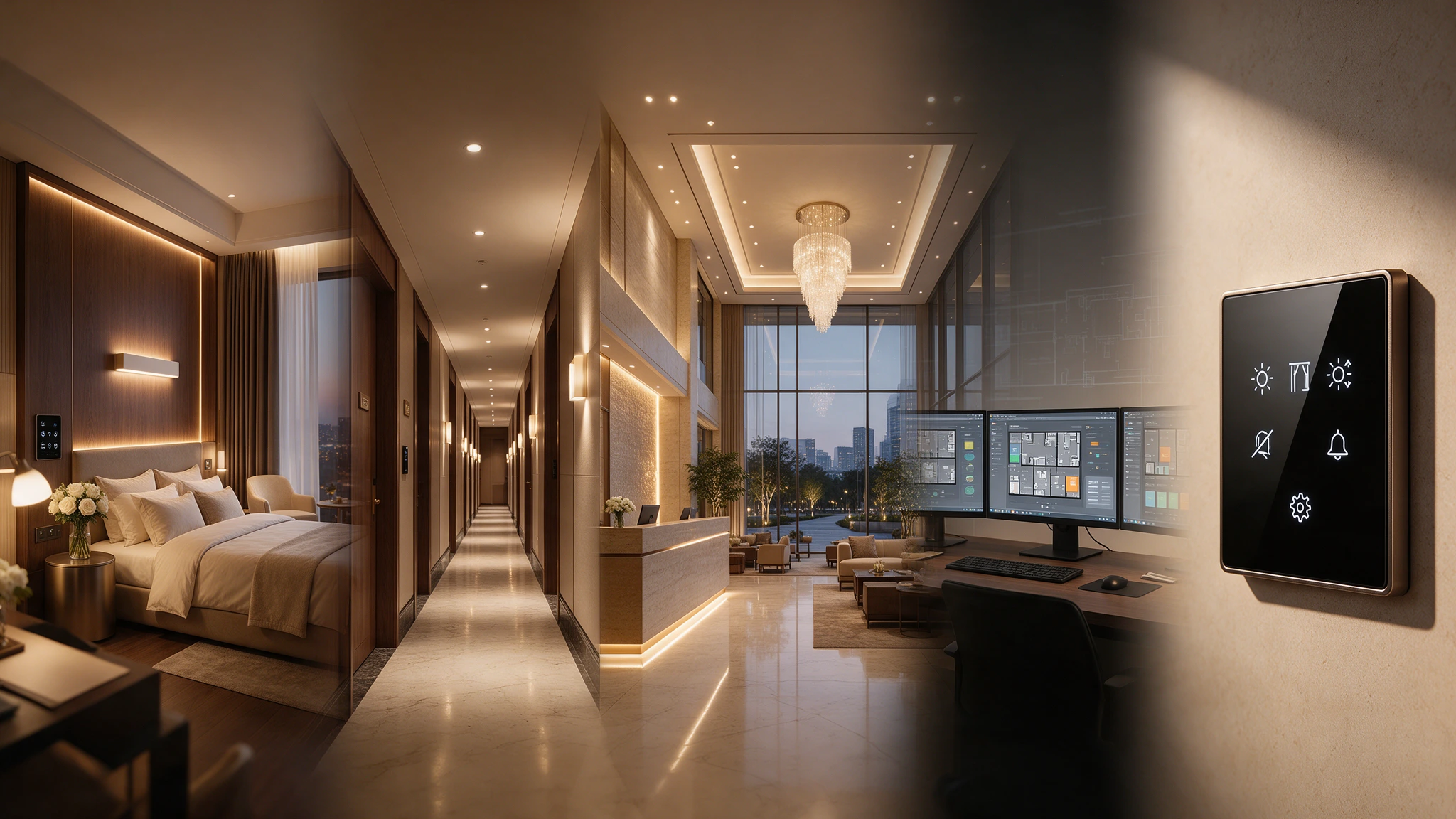
KNX hotel GRMS and lighting control solutions use the global open standard KNX to run a hotel's guest room management (lighting, climate, curtains, do-not-disturb, occupancy, service requests) and its lighting control (guest rooms, corridors, lobby, banquet, facade) on one unified, reliable platform - instead of separate proprietary systems. For hoteliers, that means lower energy costs, a better guest experience, easier management, and a system that's open, scalable, and serviceable for years.
Most hotels run their guest room management and their lighting as two different systems, from two different vendors, that barely talk to each other. KNX changes that: one open standard can power both - the GRMS in every room and the lighting across the whole property - as a single, coordinated solution. This guide explains how KNX hotel GRMS and lighting control solutions work together, and why hoteliers choose them.
What is KNX for Hotels?
KNX is the global open standard for building and home automation - a single, manufacturer-independent system that can control lighting, climate, shading, and more. In a hotel, that matters because it lets the guest room management system and the property-wide lighting run on the same platform, rather than as isolated proprietary systems. For the fundamentals, see our guide to how KNX works.
KNX-Based GRMS (Guest Room Management System)
A GRMS manages everything inside a guest room - scene lighting, air-conditioning, curtains, do-not-disturb and make-up-room indicators, occupancy sensing, welcome settings on check-in, and service requests. Built on KNX, it does all of this reliably and integrates with the wider hotel. We cover the system itself in depth in our complete guide to GRMS - this page is about running it on KNX alongside the hotel's lighting.
KNX Lighting Control for Hotels
Hotel lighting is more than switches - it's guest-room scenes, corridors, the lobby and reception, restaurants and banquet halls, the spa and pool, back-of-house, and the facade, all needing consistent, managed, energy-efficient control. KNX (often with a DALI layer for the luminaires) runs it all on one system. Our guide to KNX hotel lighting retrofits covers upgrading an existing property and BMS lighting control the commercial-building view.
Why Combine GRMS + Lighting on KNX?
Here is the real point of a KNX solution: one standard for both. When the GRMS and the lighting control share the same KNX platform, you get:
- One integrated system — the guest room, the corridors and the common areas work together, not as silos.
- Consistent control & management — a single way to manage, monitor and adjust lighting and room systems across the property.
- Simpler expansion — add floors, wings or features on the same standard.
- No vendor lock-in — combine products from many KNX-certified brands, and keep the hotel serviceable for years.
Running GRMS and lighting on two unconnected systems is the common, costly mistake; KNX avoids it.
Inside the Guest Room: GRMS Features & Panels
A KNX GRMS brings the room together through a set of elegant in-room panels and controls, finished to match the hotel's interior:
- Lighting control — on/off and dimmable scenes for the right mood at the right moment.
- HVAC / climate — a thermostat that manages heating and cooling to occupancy, for comfort and energy saving.
- Shades, drapes & blinds — motorised window coverings controlled by daylight, occupancy and scene.
- DND / MUR door panels — "Do Not Disturb" and "Make Up Room" indicators outside the door, usually with the room number, so housekeeping knows at a glance.
- Bedside & welcome panels — one-touch control of lights, climate, curtains, and scenes from the bed or on entry.
- Card holder — or card-free — a key-card pocket that powers the room, or a card-free solution where an occupancy sensor runs the energy-saving scenes even if the card is left in the holder.
Occupancy-Based Scene Control
Much of a GRMS's value is in automatic scenes that follow the guest through their stay:
- Pre-Welcome — as the guest enters, a gentle welcome lighting scene turns on.
- Welcome — full use of lighting, HVAC, shading, and sockets while the guest is in the room.
- Air-conditioning safety — when a window or balcony door is opened, the AC reduces or switches off, and restores to its previous state when closed — so energy isn't wasted cooling the outdoors.
- Leave — a short while after the guest leaves, lights, sockets, and AC switch off or are set back to a defined state.
- Check-in / Check-out — scenes triggered automatically through the hotel's PMS as a guest checks in or out.
Together, these balance a warm guest experience with real energy saving.
PMS & BMS Integration
A hotel GRMS is most powerful when it talks to the systems the hotel already runs:
- PMS (Property Management System) — integration with platforms such as Opera, Fidelio, OnQ and Micros means check-in and check-out automatically trigger the right room scenes and energy states, linking the front desk to the room.
- BMS (Building Management System) — integration via open protocols like BACnet and Modbus ties the rooms into the building's wider energy and facilities management.
- Door lock systems — integrated with the access/lock system for a seamless, secure and energy-efficient guest journey.
Benefits for Hoteliers
- Energy savings — rooms set back or switch off when unoccupied or checked out; corridors and common areas run on occupancy and daylight. Across hundreds of rooms, the savings are substantial.
- Better guest experience — welcoming scenes, intuitive controls, comfortable rooms, and discreet service indicators, as we explore in making guests happier through hotel automation.
- Staff efficiency — occupancy, service requests, and faults visible centrally, so housekeeping and maintenance work smarter.
- Reliability & longevity — an open standard built to last and be serviced for years.
- Scalability — one platform that grows with the property.
KNX vs Proprietary Hotel Systems
Many hotel GRMS and lighting products are proprietary — they tie the property to one manufacturer for support, spares, and upgrades. KNX is open and global: a hotel can combine certified products from many brands, avoid lock-in, and keep the system serviceable and extendable for decades. For a hotel group planning for the long term, that openness is a meaningful advantage.
How We Deliver KNX Hotel GRMS Solutions
TechVault is a KNX-certified integrator. We design and deliver hotel GRMS and lighting control on KNX as one solution — specifying the room and property systems, programming (ETS6) and commissioning them, integrating GRMS with lighting, energy management and the wider property, and handing over a system that is reliable, efficient and serviceable. We work with leading KNX GRMS product ranges, including EAE, and select the right products for each hotel's requirements — so the solution fits the property, not the other way around. We also integrate the GRMS with the hotel's PMS (such as Opera or Fidelio) and BMS where required. New build or retrofit, phased floor-by-floor so an operating hotel keeps running — explore our hotel automation, guest room automation and lighting automation services.
If you operate or are building a hotel and want GRMS and lighting on one reliable open standard, book a consultation with TechVault.
FAQs
What is a KNX GRMS for hotels?
A KNX GRMS (Guest Room Management System) uses the global open standard KNX to manage everything inside a hotel guest room - lighting, climate, curtains, do-not-disturb and make-up-room indicators, occupancy sensing, and service requests - as one coordinated system. Because it is built on KNX rather than a closed proprietary platform, it integrates cleanly with the rest of the hotel's automation, including lighting control across the property, and is reliable and serviceable for years.
Can KNX control both guest room management and hotel lighting?
Yes, and that is the main advantage. KNX is a single open standard that can run the guest room management system AND the lighting control for the whole hotel (rooms, corridors, lobby, banquet, facade) on one platform, rather than separate systems that don't talk to each other. One standard means simpler integration, consistent control, and easier management and expansion.
Why use KNX instead of a proprietary hotel system?
KNX is an open, globally used standard, so a hotel built on it is not locked to one manufacturer, can combine products from many brands, and can be serviced and extended for decades. Proprietary systems can tie a property to a single vendor for support and upgrades. For hotels that want long-term reliability, flexibility, and a system that integrates GRMS and lighting together, KNX is a strong, future-proof foundation.
How does a KNX GRMS save energy for a hotel?
A KNX GRMS saves energy by matching room systems to occupancy: lights and air-conditioning set back or switch off when a room is unoccupied, or the guest checks out; lighting responds to daylight; and corridors and common areas run on occupancy and schedules. Across hundreds of rooms, cutting the energy wasted in empty rooms adds up significantly - which is one of the strongest reasons hoteliers adopt it.
What areas of a hotel can KNX lighting control cover?
KNX lighting control can run the whole property on one system - guest-room scenes, corridors and lift lobbies, the main lobby and reception, restaurants and banquet halls, the spa and pool, back-of-house areas, and facade and landscape lighting. Managing it all on one standard, often with DALI for the lighting layer, gives consistent control and central management across the hotel.
Can KNX hotel systems be retrofitted into existing hotels?
Yes. KNX GRMS and lighting control can be installed in new hotels and retrofitted into existing ones, including wireless KNX (KNX RF) options that reduce disruption during a refurbishment. A phased approach - a floor or a wing at a time - is common, so an operating hotel can upgrade without closing. A site assessment determines what is practical for a specific property.
Does a KNX hotel GRMS integrate with the hotel PMS?
Yes. TechVault integrates the GRMS with hotel property management systems such as Opera, Fidelio, OnQ, and Micros, so guest check-in and check-out automatically trigger the right room scenes and energy settings - a seamless link between the front desk and the room. It can also integrate with the building's BMS via open protocols like BACnet and Modbus.
What occupancy scenarios does a KNX hotel GRMS support?
Common scenarios include Pre-Welcome (a welcome light scene as the guest enters), Welcome (full room control while occupied), an air-conditioning safety scene (the AC reduces or switches off when a window or balcony door is opened), Leave (lights, sockets, and AC set back after the guest leaves), and Check-in/Check-out scenes triggered through the PMS. Together, they balance guest comfort with energy saving.