

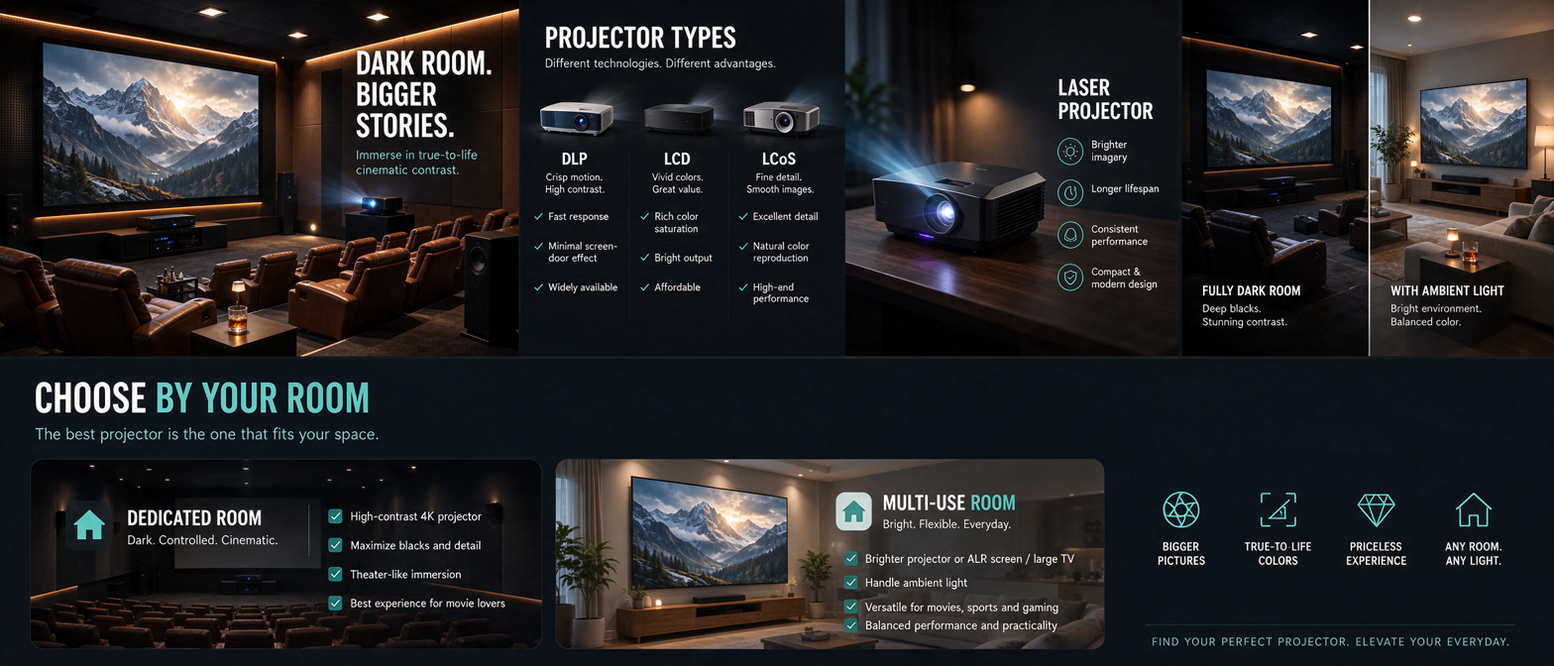
For a dedicated, light-controlled home theatre, the best projector is usually a 4K model with a laser or LED light source and strong contrast - often a DLP or LCoS design. But there's no single "best" projector in isolation: the right type depends on your room size, how well you control light, your screen, and your budget, which is why the projector should be chosen as part of the complete theatre design, alongside the screen, audio, lighting and seating.
A projector makes or breaks a home theatre - it's the difference between "a big TV" and a genuine cinema. But walk into the market and you're hit with DLP, LCD, LCoS, lamp, LED, laser, 1080p, 4K, lumens, contrast ratios. This guide cuts through it: the projector types that matter, what actually affects the picture, and how to match a projector to your room - as part of a complete home theatre, not a lone purchase.
First: A Projector Is One Part of a Theatre
Before the projector itself, remember that image quality depends on the whole room working together - the screen, the lighting control, the seating distance and the acoustics. The best projector in a bright, reflective room will still disappoint. That's why we design the projector choice alongside the rest of the setup; our guides to home theatre cost and home theatre acoustics cover the surrounding decisions.
Projector Types by Imaging Technology
The core of a projector is how it creates the image:
- DLP — uses millions of micro-mirrors on a chip (DMD) to form the picture. DLP is known for sharpness, fast response (good for motion and gaming) and solid contrast, with a very wide range of models from entry-level to reference-grade. It's a common, reliable choice for home theatres. Single-chip DLP can show a faint "rainbow" flash to a small number of sensitive viewers; three-chip DLP removes this but costs significantly more.
- LCD — passes light through liquid-crystal panels. LCD (and 3LCD) projectors typically deliver bright, colour-rich images with no rainbow effect, and tend to offer strong value. The trade-off is that black levels and contrast can trail DLP and LCoS, which matters most in a fully dark cinema.
- LCoS — "Liquid Crystal on Silicon" is a premium hybrid technology (sold under manufacturer names like SXRD and D-ILA). It usually produces the deepest blacks, smoothest gradients and the most film-like image, which is why it's favoured for high-end dedicated cinemas - at a notably higher price and often lower peak brightness than DLP.
There's no universal winner. For a dark, dedicated theatre where black levels are everything, LCoS leads; for sharpness, value and flexibility, DLP is hard to beat; LCD earns its place where brightness and colour on a budget matter most.
| Technology | Strengths | Trade-offs | Best for |
|---|---|---|---|
| DLP | Sharpness, contrast, fast motion, wide model range | Possible rainbow effect (single-chip) | Most home theatres, mixed movie/gaming use |
| LCD / 3LCD | Bright, colour-rich, good value, no rainbow | Weaker black levels in a dark room | Brighter or budget-conscious rooms |
| LCoS | Deepest blacks, smoothest, most film-like | Premium price, often lower peak brightness | High-end dedicated cinemas |
Brightness (Lumens) - Matched to Your Room, Not Maxed Out
Brightness is measured in lumens, and more is not automatically better. In a fully dark, dedicated theatre, a moderate brightness projector delivers rich contrast without washing out black levels. In a room with some ambient light, you need more lumens (or a special screen) so the image doesn't look flat and grey. The goal is to match brightness to the room and screen size — an over-bright projector in a dark room can actually hurt the cinematic feel, while an under-bright one in a lit room disappoints. This pairing of projector, screen and light control is exactly why we specify them together rather than one at a time.
Contrast Ratio - Where "Cinematic" Really Comes From
If brightness is how bright the whites are, contrast is the gap between the brightest white and the darkest black - and it's what makes an image look deep and three-dimensional rather than flat. A dark room with controlled light lets a projector's native contrast shine, which is a big reason LCoS (with its deep blacks) is prized for dedicated cinemas. Published contrast numbers vary in how they're measured, so native contrast and real-world black level matter more than a headline figure.
Resolution & HDR: 4K Is the Standard
On a large screen, resolution shows. 4K with HDR holds detail and depth across a big image and is now the benchmark for a premium home theatre. 1080p can still make sense for smaller screens or tighter budgets, but for a true cinema scale, 4K is the target. HDR support matters too - it widens the range between light and dark and expands colour, so compatible content looks closer to what filmmakers intended. Worth noting: projectors achieve 4K in different ways (native 4K panels vs pixel-shifting), which affects price and ultimate sharpness.
Light Source: Lamp vs LED vs Laser
How the projector makes light matters for brightness, lifespan and upkeep:
- Lamp — lower upfront cost, but the bulb dims over time and needs periodic replacement.
- LED — long life, low heat, stable colour; great for regular use.
- Laser — long lifespan, near-instant full brightness, consistent output and low maintenance. Increasingly the choice for home theatres used often.
For a theatre you'll actually use week after week, a laser or LED source usually pays off in the long run.
Screen Pairing: The Projector's Other Half
A projector is only as good as the screen it pairs with - yet the screen is often an afterthought. Screen size should match the room and seating distance (too big and you see pixels and strain; too small and you lose immersion). Screen gain and type matter too: a dark, controlled room suits a neutral matte-white screen, while a room with ambient light benefits from an ambient-light-rejecting (ALR) screen that preserves contrast. Choosing the projector and screen together - for your exact room - is what delivers a clean, bright, even image rather than a compromise.
Aspect Ratio: 16:9 vs Cinemascope (2.35:1)
Most projectors and content default to 16:9, but true film buffs often want a wider 2.35:1 "Cinemascope" screen for an authentic cinema shape, using lens memory or an anamorphic setup. This is a design decision best made early, because it affects the screen, the projector choice and the room layout - another reason the projector isn't a standalone purchase.
Throw Distance: Standard vs Short vs Ultra-Short
How far the projector sits from the screen decides what fits your room. Standard-throw suits dedicated rooms with space behind the seating; ultra-short-throw sits inches from the wall for tight or multi-purpose rooms. We cover this decision fully in our projector vs ultra-short-throw guide.
Projector or a Large TV?
If you're still weighing a projector against a large television, that's a room-and-use question more than a spec one - see our projector vs large-screen TV comparison.
Placement, Mounting and Installation
Even the right projector underperforms if it's poorly installed. Placement depends on the throw type and screen size - a ceiling mount for standard-throw rooms, a low front cabinet for ultra-short-throw. Getting the geometry right (so the image fills the screen squarely without heavy digital keystone correction, which softens the picture) is part of a proper setup, along with concealed cabling, ventilation for the projector, and integration with motorised screens and lighting. In our installations, the projector powers on, the screen drops, the lights dim and the source starts from a single "Movie" command - because it's wired into the room's automation, not plugged in on its own.
Maintenance and Running Cost
A projector is a long-term investment, so running cost matters. Lamp-based models need a replacement bulb every few thousand hours, which adds to the lifetime cost; laser and LED models largely remove that, running maintenance-free for far longer. Dust management and ventilation also affect lifespan. Factoring in light-source type, expected usage hours and upkeep gives you the true cost of ownership - not just the sticker price - which is worth weighing when you choose.
Best Projector for a Home Theatre vs a Living Room in India
A question we hear constantly is some version of "what's the best projector for a home in India?" - and the honest answer is that it depends on the room. The best 4K projector for a home theatre in India is one tuned for a dark, dedicated room: strong contrast and deep blacks matter more than raw brightness. The best projector for a living room, on the other hand, is a brighter unit (higher lumens) paired with an ambient-light-rejecting screen, because a living room has windows, lamps and daytime use to contend with. Same house, two very different answers.
On affordability: a good home-theatre projector exists at most budgets, and spending wisely matters more than spending big. Rather than chase the cheapest or the flashiest model, aim for a balanced setup where the projector, screen, audio and light control are each sized to the room - that's what delivers a result that looks premium regardless of budget tier.
And on the best projector brand for home - there's no single right brand for everyone. Each leading manufacturer has strong models in different categories (bright living-room units, reference-grade cinema projectors, compact UST designs). We specify the specific model to the room and the overall system rather than defaulting to one brand, so the projector performs as part of your complete theatre, not just as a standalone box.
How to Match a Projector to Your Room
Bring it together with a few questions:
- How dark can the room get? More ambient light → more brightness (lumens) or an ambient-light-rejecting screen.
- How big is the screen and how far the seating? This sets resolution and throw needs.
- How often will it run? Frequent use favours laser/LED over lamp for lower upkeep.
- What content and sources? 4K/HDR streaming and discs reward a 4K HDR projector; mixed movie-and-gaming use rewards fast-response DLP.
- What's the budget — and where does it go? A balanced spend across projector, screen, audio and light control beats overspending on one piece.
A common mistake is buying the brightest or highest-spec projector on paper and pairing it with an untreated, light-filled room - the result underwhelms. The opposite approach wins: control the light, choose the screen, then match the projector type to that room. Spec sheets don't watch films; rooms do.
As a KNX-certified integrator, TechVault designs the projector into the complete home theatre - screen, audio, acoustics, lighting scenes and one-touch control - so the whole room performs as one. Planning a home cinema in Noida, Delhi NCR, or Gurgaon? Talk to our team.
FAQs
Which type of projector is best for a home theatre?
For a dedicated, light-controlled home theatre, a 4K projector with a laser or LED light source and strong contrast (often a DLP or LCoS model) is usually the best fit. The exact choice depends on your room's size, light control, screen and budget - which is why the projector is best specified as part of the overall theatre design rather than in isolation.
What is the difference between DLP, LCD and LCoS projectors?
DLP projectors are known for sharpness and good contrast and are widely used. LCD projectors often deliver bright, colour-rich images. LCoS projectors (a more premium technology) typically offer the deepest blacks and smoothest image, at a higher price. Each has trade-offs in contrast, brightness and cost.
Is a laser projector better than a lamp projector?
Laser (and LED) light sources last far longer than traditional lamps, reach full brightness almost instantly, and need less maintenance. Lamp projectors can be more affordable upfront but require periodic lamp replacement. For a home theatre used regularly, a laser or LED source is often the better long-term choice.
Do I need a 4K projector for a home theatre?
For a large screen and a true cinema experience, 4K resolution with HDR support is recommended, as it holds detail and depth on big images. 1080p can still work for smaller screens or tighter budgets, but 4K is now the standard for a premium home theatre.
Should I choose a projector or a large-screen TV for my home theatre?
A projector gives the large, immersive, cinema-scale image a dedicated theatre calls for, while a large TV suits brighter, multi-purpose rooms. The right answer depends on room size and light control - we compare the two in detail in our projector vs large-screen TV guide.
Does room lighting affect which projector I should choose?
Yes, a lot. A dark, light-controlled room lets a projector show its best contrast and black levels, so you can prioritise image quality. A room with ambient light needs a brighter projector (higher lumens) or an ambient-light-rejecting screen. Light control is one of the first things to assess.
What is the best 4K projector for a home theatre in India?
For a dedicated, light-controlled home theatre in India, the best 4K projector is one with strong native contrast, deep blacks and HDR support - qualities found in good DLP and premium LCoS models with a laser or LED light source. The ideal model depends on your screen size, room and budget, so it's best chosen as part of the overall theatre design rather than from a spec sheet alone.
What is the best projector for a living room?
A living room usually has windows and ambient light, so the best projector for it is a brighter unit (higher lumens), ideally paired with an ambient-light-rejecting (ALR) screen to preserve contrast. For a bright, multi-purpose room, brightness and screen choice matter more than the deep-black performance you'd prioritise in a dark cinema.
Which is the best projector brand for a home?
There's no single best brand for every home - leading manufacturers each have strong models in different categories, from bright living-room projectors to reference-grade cinema units. The right choice is the specific model that suits your room, screen and budget, specified as part of a complete home theatre rather than by brand name alone.