

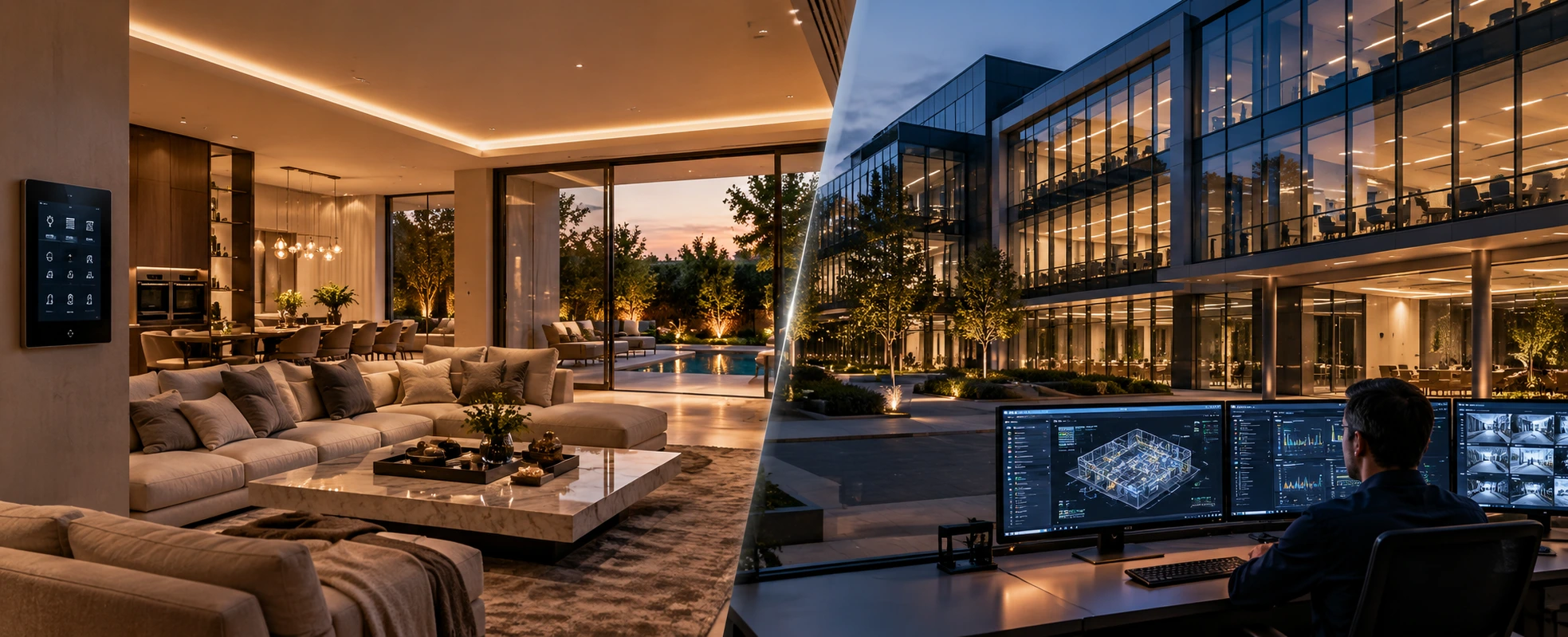
A Building Management System (BMS) manages the core services of a large building — HVAC, lighting, energy, fire, and access — for efficient, reliable operation, and is run by a facilities team. Home automation controls a residence — lighting, climate, curtains, security, and entertainment — for comfort, convenience, and security, and is run by the homeowner from an app or keypad. The underlying technology can be the same (KNX works for both); what differs is scale, purpose, and who operates it.
The terms sound similar, and because an open standard like KNX can power both, they are often confused. But a BMS and home automation are built around different goals. This guide explains what each one is, sets them side by side, shows where they overlap, and helps you decide which your project needs.
If you want the deep dives, we have full guides on building automation systems for commercial buildings and what home automation is. This article is about the difference between them.
What is a BMS (Building Management System)?
A Building Management System — sometimes called a Building Automation System (BAS) — is the centralised system that monitors and controls the core services of a large building.
Its job is operational: keep the building running efficiently, reliably and safely. A BMS typically oversees central HVAC and chillers, building-wide lighting, energy metering and management, fire and life-safety systems, access control and sometimes lifts — all reporting to supervisory software that a facilities or technical team watches and manages. The priorities are efficiency, uptime, monitoring and cost control across a big footprint.
BMS platforms commonly use protocols such as BACnet, Modbus and KNX, and are standard in offices, hotels, hospitals, malls, schools and campuses. We cover the details — including the BAS-vs-BMS distinction, protocols and costs — in our complete guide to building automation, and the function-level view in BMS for HVAC control and BMS for lighting control.
What is Home Automation?
Home automation is the integration of a home's systems — lighting, climate, curtains and blinds, security, access and entertainment — so they work together and respond to the people living there.
Its job is experiential: make the home more comfortable, convenient, secure and efficient to live in. Instead of a facilities team, the people in control are the residents, operating the home through an app, wall keypads, touch panels, or voice — or not operating it at all, as scenes and schedules handle routine moments automatically. The priorities are comfort, security, simplicity, and a seamless day-to-day experience.
Home automation is built for residences, from apartments to large villas, and on open platforms like KNX, it unifies everything behind one interface. For the full picture, see our complete guide to home automation. If you are also wondering how "smart home" differs from "home automation," that is a separate question we answer in smart home vs home automation.
BMS vs Home Automation: Key Differences
Both connect a building's systems — but around different goals, at different scales, for different people.
| BMS (Building Management System) | Home Automation | |
|---|---|---|
| Primary goal | Efficient, reliable building operation | Comfort, convenience, security, lifestyle |
| Environment | Large commercial/institutional buildings | Residences — apartments to large villas |
| Focus | Monitoring, management, energy, uptime | The lived experience of the occupants |
| What it controls | Central HVAC, energy, fire/safety, access, lifts, building-wide lighting | Lighting scenes, climate comfort, curtains, security, audio-video |
| Who operates it | Facilities / technical team | The homeowner and family |
| Interface | Supervisory BMS software/dashboards | App, keypads, touch panels, voice, scenes |
| Optimised for | Operational efficiency at scale | A seamless, personal home experience |
| Common protocols | BACnet, Modbus, KNX | KNX, plus wireless where suitable |
Where They Overlap
The line blurs for two reasons.
First, the technology is often shared. KNX is an open standard used for both residential and building-level automation, which is why one integrator can design across both. Our guide to how KNX works in building and home automation explains this common ground, and BACnet vs Modbus covers the protocol side.
Second, large properties sit between the two. A sprawling estate with heavy plant — large central HVAC, water systems, generators, extensive outdoor areas — may want BMS-style monitoring and management layered on top of the comfort and security of home automation. At this scale, the best solution is usually a considered blend rather than a label. Our luxury villa automation ideas show where that balance lands in practice.
Which One Do You Need?
A simple way to decide:
- It's a home — an apartment, a villa, a private residence. Home automation is almost always the right fit, focused on comfort, security, and a seamless experience. Start with our automation service.
- It's a commercial or institutional building — an office, hotel, hospital, mall, or campus. A BMS is the standard, focused on efficient operation and monitoring. Start with our building automation service.
- It's large or complex, and sits between the two — a big estate, a mixed-use property, a home run by staff with significant plant. The right answer is usually a mix, and the only reliable way to size it is a site assessment.
How Approaches Both
We are a KNX-certified integrator that designs across both worlds — home automation for residences and building automation for commercial and institutional projects — on open standards rather than closed, single-brand systems. Because the same certified expertise spans both, we can assess a property honestly and recommend what actually fits it: pure home automation, a full BMS, or a considered combination for a large estate.
If you are not sure which your project needs, that is exactly what a conversation is for. Book a consultation, and we will help you scope the right system for your building.
FAQs
What is the difference between a BMS and home automation?
A Building Management System (BMS) monitors and manages a large building's core services— HVAC, lighting, energy, fire safety, access control, and lifts—with the goal of efficient, reliable operation across a large facility, managed by a technical or facilities team. Home automation controls a residence — lighting, climate, curtains, security, audio-video — with the goal of comfort, convenience, and security for the people living there, controlled by the homeowner through an app, keypads, or voice. In short, a BMS manages a building; home automation improves how you live in a home.
Can the same technology run both a BMS and home automation?
Yes. Open standards like KNX are used for both residential home automation and building-level automation, which is why the line between them blurs on large properties. The difference is less about the underlying technology and more about scale, purpose, and who operates the system day to day.
Does a large villa or estate need a BMS or home automation?
It depends on how it is used. A private luxury residence is usually best served by sophisticated home automation focused on comfort, security, and a seamless experience. A very large estate, a property with heavy plant (large HVAC, water systems, generators), or one run by staff may benefit from BMS-style monitoring and management layered on top. The right answer comes from assessing the property, not from a rule of thumb.
Is a BMS only for commercial buildings?
Traditionally, a BMS is used in commercial and institutional buildings — offices, hotels, hospitals, malls, campuses — where efficient operation of large building services matters most. However, the monitoring-and-management principles of a BMS can be applied to large residential estates too, which is where residential automation and building management overlap.
What does a BMS control that home automation usually doesn't?
A BMS typically oversees large-scale building services and plant — central HVAC and chillers, energy metering and management, fire and safety systems, lifts and escalators, and building-wide access control — with a focus on operational efficiency and monitoring. Home automation usually focuses on the lived experience: lighting scenes, climate comfort, curtains, entertainment, security, and single-app control.
Which is right for my project — BMS or home automation?
Choose based on what the building is and how it is run. For a home, home automation is almost always the right fit. For a commercial or institutional building, a BMS is the standard. For a large or complex property that sits between the two, the best solution is often a considered mix — which is exactly what a consultation and site assessment are for.